
How to Be an Example
How to be an example offers you insights on he paradox of this question. We are all examples, but how can I be a good one?

How to be an example to others isn’t always easy. Especially when we want to be a good example to those around us. We have our ideas of how life is lived best, and we wish that for others. Better yet, we sometimes think others should live the way we do. Although they will have different ideas about that. If we start to tell people what the best way is, then the chances of conflict increase. People don’t like when they are told what to do and how to act. Think about how you would react to someone telling you how to live your life. We can see examples everywhere, but how can we be a good one?
What does it mean to be an example to others? And when do we leave an impression? Should all our actions be visible, and should we worry about this? Whether our actions are seen is not up to us and shouldn’t concern us. But the thought of setting the right example should stay in the back of our minds. That way, we can test our own actions and see if they meet our standards. To view whether our outward behavior is consistent and in line with our virtues and values.
We belong to the universe
The Stoics tell us that we can’t control others or how they view our behavior. Whatever we do, people can and will create an opinion on how we act. This lies beyond our power to change or influence. We must let that go and focus on our own lives. It sounds like a paradox, but by doing so, we can set an authentic good example to those who are ready and willing to see it. There are plenty of good people out there; the problem is that they go unseen by those who should keep their eyes open. We are those people as well. We shouldn’t be so arrogant as to think that our lives are perfect. Make sure you look around you and find those examples. Then model your life to what is good and works for you.
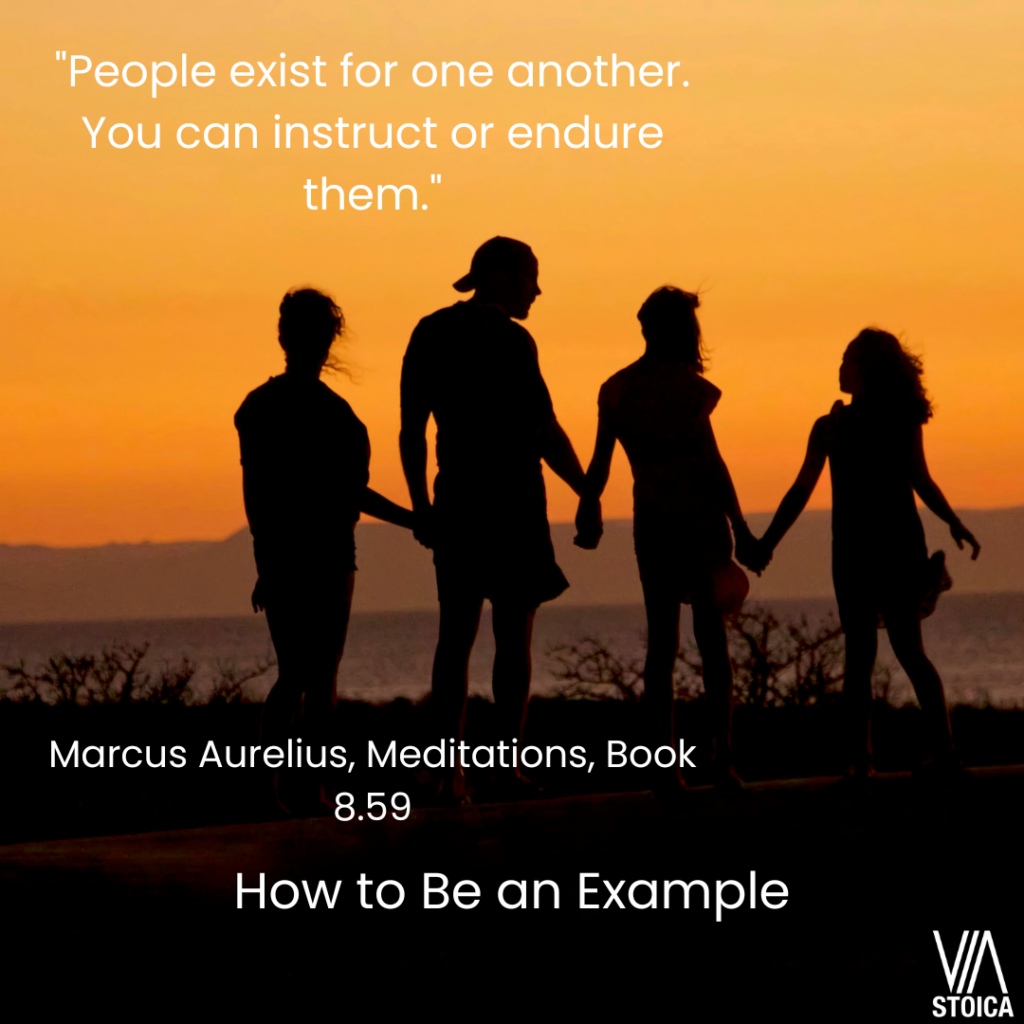
“People exist for one another. You can instruct them or endure them.”
Marcus Aurelius, Meditations, Book 8.59
We live our lives alone, as I’ve looked into in this post, How to be Alone. If we can embrace that and make progress as individuals to become the best version of ourselves, then we can become valuable and good members of society this way. With our individual qualities making contributions to the whole. In his Meditations, Marcus reminds us of the connection we have with those around us. All our actions influence the people we interact with in one way or another. We belong to the big picture and live for each other. But we don’t know how we influence them and how they will deal with it. And that’s ok because it’s up to them to decide how they learn from their environment, and if they do.
Instruct or endure

In the quote above, Marcus tells us we have two options. We can instruct them or endure them. Which is easier said than done, for both sides. Enduring them is difficult because we often feel that they are making wrong decisions or harming themselves. This is how we see it because they are not doing what we would do. Which doesn’t make it better or worse. It’s also important to ask ourselves when we should step in to be more active. But that means moving away from being an example and becoming a more direct participant. Even then, at the end of the day, it’s up to them to change. If they want long-term improvement, it has to be with conviction. Sometimes we have to make the difficult decision to step away.
How to be a good example is the question. What is the best way to instruct those around you? We must remember that our focus should be on our own behavior. It’s always good to talk about topics of self-improvement, such as I do here with philosophy as the backdrop. But that only gets you so far. We can’t be the best version of ourselves only in books; we need to be that in action. And this is where our message is sent into the universe. I can tell someone to throw away their garbage, but if I don’t do it myself, it goes mute. To make matters more difficult, others often keep acting the way we think they shouldn’t. This is when we need to endure them and go back to ourselves.
What example are you?
There are different kinds of examples we see around us. The loud ones often think that they have it all figured out. They are in our faces and tend to miss a lot of what is going on themselves. Sometimes that overconfidence can trick us into following them, or their strong will can master us. It is important to keep analyzing the examples you wish to follow. Then there are the silent ones. Those who go about their business don’t push anything or tell you what to do. But seems to be doing alright. Talking to them and asking them questions will show you more layers and leave you impressed. The problem with these examples is that they can be overlooked. That’s why it’s important to keep your eyes open. Life is difficult, but having a good example can make it a bit easier.
Being the right example can help us to examine and test ourselves. If you know who you are and understand what kind of life you think is the right one, then you can hold yourself accountable. You can measure your actions by how you want people to perceive them. Whether they do, that’s not up to you. But we can try to reflect on our behavior and see it from the outside. Are we satisfied with how we perceive our actions and progress? We should use the mirror of the world around us.
Your duty to society

But if I set a good example and help people, then what is my reward, or what will I get from it? Is this the only reason to be a good person? You will only do good when you get something in return. Let me ask you this: Is being a good person not enough? Living virtuously is not sufficient for you? What more do you want? Do you want a prize or a medal for being a just and wise person? So let’s forget about asking for something in return; we get more than enough by being our true, authentic selves.
The topic of this post carries some contradictions. By being too aware of the example you wish to set, you might lose your focus. You can start to live by externals and run the risk of being less authentic. You might also start to fill in the lives of others as you see fit. When we don’t focus on being an example, we can become the best one. We are then focusing on our own actions. And if those actions are rational and good, then that’s what the people around us will see. Thus leading to us inadvertently being the best example and doing our duty to society.
How to be or not be an example
As we have seen before, we can use our idea of being an example to reflect on ourselves. We can do this by using the technique of otherizing in our actions. That means to step outside ourselves and look back at how we behave. What would we tell ourselves if we saw our actions? Would we feel good about it, or would we find things to improve on? We can apply otherizing in different situations. But if we wish to set a good example, it is an excellent tool we have to keep ourselves in check. How would you react to someone else if they displayed the behavior you have shown?
It is important to me to set a good example for myself. The world around us is our mirror; we need to make sure we look into it. And whether other people see it and do the things I do or not is not of my interest. I wish to treat people the way I wish to be treated, and I don’t expect anything in return. It all starts with you, and it should be authentic. You need to do it for yourself. Only that way can you set the right example and give back to the world around you. Try it from now on. Set the right example without trying to set an example. Do it for yourself and see how society takes on a different approach to you. Don’t want to be an example, but understand that you are one.
Want to explore more Stoic Practice?
Book a free consultation with one of our Stoic Coaches to get support. Or read more about How to Practice Stoicism here. Listen to the Via Stoica Podcast on Spotify, Apple Podcasts, or YouTube.
Author Bio
Benny Voncken is the co-founder of Via Stoica, where he helps people apply Stoic philosophy to modern life. He is a Stoic coach, writer, and podcast host of The Via Stoica Podcast. With almost a decade of teaching experience and daily Stoic practice, Benny creates resources, workshops, and reflections that make ancient wisdom practical today.
Related Posts
-
 Inner Life Terms
What Are Values? Principles That Guide Action and Display Nature
What are Values? Most people don’t wake up thinking about their values. They notice them indirectly, when something feels slightly misaligned. When a choice looks right on paper but leaves a faint sense of resistance. When success arrives, yet doesn’t land the way it was expected to. Values are often mistaken for opinions, preferences, or […]
Read more -
 Via Stoica Podcast
A Stoic Conversation with Jason Nelson: Six Seeds for a Happier Life
What if happiness is not something you achieve one day, but something you practice every day? In A Balm for Your Soul: Six Seeds for Happiness, Jason Nelson offers a grounded and humane answer to a question many people quietly struggle with: Why does life still feel off, even when things look good on paper?Rather […]
Read more -
 Greek Stoic Philosophy Terms
What Is Philanthropia? How Stoicism Views Love for Humankind
What Is Philanthropia? Philanthropia in Stoicism is the cultivated disposition to care for human beings simply because they are human. It describes a rational, practiced goodwill toward others that flows from understanding our shared nature, rather than from emotion, obligation, or reward. This concept matters today because modern life often treats kindness as optional, sentimental, […]
Read more

Comments 0