
Stoic View on Praise and Flattery: A Warning by Epictetus on Seeking Approval
“…you have not been invited to such a person’s banquet, because you have not paid him the price for which a meal is sold. It is sold for praise; it is sold for attention. Make up the price, then, if that is to your advantage. But if you would at the same time not pay the one and yet receive the other, you are greedy and stupid. Have you nothing, then, in place of the meal? Yes, indeed, you have: that of not praising someone you did not want to praise, and of not putting up with the people around his door.”
Epictetus, The Handbook, 25
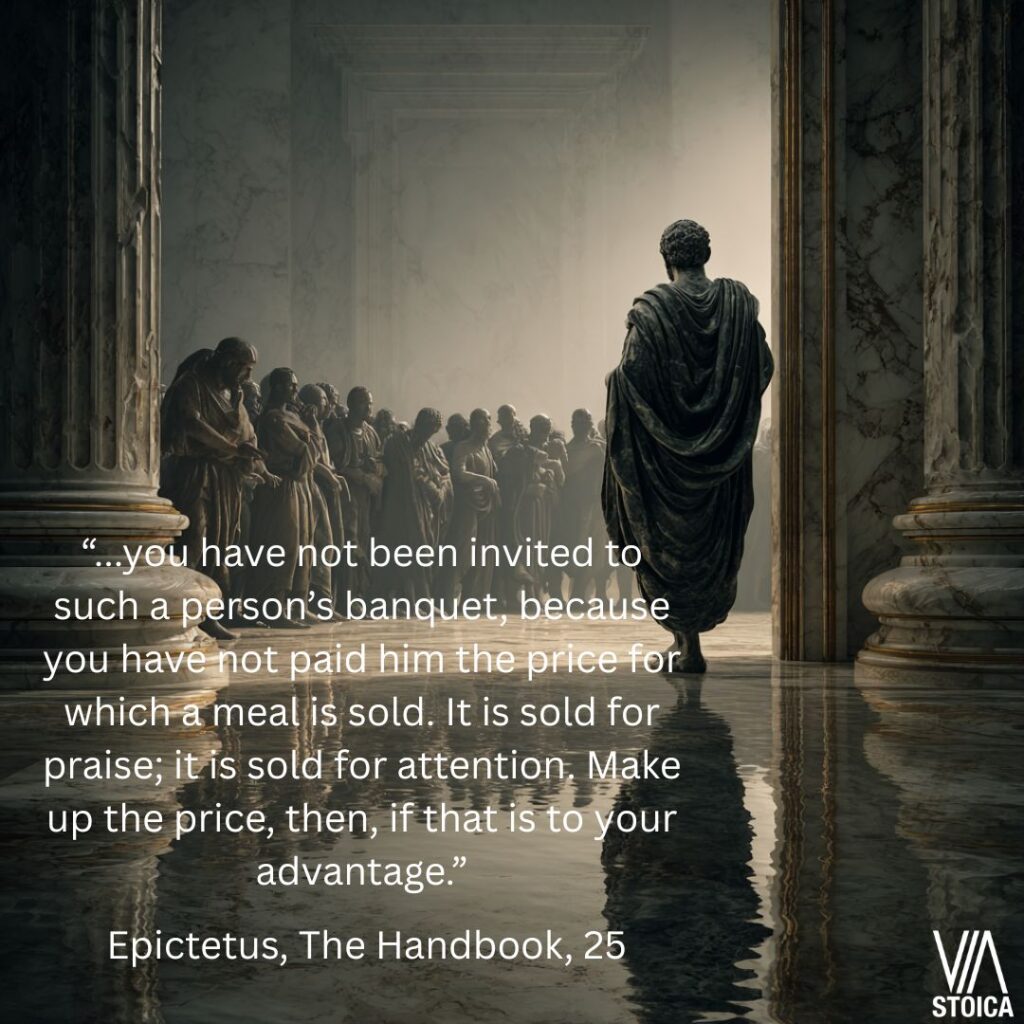
This sharp reminder from Epictetus cuts to the heart of a very modern trap: the temptation to trade our integrity for access, attention, or approval. Whether it’s a corporate hierarchy, a social circle, or a digital following, we’re often asked to “pay the price”, not in money, but in praise and performance.
But the Stoic view on praise and flattery is clear: if the cost of the invitation is compromising your values, you are better off not attending the banquet at all.
Practical reflections or insights
1. Not everything is worth the price
Epictetus calls us out for wanting the perks of praise without the compromise it demands. If you truly admire someone, let your praise be genuine. But if you’re offering flattery just to gain favor, you’re selling part of your soul for scraps.
2. True self-worth is internally sourced
Stoicism teaches us to root our worth in our character, not in someone else’s recognition. The Stoic view on praise and flattery invites us to measure ourselves by our actions, not by applause.
3. Freedom is found in walking away
You always have something in return: the freedom to withhold false praise, and the peace of avoiding those who demand it. That’s a quiet kind of dignity, and one well worth keeping.
4. This goes back to Diogenes
We can trace the Stoic view on praise and flattery all the way back to the Cynics, especially Diogenes. In one story, Plato teased Diogenes for washing lettuce instead of attending a banquet hosted by a tyrant. Diogenes replied that if Plato had chosen to wash his own lettuce, he wouldn’t have to flatter tyrants for a meal.
It’s a perfect example of what Epictetus later articulated: if the price of a meal is praise, and you don’t want to give it, then don’t eat it. The cost is too high when it chips away at your self-respect.
FAQ Section
What is the Stoic view on praise and flattery?
Stoics view praise and flattery with suspicion, especially when they require you to compromise your integrity. They believe true worth comes from virtue, not validation.
Why does Epictetus warn against people pleasing?
Because it leads you to act against your nature. When you seek approval from others, you risk losing your independence and becoming a slave to external judgments.
How can I stop needing validation from others?
Practice focusing on what is within your control, your actions, your choices, and your values. Let others think what they will; your peace lies in what you do, not in what they say.
Want to explore more Stoic strategies?
Book a free consultation with one of our Stoic Coaches or read more on the Epictetus Quotes page. You can also listen to the Via Stoica podcast on Spotify or Apple Podcasts or watch it on YouTube.
Author Bio
Benny Voncken is the co-founder of Via Stoica, where he helps people apply Stoic philosophy to modern life. He is a Stoic coach, writer, and podcast host of The Via Stoica Podcast. With almost a decade of teaching experience and daily Stoic practice, Benny creates resources, workshops, and reflections that make ancient wisdom practical today.
Related Posts
-
 Inner Life Terms
What Are Values? Principles That Guide Action and Display Nature
What are Values? Most people don’t wake up thinking about their values. They notice them indirectly, when something feels slightly misaligned. When a choice looks right on paper but leaves a faint sense of resistance. When success arrives, yet doesn’t land the way it was expected to. Values are often mistaken for opinions, preferences, or […]
Read more -
 Via Stoica Podcast
A Stoic Conversation with Jason Nelson: Six Seeds for a Happier Life
What if happiness is not something you achieve one day, but something you practice every day? In A Balm for Your Soul: Six Seeds for Happiness, Jason Nelson offers a grounded and humane answer to a question many people quietly struggle with: Why does life still feel off, even when things look good on paper?Rather […]
Read more -
 Greek Stoic Philosophy Terms
What Is Philanthropia? How Stoicism Views Love for Humankind
What Is Philanthropia? Philanthropia in Stoicism is the cultivated disposition to care for human beings simply because they are human. It describes a rational, practiced goodwill toward others that flows from understanding our shared nature, rather than from emotion, obligation, or reward. This concept matters today because modern life often treats kindness as optional, sentimental, […]
Read more

Comments 0