
What is Justice
Living a life of virtue is the chief aim of the Stoics. To do so, we must understand what Virtue is. Here is my take on it. The four virtues in Stoicism are; Wisdom, Justice, Courage, and Temperance. It is time to take a look at Justice and what it means to be just.

Living a life of virtue is the chief aim of the Stoics. To do so, we must understand what Virtue is. Here is my take on it. The four virtues in Stoicism are: Wisdom, Justice, Courage, and Temperance. It is time to take a look at Justice and what it means to be just.
The part that Justice plays among the Virtues is that of a guide, a compass. It shows us how to navigate the waters and ensure that we stay true to our values and remain at peace. No matter how rough the seas might be, we can be confident that we are doing the right thing. Even if the waves prove too strong, we will have no regrets because we have done all we could.
Justice is about kindness and equality
When thinking of justice, we immediately think of the law, the police, the courts, and punishment. But for the Stoics, it was more about how well you lived. You can’t live a peaceful life if you have to worry a lot about what you have done that might have been wrong. And although we won’t all have the same sense of right and wrong, we can feel when something has been against our nature. This will make us feel uncomfortable and scared of the repercussions.
Justice is about kindness and equality, to yourself and to the people around you. If you know an action might harm you or someone else, then it is best to look for other options or not do it at all. You say you might benefit from it, but in what way? Is it to gain some money, power, or status? You might lose something more important. You might lose a friend or your place in society because you have forsaken your nature. And most importantly, you might lose yourself.
Trial and error

What we tend to do nowadays is to look outward at how the world might respond to our actions. Yet, we should keep in mind that it all starts with ourselves. Our mind is what we can control, and we should therefore first be just to ourselves. That means that we need to treat ourselves with respect and honesty. If we want to know what justice means to us, then we need to understand ourselves. What values are important to us, and what is the life we wish to lead?
As we grow up, we get input from the world around us that creates our first sense of justice. The authoritative figures tell us what we can and can’t do. This is the moment to adjust our compass. We do this by trial and error. Our intuition will help us understand when we go the wrong way. As we gain experience and learn to listen to ourselves, we can add that information, and our reasoning faculties will help us stay on track.
To what extent are you willing to go?
The same goes for when we deal with the society around us. There is a general sense of what is right and wrong and what the laws tell us. However, there is a deeper layer we should examine. One that shows us how to treat each other. Although several sources will have told us to be good and kind to each other, this is often not what happens. This comes from a sense of entitlement we have given ourselves. We have grown soft, and when things don’t go our way, we feel hurt.
Justice sometimes requires a difficult choice and giving up some of your supposed privileges. These arise from the view that we are in competition and compare ourselves with everyone around us. We must be better off than our friends and family. But better in what sense? To have more money, be first in line, and get the best deal. To what extent are you willing to go?
Till philosophers become kings in the world

If we lived in a completely virtuous society, then there would be equality for all. Everyone would have the same opportunities, and it would be up to the individual to see how they would use those opportunities. But where there are people in power, there will be injustice. Unless Plato’s philosopher-king stands up and leads the way. Power and justice only go together when the power is used to serve all. But then we wouldn’t be speaking of power anymore; then it would be doing your duty.
“There will be no end to the troubles of states, or of humanity itself, till philosophers become kings in this world.”
Plato
When there are people in power, there are also people who must submit to them. As we have seen throughout history, power doesn’t like to let go of it. Games are played, and wars are started. When this happens, we move away from a just society at an increasing rate. Power needs the majority to follow them, thus they create a standard of living that is good enough for the,m and where there is hope to join the elite ranks. The marginalized pay the price for this supposed prosperity.
“The higher we are in places, the more humble we should walk.”
Cicero
To be just is to do your duty
Justice should reflect the average sentiment in society. Where differences are listened to, understood, and compromises made. But most importantly, there must be mutual respect and equality. Reading this, we all know that this is far from the case. And the marginalized are staying behind. Used to harbor fear in those trying to grasp power as an example of what might happen if they stray. In order to have more equality, those who are falling behind need to be brought to the front. Here they can be seen and recognized. Everyone can be assessed on their individual merits and what duty they have towards society.
Duty is an important aspect of societal justice. Again, we come back to knowing what your nature is. We all have our roles to play, and we should try to figure out what this is. A great responsibility falls on our educational system to allow the freedom of each child to explore all avenues. Not to make any career more desirable than another, because that is filling in the gaps in the mind of a child. Nowadays, it is almost a sin if you can’t make it to university. But learning a craft, a real skill, should be valued the same, if not more.
Justice starts from within
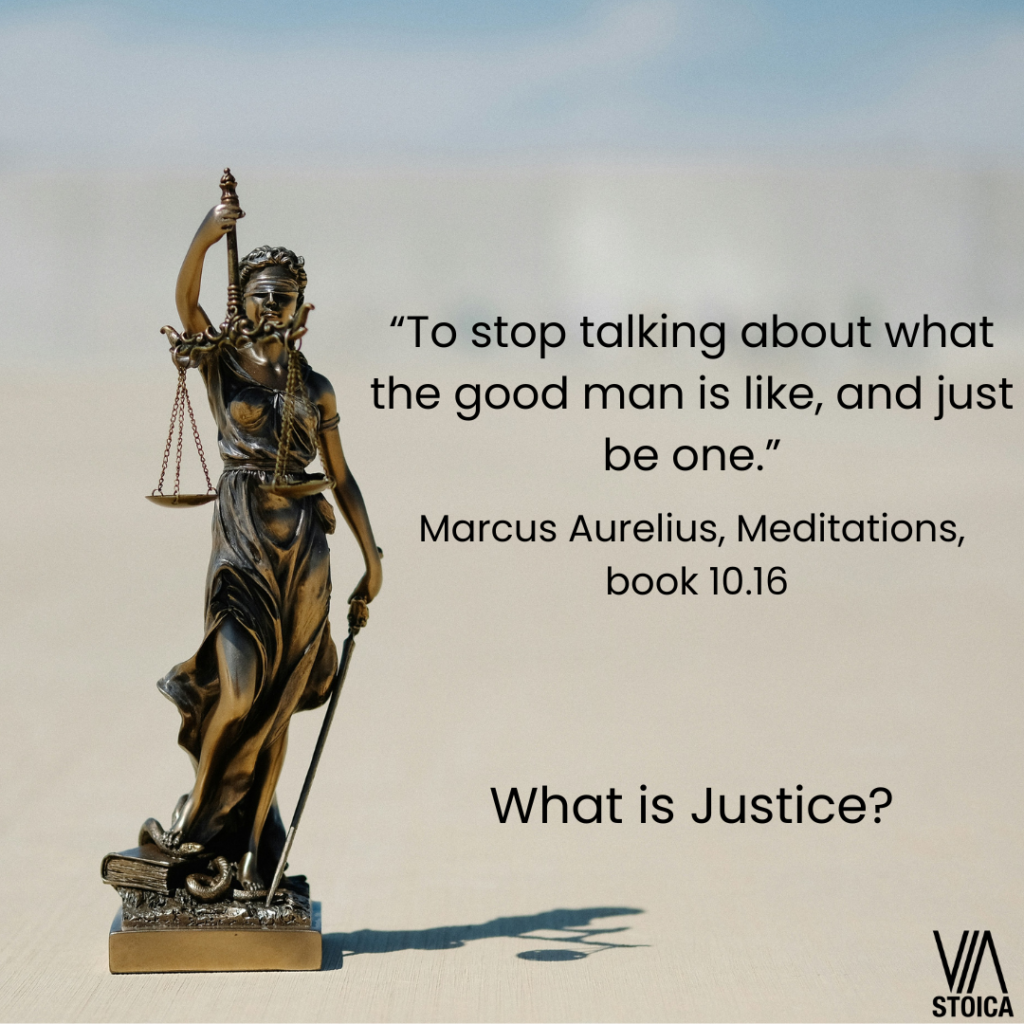
Empathy is key in figuring out where justice is guiding us. Justice is about being kind and fair to the people around you. But to do so, we need to be able to understand our fellow people and listen to them. Show respect to everyone and value them for their individual contribution, not for their background or race. Because we are all the same, one group living on this planet. This is something we can start right now. By reflecting on our own lives and asking if we are doing ourselves justice. From there, we can continue to set a good example and do our moral duty to those around us.
Let’s give the final word to Marcus Aurelius:
“To stop talking about what the good man is like, and just be one.”
Marcus Aurelius, Meditations, book 10.16
Read about the other virtues: Wisdom, Courage, Temperance
Want to explore more Stoic Practice?
Book a free consultation with one of our Stoic Coaches to get support. Or read more about How to Practice Stoicism here. Listen to the Via Stoica Podcast on Spotify, Apple Podcasts, or YouTube.
Author Bio
Benny Voncken is the co-founder of Via Stoica, where he helps people apply Stoic philosophy to modern life. He is a Stoic coach, writer, and podcast host of The Via Stoica Podcast. With almost a decade of teaching experience and daily Stoic practice, Benny creates resources, workshops, and reflections that make ancient wisdom practical today.
Related Posts
-
 Greek Stoic Philosophy Terms
What Is Ekklisis? The Stoic Art of Avoiding What Harms Your Character
What Is Ekklisis? Ekklisis in Stoicism is the rational refusal to engage with what would damage one’s moral choice. The Stoic meaning of ekklisis is important because it teaches us what to turn away from, not out of fear, but out of commitment to living well. In daily life, ekklisis helps us step back from […]
Read more -
 Via Stoica Podcast
A Hark Audio Curated Stoic Playlist for 2026
At the start of a new year, there is often an unspoken promise that things will somehow be different. Calmer. More ordered. More predictable. Yet life rarely follows that script. Delays disrupt flights, plans break down, people drift away, and life brings events we cannot control. What we can work on, and what Stoicism has […]
Read more -
 Book Reviews
The Stoic Leader by John Sellars and Justin Stead
The Stoic Leader introduces Stoicism as a practical philosophy and explores how its principles shape leadership, judgment, and character in both work and life. Summary Written by John Sellars and Justin Stead, The Stoic Leader offers what is effectively two books in one. Sellars provides an introduction to Stoicism and its philosophical foundations, while Stead […]
Read more

Comments 0