
What Is Telos? Understanding the Stoic Meaning and Practice
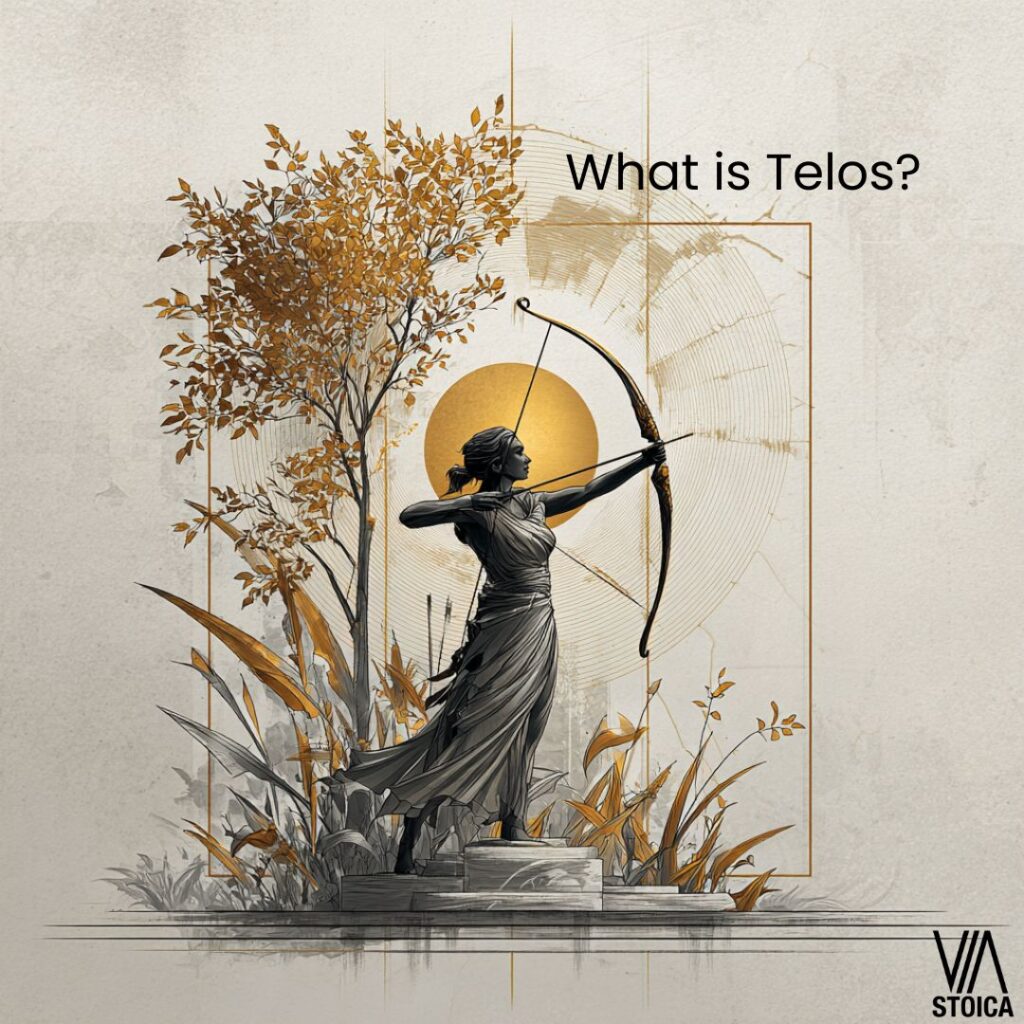
What Is Telos?
Telos (τέλος) in Stoicism is the ultimate goal or purpose of human life, the end toward which all actions should aim. The Stoic telos is to live in agreement with nature, which means living rationally and virtuously.
Understanding telos helps us orient every decision, desire, and effort toward what truly matters. In a world of distractions and conflicting goals, remembering your telos brings clarity; it reminds you that your purpose is not to chase pleasure, fame, or wealth, but to live with excellence of character.
Breaking Down the Word
Greek spelling: τέλος (telos)
Root meaning: “end,” “goal,” or “completion.”
- In Greek philosophy, telos refers to the final purpose or culmination of something.
- For the Stoics, it is the ultimate aim of human life to live virtuously and rationally.
- It suggests wholeness, not termination: the fulfillment of one’s nature, not the end of existence.
Understanding telos matters because Stoicism begins and ends with purpose. Without knowing the telos, one cannot know what to choose or avoid. It serves as the compass for all ethical and practical reasoning.
Key Dimensions of Telos
- Ultimate Aim: Every being has a natural end. For humans, that end is to live according to reason, our defining feature.
- Measure of Good: Actions are judged good or bad based on how well they align with the telos.
- Unity of Virtue: All virtues, wisdom, courage, justice, and temperance are expressions of the same goal: harmony with nature.
- Continuous Practice: The telos is not a future reward; it is realized moment by moment through right intention and right action.
Core Stoic Principles Connected to Telos
- Logos (λόγος): The rational order of the cosmos that gives structure and meaning to everything. Living in accordance with telos means aligning with the Logos.
- Arete (ἀρετή): Virtue or excellence, the practical path toward the telos of life.
- Physis (φύσις): Nature, both the universal order and one’s own human nature, guiding us toward rational and moral development.
- Oikeiōsis (οἰκείωσις): The process of self-appropriation and moral growth that leads each person closer to their true telos.
Modern Misunderstandings
Many people today mistake telos for career goals, personal success, or happiness in the emotional sense. But the Stoic telos is not about external achievements or pleasure. It is an inner orientation, the alignment of your actions with moral purpose and reason.
Read about the Stoic Archer
Others think telos implies fate or a fixed destiny. Yet for the Stoics, while fate governs external events, telos refers to how we live within those events. It is not about what happens to you, but about how you respond, and whether your response is guided by virtue.
Why Telos Is Central to Stoicism
The Stoic telos is not just an abstract concept but the living thread that connects ethics, reason, and nature. It teaches that our highest purpose is to bring our actions into harmony with the rational order of the cosmos. This means shaping our will to align with what is natural and right, regardless of external circumstances.
Understanding telos reminds us that Stoicism is both cosmic and personal: we are fragments of a greater order, and every moment offers a chance to act in tune with it. When we live with that awareness, philosophy becomes practice, and each decision becomes an expression of our true purpose.
Practical Applications of Telos
- Morning Reflection: Before starting your day, ask, “What is my true goal today: to be comfortable, or to act with virtue?”
- Pause Before Action: When faced with temptation or frustration, remember your telos and choose the response that aligns with your nature.
- Journaling: Reflect each evening: Did my actions today serve my highest purpose?
- Connect with Nature: As described in How to Practice Stoicism, take time to see yourself as part of the larger Logos, calm, ordered, and purposeful.
For related concepts, read our guide on Logos (λόγος) to understand how universal reason connects to your personal telos.
FAQ
What does Telos mean in Stoicism?
It means the ultimate purpose or goal of life, to live in accordance with nature and virtuously.
How is Telos different from destiny?
Destiny refers to external events beyond control; telos is your chosen way of living, guided by virtue and reason.
Why is Telos important for Stoic practice?
Because it defines what “the good life” truly is and keeps all actions directed toward moral excellence.
Conclusion
Telos reminds us that life is not random; it has direction. In every decision, big or small, we can move closer to or further from our true purpose. By living in accordance with reason, virtue, and nature, we fulfill our human potential and become part of the harmony that guides the cosmos itself.
Remember your telos daily, and let it shape how you see, choose, and act.
Want to explore more Stoic practices?
Book a free consultation with one of our Stoic Coaches or learn about more Stoic philosophy terms. You can also listen to the Via Stoica podcast on Spotify or Apple Podcasts or watch it on YouTube.
Author Bio
Benny Voncken is the co-founder of Via Stoica, where he helps people apply Stoic philosophy to modern life. He is a Stoic coach, writer, and podcast host of The Via Stoica Podcast. With almost a decade of teaching experience and daily Stoic practice, Benny creates resources, workshops, and reflections that make ancient wisdom practical today.
Related Posts
-
 Greek Stoic Philosophy Terms
What Is Ekklisis? The Stoic Art of Avoiding What Harms Your Character
What Is Ekklisis? Ekklisis in Stoicism is the rational refusal to engage with what would damage one’s moral choice. The Stoic meaning of ekklisis is important because it teaches us what to turn away from, not out of fear, but out of commitment to living well. In daily life, ekklisis helps us step back from […]
Read more -
 Via Stoica Podcast
A Hark Audio Curated Stoic Playlist for 2026
At the start of a new year, there is often an unspoken promise that things will somehow be different. Calmer. More ordered. More predictable. Yet life rarely follows that script. Delays disrupt flights, plans break down, people drift away, and life brings events we cannot control. What we can work on, and what Stoicism has […]
Read more -
 Book Reviews
The Stoic Leader by John Sellars and Justin Stead
The Stoic Leader introduces Stoicism as a practical philosophy and explores how its principles shape leadership, judgment, and character in both work and life. Summary Written by John Sellars and Justin Stead, The Stoic Leader offers what is effectively two books in one. Sellars provides an introduction to Stoicism and its philosophical foundations, while Stead […]
Read more

Comments 0