
How to Control Anger Through Stoicism
How often do you get angry? And what are the triggers that get you into that emotional state? It is time to address this ugly side of us because it can be seen everywhere and we should avoid it. Anger blinds us to what would be the just and rational action to take. If we wish to live a virtuous and peaceful life, as the Stoics strive to, then we should avoid anger.

How to control anger? Can Stoicism help us? To examine this, we need to look into what it is. How often do you get angry? And what are the triggers that get you into that emotional state? How do you feel when you are angry and when you finally calm down, how do you judge yourself? It is time to address this ugly side of us because it can be seen everywhere and we should avoid it. Anger blinds us to what would be the just and rational action to take. If we wish to live a virtuous and peaceful life, as the Stoics strive to, then we should avoid anger.
“But since the first essential is not to become angry, the second to cease being angry, and the third to cure also anger in others.”
Seneca, Dialogues and essays, On Anger, 5
We will take the quote from Seneca as a guide on how to control anger. First, we will examine how we can prevent or at least limit our exposure to this dark side of emotions. After that some steps we can take if we do find that we have become agitated. And finally, how can we show others not to be so angry? One way for me is to write this post to share my views on it. I would recommend reading Seneca’s essay On Anger. I have no intention whatsoever to start comparing myself to his masterwork. This can be seen as a shorter practical guide.
Living in peace and being angry don’t match
In his essay On Anger, Seneca refutes Aristotle’s claim that we shouldn’t eliminate this emotion. It is the drive towards virtue. Aristotle’s claim is that without anger, the mind becomes lazy, cannot defend itself, and becomes
“indifferent to great endeavors.”
Reference to aristotle by Seneca, Dialogues and essays, on anger, 3
Seneca asks the following:
“So, tell me, will someone call a man sane who, as if caught up in a tempest, does not walk but is driven along, and takes as his master a furious demon…?”
seneca, Dialogues and essays, on anger, 3
He points out that this is not something that can help us lead a virtuous life, as
“it makes havoc of the resolutions essential to virtue achieving anything.”
seneca, Dialogues and essays, on anger, 3
Living in peace and being angry don’t match; we must thus try to control it as much as we can. You can read more about what we can control in my post about this topic, here.
We must prevent it at all costs

There are many situations throughout the day that can put us in a state where our blood can be put to a boil. These events can be the trigger, but at the end of the day, we allow ourselves to become angry. It is a decision, although it doesn’t always feel that way. There are enough frustrating people around us who seem to rub us the wrong way without even trying. Yet, we can deal with them, and we can prepare ourselves for those situations. It’s time to remove the triggers.
How to control such an aggressive emotion as anger? It is not like the other emotions. This one can overtake us in a violent impulse, and it does us more harm than any other. There is a difference between standing up for yourself and being angry. And we can be far more effective in the first if we can cut the latter. We lose much more because of it. Who has ever said they were proud of becoming angry or that they felt good about being in that state? Then we must prevent it at all costs if we wish to lead a peaceful life. But how can we get there?
When the tempest starts, we must pause ourselves
We start by looking at ourselves. If we look deep enough, then we will find some answers. We are able to see some patterns emerging from the moments our hearts went up a few beats. If you see that certain environments induce this rage more often, then it is better to avoid them. But if you prepare yourself, you can take the sting out of them. You could, for example, visualize these moments from a calmer state of mind and use your rationale to find different ways of reacting. It is better to walk away or to try to listen to the other person and understand their point of view. There might be hundreds of other solutions, but by reflecting on them from afar, they can become clearer.
When the tempest starts, and we notice it coming, we must pause ourselves. Focusing on your breath could be one solution to help you from outbursts when you are almost ready to pop. Learn to focus on your breath when you notice that you might lose control. Take deep, steady breaths and use that time to assess the place you are in. Think back to the options you have seen. It is important to defuse that first reaction. When the steam is building, and you can still find a way to release the pressure, open the valve. Breathe in and out, take your time, and think about what you should do.
How to control anger in others

It is up to you to find the right method for you. This is one example, but maybe you need to be more active to release the excess energy. Or you need to find more peace from within. Trial and error will get you there. You need to be ready for it and see whether it is something you should address. There are different levels of anger and how one expresses them, but they all have the same effect on us. We lose our calm, and even worse, ourselves.
Now that we have seen some ways to reduce or even prevent anger from taking over our lives, we must look at how to control anger toward others, or at least reduce it. As human beings, we are part of society. In our small circle or as cosmopolitans and citizens of the world, we have our duties to perform. One of them is to help others live a better life. This can be done in small or big ways, but we first must do it ourselves. Once we do, we can achieve one step toward reducing anger in those around us by setting the right example.
It is easy to underestimate the power of a good example. It feels like you aren’t doing anything because the behavior is normal to you. Or at least it should be. It doesn’t show a direct impact. Yet, it can have a longer-lasting and deeper result than giving a lecture. People don’t like to be told what to do or what not to do. Show, don’t tell.
What about anger towards us?

What do we do if we find someone who is angry? Our good example won’t be seen by eyes so inflamed by rage. The best way to treat inflammation is by rest and with some soothing balm. But first, we must protect ourselves from their rage. Anger can be like a virus and spread. We must make sure it won’t jump over to us. Examine the situation and look for the source of their rage. Try to move them away from this spark and take away the fuel.
But what about anger towards us? How should we act then? We can take similar steps as before. Examine the source. This person can be right in his views, but chooses to express them in a tormented way. We can then, instead of being attacked, take the sting away by reasoning their position. If they are wrong or at least not within our possibilities of satisfying their demands, then we are best to let them ride the fumes of their explosive behavior. Insults shouldn’t harm us unless we allow them to. As Marcus Aurelius teaches us in his Meditations:
“Choose not to be harmed—and you won’t feel harmed. Don’t feel harmed—and you haven’t been.”
Marcus Aurelius, Meditations, book 4.7
If we do feel harmed by the anger, by their words or actions. How should we proceed then? Again, we can turn to Marcus Aurelius for advice.
“The best revenge is not to be like that.”
Marcus Aurelius, Meditations, book 6.6
Final words from a Stoic
It is in our power to be better people. If we feel that we must retaliate, then we are adopting some of their anger. Which brings us down to their level and takes away our peace and removes us from the virtuous path.
We have now seen what anger is and what it can do to us and those around us. Look at the situations that make you angry. These will help us learn how to control anger. It could be a lack of nutrition or sleep, so address this. Or could it be a stressful situation or some continuous frustration? It is up to you to look into the causes and reduce them. If you do find yourself in a state of anger, and you manage to see it at the moment. This is difficult with an aggressive emotion like anger because it shuts down the rational side of our minds. But if you do see it or feel it coming up, then take a pause and step back.
There are ways to deal with this; it is up to us to acknowledge that we can do something about it. What are your ways of dealing with anger? Have you managed to control it, or does it still take over? Let’s leave this topic with some words of wisdom from our Stoic Emperor. This is what Sextus taught him:
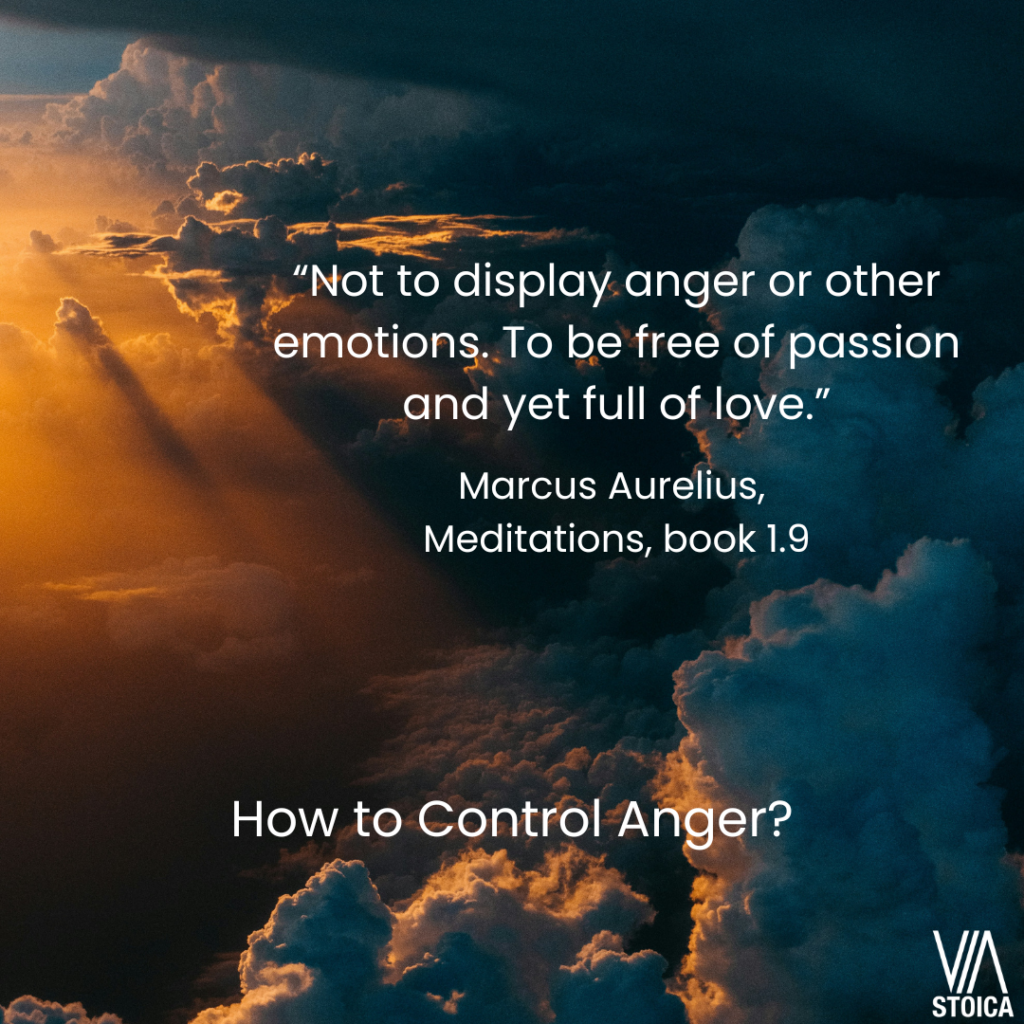
“Not to display anger or other emotions. To be free of passion and yet full of love.”
Marcus Aurelius, Meditations, book 1.9
Want to explore more Stoic Practice?
Book a free consultation with one of our Stoic Coaches to get support. Or read more about How to Practice Stoicism here. Listen to the Via Stoica Podcast on Spotify, Apple Podcasts, or YouTube.
Author Bio
Benny Voncken is the co-founder of Via Stoica, where he helps people apply Stoic philosophy to modern life. He is a Stoic coach, writer, and podcast host of The Via Stoica Podcast. With almost a decade of teaching experience and daily Stoic practice, Benny creates resources, workshops, and reflections that make ancient wisdom practical today.
Related Posts
-
 Via Stoica Podcast
A Stoic Conversation with Jason Nelson: Six Seeds for a Happier Life
What if happiness is not something you achieve one day, but something you practice every day? In A Balm for Your Soul: Six Seeds for Happiness, Jason Nelson offers a grounded and humane answer to a question many people quietly struggle with: Why does life still feel off, even when things look good on paper?Rather […]
Read more -
 Greek Stoic Philosophy Terms
What Is Philanthropia? How Stoicism Views Love for Humankind
What Is Philanthropia? Philanthropia in Stoicism is the cultivated disposition to care for human beings simply because they are human. It describes a rational, practiced goodwill toward others that flows from understanding our shared nature, rather than from emotion, obligation, or reward. This concept matters today because modern life often treats kindness as optional, sentimental, […]
Read more -
 Blog
Blog10 Stoic Quotes on Purpose: A Guide to Living as Yourself
What is Purpose? Purpose is often treated as something to be discovered, achieved, or secured. For the Stoics, it is none of these. Purpose is not a destination, but a way of orienting one’s life, a manner of acting, and a character one steadily forms. The following Stoic quotes trace a clear progression: from understanding […]
Read more
Comments 0