
The Herculaneum Scrolls: How AI Is Unwrapping a Lost Ancient Library
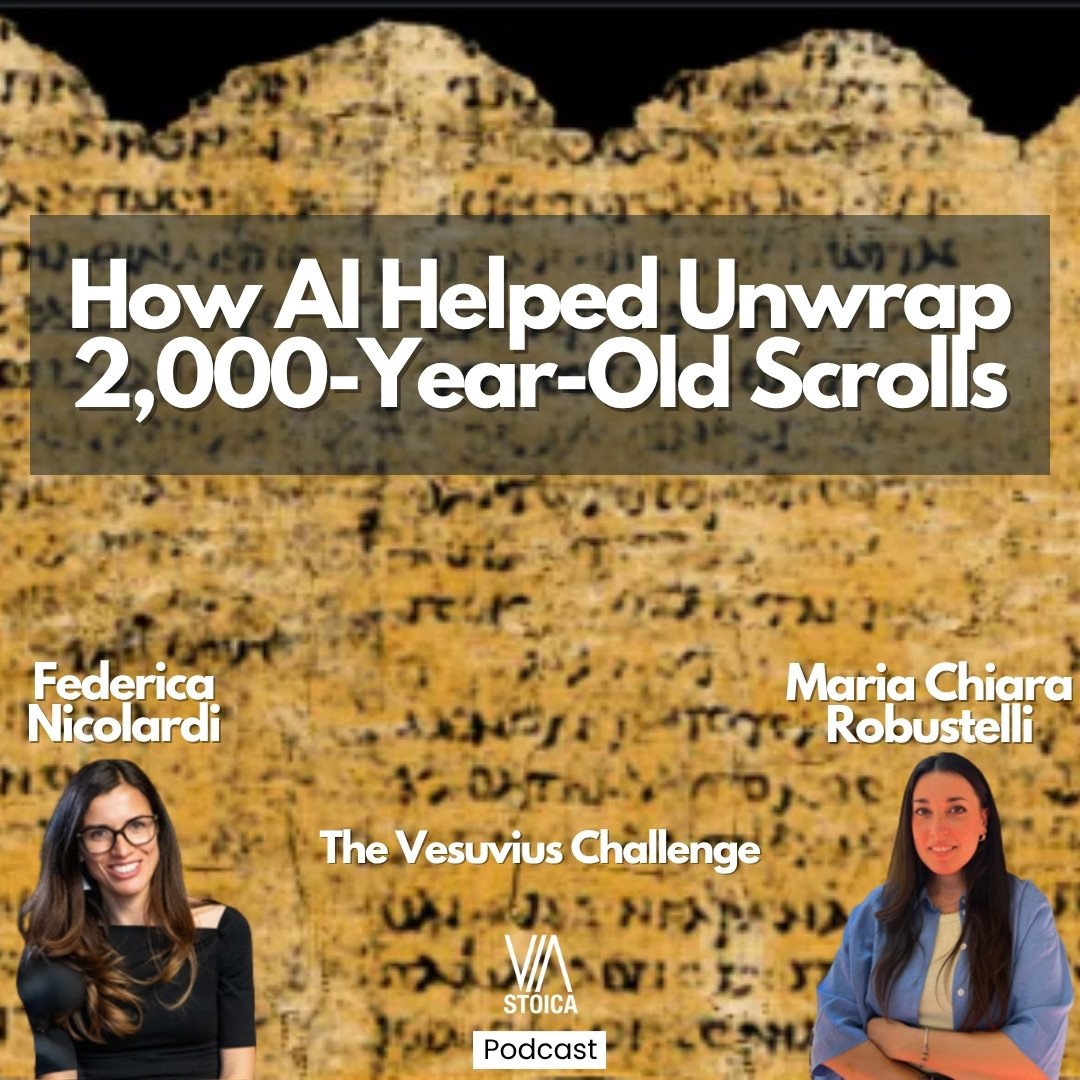
The Herculaneum scrolls are the carbonised remains of a Roman library, and researchers now read them with X-rays and machine learning without ever opening them. In 79 AD, Mount Vesuvius buried the town of Herculaneum under volcanic material, and the library disappeared with it. Nearly 1,700 years later, in 1750, diggers tunnelling into the ruins found a luxurious villa full of sculpture. They also found hundreds of lumps that looked like charcoal, and those lumps turned out to be books.
That work brings X-rays, machine learning and papyrology together to read texts nobody can open. We spoke with two people at its heart. Federica Nicolardi is lead papyrologist of the Vesuvius Challenge and associate professor of papyrology at the University of Naples Federico II. Maria Chiara Robustelli belongs to the Vesuvius Challenge papyrology team and works as a postdoctoral scholar at the same university, where she is preparing a critical edition of a Herculaneum scroll on the Stoics.
Why the Herculaneum Scrolls Survived
Pompeii gets most of the fame, yet Herculaneum met a different fate. Pompeii lay downwind in the first phase of the eruption, and its bodies and organic materials burned. Herculaneum lay closer to the volcano but upwind. The eruption reached it later, as a wave of extreme heat in a closed environment with almost no oxygen.
Without oxygen, nothing burned. Instead the heat drove the water out of every organic object and carbonised it. This is remarkable for papyrus, which most of us link to the dry desert of Egypt, since a humid climate like Campania’s destroys it. The carbonisation that wrecked the scrolls also saved them, which is a paradox the papyrologists mention often.
The scrolls came from the Villa dei Papiri, which the eruption covered with several metres of volcanic material. The first explorers reached it through underground tunnels, and large parts of it still lie unexcavated. The collection today holds around 1,800 inventory numbers. The original library held roughly 800 to 1,000 scrolls, and various methods have opened about half of them.
How People Tried to Open the Scrolls
At first the scrolls looked like dissolved charcoal or burned wood, and nobody knew how fragile they were. Early attempts did serious damage. People tried to soften the fibres with different substances, including mercury, and some scrolls were cut into pieces with a knife.
A major step forward came with a machine that unrolled a scroll slowly by pulling on its layers. Thanks to it, many extraordinary texts came to light. Later, in the 1980s and 1990s, a Norwegian team working with Italian scholars lifted the outer layer with a mixture of gelatin and acetic acid. The results were hard to read, and each method destroyed something. The question became how to read a scroll without opening it.
The Vesuvius Challenge and Virtual Unwrapping
The idea behind virtual unwrapping is to scan a scroll with X-rays and look inside it on a screen. Computer scientist Brent Seales spent about twenty years on this problem, and his colleagues at the University of Kentucky showed that it could work. In their Herculaneum project, the team trained algorithms on fragments where the ink was visible, which proved that carbon ink could show up in a scan.
Nicolardi explains why this is so hard. A scroll can hold well over ten metres of papyrus wound into a tight spiral, and the scan shows an inner structure that varies wildly from one scroll to the next.
"The very first surprise that you have when you look at the scan data is how complex these objects are."
Federica Nicolardi, Via Stoica Podcast, The Herculaneum Scrolls (26:54)
Two problems stand in the way. The first is segmentation, which means telling one layer of a tightly compressed spiral from the next and flattening it into a readable surface. The second is ink detection. Medieval inks contain metal, which shines brightly in an X-ray. The ink on these scrolls is carbon, and so is the papyrus, so the human eye cannot tell them apart.
To solve both, the organisers turned the work into a competition, the Vesuvius Challenge, because they needed the ideas of a whole community. People with very different backgrounds took part, some of them students or amateurs who wanted to try the impossible. Nicolardi says the community itself came out as the winner, even though individuals took the prizes.
What Papyrologists Do in the Age of AI
Nicolardi explains that the role of the papyrologists changed during the project. In the early phase of the competition, the papyrology team judged the submissions together with the technical team. The technical experts checked whether others could repeat a method and whether it was legitimate. The papyrologists checked how readable the text was and watched for repeated patterns that would suggest the algorithm had memorised something. They also produced first readings, so the community could share in the results.
A new phase began after the organisers announced the first grand prize in February 2024. Some community members joined the project as researchers, and younger scholars such as Robustelli entered the team. They now help annotate images to train the models, so the ink detection keeps improving. The field itself is changing fast, since young papyrologists now work with geometry and mathematics as well as the microscope.
Robustelli says the project taught her something that reaches beyond papyrology.
"I don't believe that everything in the world is possible, but at least I do believe that we can try."
Maria Chiara Robustelli, Via Stoica Podcast, The Herculaneum Scrolls (09:26)
What the Herculaneum Scrolls Have Revealed
Several scrolls have already given up their secrets. The first Herculaneum scroll to undergo virtual unwrapping, which a Paris institute keeps, contains a new Epicurean text on how we perceive pleasure, probably by Philodemus of Gadara. A scroll in Oxford revealed its final title and a quotation from Theophrastus. Another scroll turned out to be the eighth book of Philodemus on the gods. That shows the library held at least eight books of that work.
For Stoics, the most exciting result is the scroll known as PHerc. 1667, kept in Naples. It is the first scroll the team could read in its entirety, and what survives is about twenty columns of an ethical text. The very last column names Aristocreon, who was the nephew and pupil of Chrysippus and the dedicatee of many of his treatises. The text probably dates to the late third century BC, and it belongs to the ethical side of Stoic philosophy.
Nobody can say yet who wrote it. Robustelli and her colleagues find it plausible that Chrysippus himself wrote it, given his close tie to Aristocreon and the ethical content. The passage is too fragmentary to be sure. The text discusses human nature, the value of wisdom and the knowledge of what is good and bad. The top of the scroll is missing, so the team hopes to find the upper parts somewhere in the collection.
Reading it also felt different from the earlier scrolls. Nicolardi was present when the team read the very first word of the first scroll they unwrapped virtually, and she describes PHerc. 1667 as a story of steady improvement. Better methods and sharper data gave the team intermediate results along the way, and each one raised the hope that something bigger was coming.
"You start, you have something, and then you have the hope and the feeling that something bigger is coming, and then at some point when you get that image where you can see the full text. That's really amazing."
Federica Nicolardi, Via Stoica Podcast, The Herculaneum Scrolls (49:33)
What Comes Next for the Herculaneum Scrolls
Nicolardi walked us through the numbers, and a lot of material still waits to be read. The papyrologists estimate that around 120 to 150 scrolls are entire and unopened, and another 180 or so are almost entire. They think 150 to 200 items could be scanned and unwrapped successfully. The inner structure of each scroll stays unpredictable until the scan. Even reading 150 columns of a scroll that once had 200 would please her.
The next goal is to unwrap a complete scroll that nobody has ever damaged. The grand prize for 2027 targets that goal, and the Vesuvius Challenge website lists the prizes, which close in June 2027. New scans at the European synchrotron in Grenoble already show more columns of the first scroll that researchers opened digitally. Nicolardi expects the team to share something big around spring.
"Probably around spring next year we'll have something important, something big to share."
Federica Nicolardi, Via Stoica Podcast, The Herculaneum Scrolls (67:12)
Robustelli hopes for more Stoic texts, perhaps an early work from Zeno, the founder of the Stoa. She is studying a scroll by Philodemus that attacks the Stoics, which quotes and refers to Stoic works that the Epicureans knew. Critics often preserve a school’s ideas, so even a polemical text can fill gaps in what we know.
Two Philosophies of Life From Two Papyrologists
We also asked both guests whether this work changed how they live. Robustelli said she does not claim a full philosophy of life. Her family and her own values guided her for most of her life, until situations arrived that were new and complicated. She learned that it is important to stick to your moral values. It is just as important to stay open minded, listen to other people and look at things from different perspectives.
Nicolardi finds the Hellenistic schools motivating, and she singled out the Stoic category of adiaphora, or indifferents. We spend a lot of time on things that are not very important. She thinks we should ask more often what truly serves a happy life, and what simply sits there, pleasant or useful in the moment.
What the Herculaneum Scrolls Teach Us About Living
Four habits stand out from the work of these two researchers, and you can try them in your own life.
Begin by sorting your day into what is important and what is simply there. Federica Nicolardi’s use of adiaphora gives you a simple filter for a crowded schedule.
Stay open to other views when your values meet a complicated situation. Hold on to your principles, and listen before you decide.
Believe that a hard problem might have a solution, and work on it step by step. The people behind the Vesuvius Challenge did not know it was possible, and they tried anyway.
Finally, share the work. A puzzle that looked impossible for centuries gave way when a community pooled its ideas.
Frequently Asked Questions
What are the Herculaneum scrolls?
They are papyrus scrolls from a library in the Villa dei Papiri at Herculaneum, carbonised by the eruption of Mount Vesuvius in 79 AD. Many contain Greek philosophy, much of it Epicurean, including works by Philodemus.
How do researchers read a scroll that stays closed?
Researchers scan the scroll with X-rays, then use software to separate its layers and flatten them. Machine learning then finds the faint carbon ink, and papyrologists read and interpret the result.
What is the Vesuvius Challenge?
It is an open competition that rewards people who find ways to read the carbonised scrolls without opening them. A community of programmers, students and scholars works on it, and the prizes continue until June 2027.
Why do the Herculaneum scrolls interest Stoics?
One scroll contains an ethical text that may belong to early Stoicism and mentions Aristocreon, the nephew and pupil of Chrysippus. Researchers also hope to find more Stoic works in the collection.
How many Herculaneum scrolls remain unread?
The papyrologists estimate that around 120 to 150 scrolls are entire and unopened, with about 180 more almost entire. They think they could scan and unwrap 150 to 200 items.
A Library Waiting to Be Read
A library caught in volcanic heat survived because of that same heat. Two thousand years later, teams from several fields are reading it for the first time. As new columns appear, we may learn more about the Stoics, the Epicureans and the people who lived beside the volcano.
"I find particularly interesting the category of the adiaphora, the indifference in the Stoic philosophy, because I think that's something we should probably consider more often in our life, to think what is actually important, what is actually meaningful to happiness and to a happy life and what is not."
Federica Nicolardi, Via Stoica Podcast, The Herculaneum Scrolls (70:16)
Watch the full episode on YouTube.
Want to Learn More?
To follow the research, visit the Vesuvius Challenge website. You can also read about the Herculaneum project at the University of Kentucky and explore the University of Naples Federico II. If this resonated, a conversation with Benny as your Stoic coach can be a good place to begin. You can also sign up for the newsletter, The Pause, or follow the Via Stoica Podcast on YouTube, Spotify, or Apple Podcasts.
About the Author
Benny Voncken is the founder of Via Stoica and host of the Via Stoica Podcast. He has practiced Stoicism for over six years, spoken at Stoicon, and led Stoic walks across Europe. Through Stoic coaching, he helps people develop their own philosophy of life. It gives them the tools to face obstacles, navigate change, and find balance. He writes, teaches, and walks wherever the philosophy takes him.
Comments 0