
The Collective Existential Crisis: How to Create a more Peaceful World
The Collective Existential Crisis: How to create a more peaceful world. This post acts as a guide through the turbulent waters of our existence.

Times are always changing, moving like a wave. We find ourselves on peaks and bottoms, but the way up or down is where it is most turbulent. This applies to our individual lives as well as societies. During these moments, we can find the collective existential crises. It feels like we are heading towards one of these moments. The uncertainty of the direction in which the world is moving. With polarized narratives and a lost dialogue. While we try to cling to beauty, doubt can fill our minds. Parts of the human race have nothing, others fight to have more, and some have so much they’ve forgotten the value of life.
This post might sound like doom and gloom, but I’m trying to find a guide for the rapids. Among all the noise and disasters, we are still alive and need to make the best of it. We as humans are resilient and can handle more than we think. It’s the outside world that throws us off and makes us feel we are not adequate. It might not seem enough to follow our own path, but this is our best way to go about it. Through these cycles, it is up to us to stay the course and consistently follow our plan.
“Some things are rushing into existence, others out of it. Some of what now exists is already gone. Change and flux constantly remake the world, just as the incessant progression of time remakes eternity.”
Marcus Aurelius, Meditations, Book 6.15
Where can we find the value of our existence?
How can we change this collective existential crisis? What is it and how can we alter its course? Or should we even try? Sometimes development can run rampant, and we can lose control of it. Take social media, for example. We’ve lost control of the amount of information we can share and receive as input. There is overkill that our filters can’t handle. The algorithms have learned to read our minds and pinpoint our desired intake of content. Triggering our wants and desires all the time, making sure we are never not distracted from ourselves. The feelings of inadequacy have plenty of inspiration. On the one hand, we are bombarded with the wonderful lives of those who have more. On the other hand, we are soothed by the view that others are worse off than we are.
This doesn’t sound nice, and it isn’t. If we are continuously rocking between grasping for more and feeling better than others, how can we ever be content with our own lives? Where can we find the value of our existence? Is this value there to begin with? And if it isn’t, shouldn’t we add worth to it ourselves? The collective existential crisis is making people ask questions, look for help, and in other cases yearn for the never-ending distractions. Yet the cycles are never to be broken. Although we seem to be moving forward, we do so by destroying the progress as we go along.
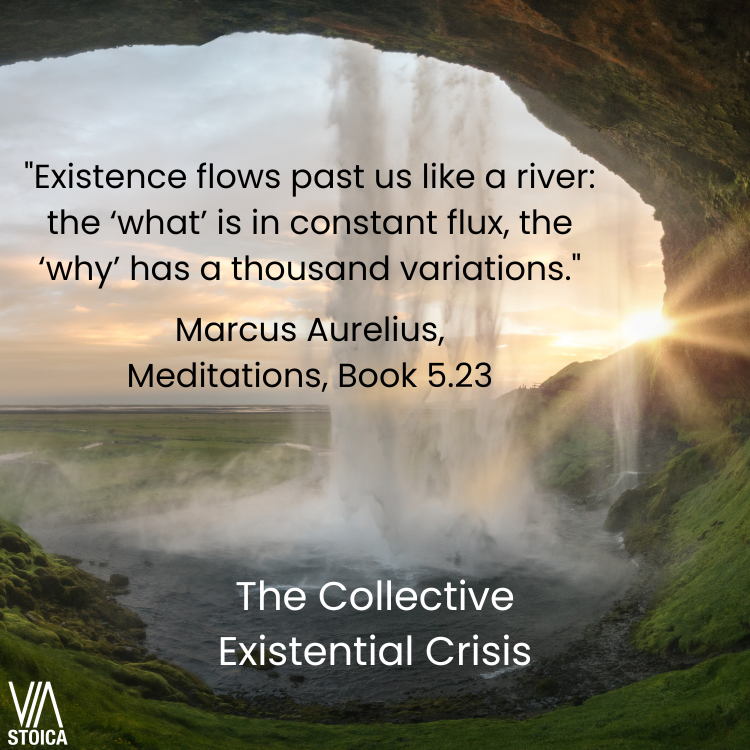
“Keep in mind how fast things pass by and are gone – those that are now, and those to come. Existence flows past us like a river: the ‘what’ is in constant flux, the ‘why’ has a thousand variations.”
Marcus Aurelius, Meditations, Book 5.23
A torn society, facing a collective existential crisis

We’ve been thrown into the age of connection. The time of consumption is still here, but it’s the connectivity and the external stimuli that push this forward. We are always moving away from our basic needs, while vast amounts of people can’t even seem to have those met. The rest ask for the internet first, or ways to connect themselves to whichever place they are not. Our cycle is moving us further away from what we are as a society. New jobs are less personal; there is usually a screen dividing us, and the authentic connection becomes alien to us. The problem is that technology seems to be taking over and has increased the flow and the rapids. We are sometimes found to be holding onto our boats for dear life. And for many, it managed to throw them overboard.
A torn society, facing a collective existential crisis, looking at the river ahead. Afraid of what is to come or what is already there. The divide between us humans, the self-imposed differences, always creates something to fear and something to desire. Only now, our awareness of the rapture is greater. Because we see it everywhere. Ignorance can be bliss and can increase our satisfaction with our present situation.
Can we try to be content with what we have?
In another post, I’ve explained how privileged my life is. And still, there are moments when I feel less than someone else. Only because they seem to have more or live a more extravagant life. While we can find happiness, or let’s start with contentment, in the little things. Breathing fresh and clean air, drinking healthy water, and having a shelter, if only we could provide this to everyone. I have this and so much more. Yet, there are times when I feel I need more.
“If it ever happens that you turn to external things in the desire to please some other person, realize that you have ruined your scheme of life. Be content, then, with being a philosopher in everything; and if you wish also to be seen as one, show yourself that you are one, and you will be able to achieve it.”
Epictetus, The Handbook, 23

The more we move away from our basic needs, the bigger our collective existential crisis becomes. And I wonder what people would answer if you asked them what they want from life. Wouldn’t it be to live a healthy and happy one? But because we want more and can’t stand the fact that others have it all. We wage wars, destroy nature, scavenge our resources, and wreak havoc while doing so. In the meantime, we aren’t destroying our planet, we are only making it less habitable for us. Earth will continue to revolve until the Sun decides it’s over. What is our goal in all of this? Never-ending progress? But it does end at one point. Can’t we try to learn to be content with what we have? Finding value in being human and part of a society?
We assign the meaning ourselves
This might sound a bit paradoxical, but to deal with a collective existential crisis, we should start with ourselves. The Stoics teach us that the only things we can control are our own opinions and actions. Therefore, instead of trying to change others, we can try to inspire them by setting a good example. We can do this by living a virtuous life or at least doing our very best to get as close as we can. Take stock of our wants and desires, and see what matters. We can still do the things that are important to us, but we can do them less excessively. Those little changes might make a big difference. Less consumption, resisting temptations, being less wasteful, and being happier with what we have.
“Besides, a man who follows someone else not only does not find anything, he is not even looking.”
Seneca, Letters From a Stoic, Letter XXXIII
The existential crisis we have, the lack of value we give to our possessions, and the constant rush and lack of time will gradually turn around. By being content with the present and our personal situation, we will attribute the value to ourselves, not to things. By chasing fewer things, we can prioritize our time to what matters to us. If we can, then combine this with introspection, learning who we are, and understanding what drives us, we can get a better grasp of the meaning of our existence. Because we assign it meaning ourselves.
The collective existential crisis is a whirlpool
While we are working on ourselves and setting the right example, let’s try to be better parts of society. Life is difficult, so try to be kind and supportive of each other. To fight the collective existential crisis, we can give it a collective meaning. Being part of the human race, a unique life here on Earth. That, in and of itself, should give us all a sense of pride. Then, the next time you see another human being, give some support, listen attentively, and show respect. We are all in the same boat; we share a powerful thing: conscious life. Don’t think of what you might lose by helping someone, but focus on gaining a true connection. A real-life experience. The collective existential crisis is a shared whirlpool; let’s make sure we get everyone back into the boat and stick together.
Want to explore more Stoic Practice?
Book a free consultation with one of our Stoic Coaches to get support. Or read more about How to Practice Stoicism here. Listen to the Via Stoica Podcast on Spotify, Apple Podcasts, or YouTube.
Author Bio
Benny Voncken is the co-founder of Via Stoica, where he helps people apply Stoic philosophy to modern life. He is a Stoic coach, writer, and podcast host of The Via Stoica Podcast. With almost a decade of teaching experience and daily Stoic practice, Benny creates resources, workshops, and reflections that make ancient wisdom practical today.
Related Posts
-
 Inner Life Terms
What Are Values? Principles That Guide Action and Display Nature
What are Values? Most people don’t wake up thinking about their values. They notice them indirectly, when something feels slightly misaligned. When a choice looks right on paper but leaves a faint sense of resistance. When success arrives, yet doesn’t land the way it was expected to. Values are often mistaken for opinions, preferences, or […]
Read more -
 Via Stoica Podcast
A Stoic Conversation with Jason Nelson: Six Seeds for a Happier Life
What if happiness is not something you achieve one day, but something you practice every day? In A Balm for Your Soul: Six Seeds for Happiness, Jason Nelson offers a grounded and humane answer to a question many people quietly struggle with: Why does life still feel off, even when things look good on paper?Rather […]
Read more -
 Greek Stoic Philosophy Terms
What Is Philanthropia? How Stoicism Views Love for Humankind
What Is Philanthropia? Philanthropia in Stoicism is the cultivated disposition to care for human beings simply because they are human. It describes a rational, practiced goodwill toward others that flows from understanding our shared nature, rather than from emotion, obligation, or reward. This concept matters today because modern life often treats kindness as optional, sentimental, […]
Read more
Comments 0