
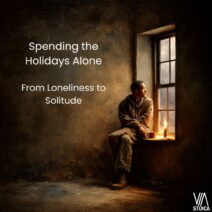
Spending the Holidays Alone: From Loneliness to Solitude

Spending the Holidays Alone
The holiday season carries a quiet weight. For many, it is a time of connection and warmth. For others, it highlights absence, distance, or a feeling of being out of step with what these days are supposed to look like.
Spending the holidays alone can bring up loneliness, self-judgment, and a sense that something has gone wrong. Yet from a Stoic perspective, these moments offer something else as well, an invitation to reflect, to accept, and to reconnect with what truly matters.
As Seneca reminds us:
“We say the wise man is self-content; he is so in the sense that he is able to do without friends, not that he desires to do without them.”
Seneca, Letters from a Stoic, Letter IX
This distinction sits at the heart of how Stoicism approaches solitude.
Why the Holidays Feel Especially Difficult
Holidays come with expectations. They are framed as special days that must be meaningful, joyful, and shared. There is pressure for everything to be perfect: the dinner, the atmosphere, the emotions, the sense of togetherness.
When reality does not match this image, discomfort arises. Even people surrounded by family can feel tense, restless, or empty, trying to meet an ideal that rarely exists. For those spending these days alone, the contrast can feel sharper.
The difficulty is not the day itself, but the story we attach to it. The belief that being alone during the holidays means something is wrong.
Loneliness as a Mismatch of Desire and Reality
From a Stoic point of view, loneliness is not simply the absence of people. It is the tension between what we want and what is actually present.
We may desire connection, familiarity, or shared rituals, while our circumstances offer something else. That mismatch creates distress. Stoicism addresses this through the discipline of desire, learning to bring our expectations into alignment with reality rather than demanding that reality bend to our expectations.
Being alone does not mean being unloved, antisocial, or disconnected from the world. Often, it is simply a matter of circumstance.
Being Alone Is Not the Same as Feeling Lonely
One of the key insights from the Stoics is that loneliness can exist even in company. We can be surrounded by people and still feel unseen, unsafe, or out of place.
What matters is not how many people are present, but whether we feel at ease with ourselves and our situation. This is where the distinction between loneliness and solitude becomes important.
“Loneliness often comes from comparing where we are with where we think we should be.”
Benny Voncken, Via Stoica Podcast, How to Navigate the Holidays Alone (00:06:42)
From Loneliness to Solitude
Loneliness is often restless. It looks outward, compares, and judges. Solitude is quieter. It begins with acceptance.
Solitude does not mean isolation. It means being at peace with oneself, without needing distraction or validation. This inner steadiness allows a person to remain content whether alone or among others.
For the Stoics, this inner connection is not withdrawal from life but a foundation for engaging with it more honestly. When we are grounded in ourselves, we relate to others without desperation or pressure.
“The more at ease we are with ourselves, the less we need the world to confirm our worth.”
Benny Voncken, Via Stoica Podcast, How to Navigate the Holidays Alone (00:14:02)
Social Pressure and the Role of Comparison
Social media intensifies this struggle. Images of decorated homes, smiling faces, and shared meals present a curated version of reality. We see the highlights without the tensions, silences, or exhaustion behind them.
For someone already feeling alone, this comparison can deepen the sense of inadequacy. A Stoic response is not to deny these feelings, but to recognize what is within our control. Limiting exposure, stepping back, or choosing not to compare can be an act of self-care, not avoidance.
Choosing Connection Without Escaping Yourself
Stoicism is not anti-social. It recognizes humans as deeply relational beings. Seeking connection is natural. The key is the motive behind it.
If the connection comes from panic, fear, or the need to escape ourselves, it often leaves us more drained. If it comes from calm preference, from knowing who we are and what we value, it becomes nourishing.
“Connection works best when it grows from inner stability, not from fear of being alone.”
Benny Voncken, Via Stoica Podcast, How to Navigate the Holidays Alone (00:15:48)
Being alone, then, is not a failure. Sometimes it is the more honest choice.
Reframing the Holidays Through a Stoic Lens
Instead of approaching the holidays with rigid expectations, Stoicism invites us to meet them as they are.
If you spend time with others, be present. Let go of the need for perfection. If tensions arise, respond with patience rather than resistance.
If you are alone, allow the space to rest and reflect. These days can become moments for journaling, self-examination, or simply slowing down. The turning of the year has long been associated with reflection, not performance.
Gratitude, in Stoicism, is not forced positivity. It is recognition of what is present, even when it differs from what we hoped for.
Conclusion
Spending the holidays alone does not place you outside of life or community. From a Stoic perspective, it can be a meaningful practice in acceptance, self-knowledge, and balance.
Loneliness asks for comparison and judgment. Solitude asks for presence.
By grounding ourselves in what we can control, our judgments, our responses, our values, we learn to meet these moments with steadiness rather than resistance.
If you want to explore this topic more deeply, you can watch the full episode of How to Navigate the Holidays Alone on YouTube, where these ideas are unpacked in a reflective, practical way.
Want to explore more Stoic practices?
Book a free consultation with one of our Stoic Coaches. You can also listen to the Via Stoica podcast on Spotify or Apple Podcasts or watch it on YouTube.
Author Bio
Benny Voncken is the co-founder of Via Stoica, where he helps people apply Stoic philosophy to modern life. He is a Stoic coach, writer, and host of The Via Stoica Podcast. With nearly a decade of teaching experience and daily Stoic practice, Benny creates articles, workshops, and reflections that make ancient wisdom practical today.
Related Posts
-
 Blog
BlogHow to Stop Emotional Reactivity, Learn to Pause Before You React
How to stop emotional reactivity begins with learning to pause. Stoicism teaches that peace of mind comes not from controlling life, but from mastering our judgments about it.
Read more -
 Greek Stoic Philosophy Terms
What Is Sophrosyne? The Stoic Virtue of Balance, Limits, and Staying Centered
What Is Sophrosyne? Sophrosyne in Stoicism is the virtue of balance, the ability to govern desires and impulses through knowledge of one’s limits. The Stoic meaning of sophrosyne is not strict self-denial or restraint for its own sake, but staying centered and proportionate in how we relate to pleasure, comfort, ambition, and emotion. It matters […]
Read more -
 Via Stoica Podcast
Spending the Holidays Alone: From Loneliness to Solitude
Spending the Holidays Alone The holiday season carries a quiet weight. For many, it is a time of connection and warmth. For others, it highlights absence, distance, or a feeling of being out of step with what these days are supposed to look like. Spending the holidays alone can bring up loneliness, self-judgment, and a […]
Read more

Comments 0