
What Is Sophrosyne? The Greek Meaning Behind Stoic Temperance
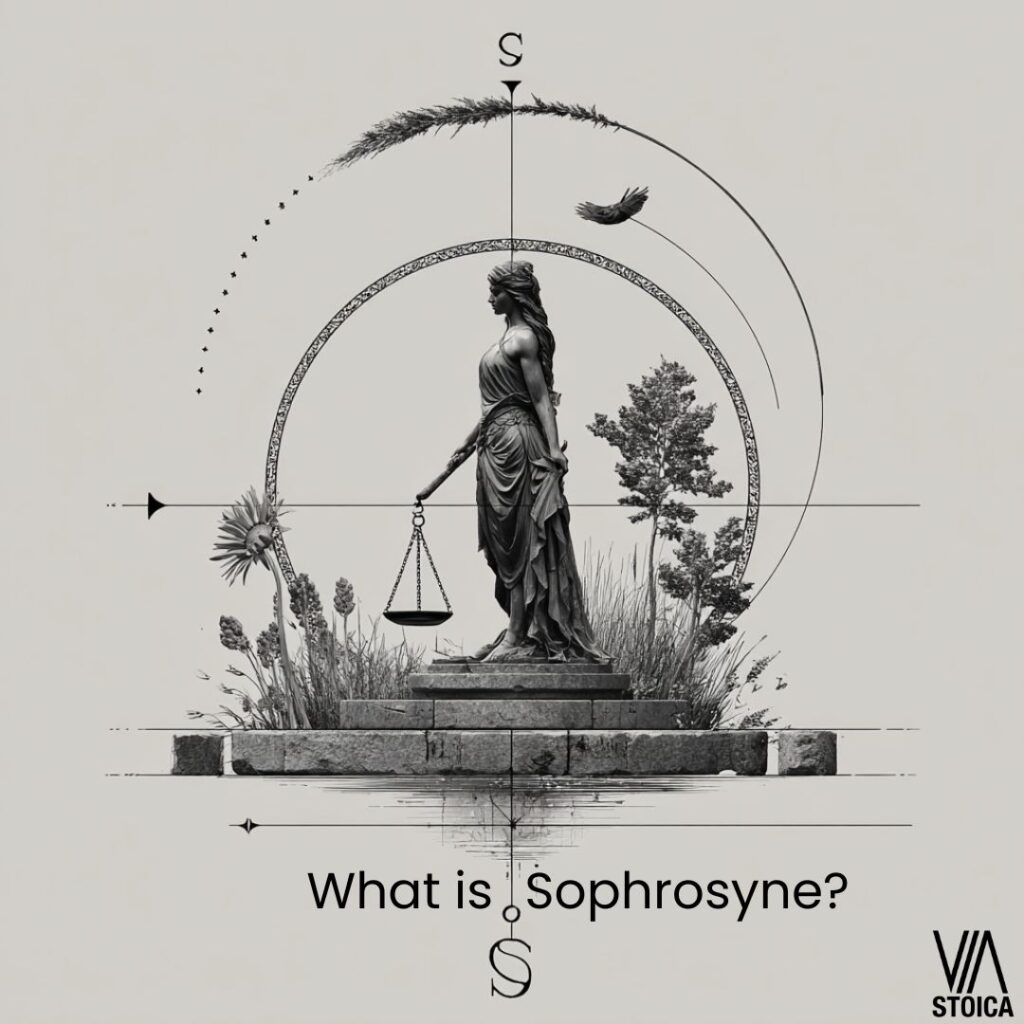
Term: Sophrosyne (σωφροσύνη) | Translation: Temperance, self-mastery | Language: Greek | Category: Four Cardinal Virtues
Sophrosyne (σωφροσύνη) in Stoic philosophy is the virtue of measured desire: the capacity to govern impulse and appetite through knowledge of one’s own limits. It is usually translated as temperance, and it is one of the four cardinal virtues. It is not strict self-denial or restraint for its own sake. The Greek word itself explains why: it points to a sound, well-ordered mind rather than a rule about restriction. Modern life constantly pushes toward excess and distraction, which is why staying centred and proportionate in how you relate to pleasure, comfort, ambition, and emotion remains such demanding, practical work.
Breaking Down the Word
The etymology of sophrosyne makes the connection between temperance and clear thinking explicit in a way the English word “moderation” loses entirely.
- Greek: σωφροσύνη
- Root: from sōs, sound or healthy, and phrēn, mind or understanding
- Literal meaning: a healthy, well-ordered mind
- Stoic meaning: self-governance guided by knowledge and proportion, keeping desire within its natural boundaries
A mind without measure cannot judge well, and this is the philosophical stake behind the word. Sophrosyne preserves knowledge of what is enough and maintains the balance between impulse and reason. It keeps the ruling faculty centred and capable of choosing well, rather than letting attention scatter outward toward whatever appears next. This is why the Stoics treated it as inseparable from clear judgment, not as a separate rule about restraint.
What Sophrosyne Actually Means
Measured desire, not suppressed desire
Sophrosyne governs the boundary of enjoyment rather than eliminating it. You can enjoy something fully while knowing where it stops serving you and starts governing you instead. Epictetus frames the whole task of Stoic practice in terms of desire and aversion directly. Your task lies in wanting rightly, so that you neither fail to attain what you genuinely desire nor fall into what you should have avoided.
"Where does your task lie? In desire and aversion, that you may neither fail to attain what you desire, nor fall into what you want to avoid."
Epictetus, Discourses, Book 1, Chapter 4.10–11
Every desire carries a price
Epictetus makes this precise in Discourses 1.25: every external desire comes with a price paid in freedom, and knowing what you are purchasing is the actual discipline. Wanting an outcome you cannot control hands a grip to whoever or whatever controls it. Sophrosyne is the habit of checking that price before paying it, not refusing every purchase on principle.
Inner balance, not suppression
Emotions still arise under sophrosyne. The virtue is not flatness. It is remaining centred while feeling them, neither suppressing what actually shows up nor being carried away by it into action that outruns judgment. This is what separates sophrosyne from the modern caricature of temperance as joylessness. The goal was never fewer feelings, only feelings that stay proportionate to what actually happened.
Sophrosyne and Self-Denial: What Is the Difference?
This term is often misread as rigid self-control, a life of constant denial, or the rejection of ambition. That misreading treats restriction itself as the goal, which gets the whole thing backwards. For the Stoics, imbalance was the actual danger, and imbalance runs in both directions. Overindulgence and total avoidance are equally disruptive to a well-ordered mind, since both let something other than reason decide the boundary.
Sophrosyne is freedom from compulsion, not the rejection of pleasure. It is knowing when something fits your life and when it has begun, without your noticing, to pull you off centre. Self-denial treats every desire as suspect by default. Sophrosyne treats every desire as something to examine on its own terms. That is a harder and more honest discipline than simply saying no to everything.
Sophrosyne and Core Stoic Principles
It is one of the four cardinal virtues rather than a standalone rule, working together with the other three rather than in isolation from them.
Logos (λόγος) is what sophrosyne relies on: reason assessing desires rather than obeying them automatically. As a cardinal virtue of aretē (ἀρετή), sophrosyne works alongside wisdom, justice, and courage. The Stoics held that a person who genuinely has one cardinal virtue has all four, since each is the same underlying rightness of reason applied to a different domain. Physis (φύσις) grounds the standard itself: living according to nature means living in proportion, not excess or deficiency. Sophrosyne is what keeps a life inside that proportion day to day.
How to Practice Sophrosyne
Sophrosyne is built through noticing the moment a desire starts to govern rather than serve, which is easiest to catch in small, ordinary decisions before it appears in large ones.
The price check
Before saying yes to something, ask what it costs in freedom, not money. What do you hand over control of by wanting this outcome? If the price is acceptable, proceed with full attention. If it is not, seeing that alone often changes the decision.
The pause before excess
When tempted toward more than you need, pause and consider whether this next choice keeps you centred or pulls you off it. The pause itself does the work. Most excess happens on autopilot, and sophrosyne begins the moment autopilot is interrupted.
The evening boundary check
At the end of the day, note one moment where restraint protected your balance rather than costing you enjoyment. Note one moment too where a boundary slipped without your noticing at the time. Over weeks, this builds an accurate picture of where your own limits actually sit.
Stoic Exercise
The Price List
Rooted in sophrosyne: every desire you hold hands a grip to something. Knowing what you are purchasing, and at what cost, is the whole of the discipline.
Name three things you currently want: an outcome, a possession, an approval you are chasing. For each one, ask what you are paying in peace of mind to keep wanting it. Then ask a second question: what handle have you left for someone or something else to grip, simply by wanting this so much? Write one sentence per item, naming the price plainly. You are not being asked to give any of them up. You are being asked to see the actual cost clearly enough to decide, with open eyes, whether it is still worth paying.
Ready to go deeper? Discourses 1.25 takes this practice into its full form.
Why Sophrosyne Is Central to Stoic Practice
Epictetus stresses repeatedly that freedom depends on how you relate to desire, not on removing desire altogether. Without sophrosyne, the mind fragments, chasing whatever appears most urgent rather than what actually counts. Marcus Aurelius returns constantly to the same discipline: refusing to let circumstance dictate anger or grief, and directing desire only toward what is genuinely within his power.
"Do not give the circumstances the power to arouse anger or grief. Instead, control yourself deliberately, and let your desire direct itself only to what is within your power."
Marcus Aurelius, Meditations, Book 8.47
Sophrosyne also governs how the other Stoic practices avoid becoming their own excess. Premeditatio malorum tips into rumination without it. Askēsis tips into self-punishment without it. Every deliberate Stoic practice needs a boundary that keeps it proportionate, and sophrosyne is the virtue that supplies it.
Frequently Asked Questions
What does sophrosyne mean in Stoicism?
Sophrosyne means rational temperance: living with balance and clear knowledge of your own limits. It is one of the four cardinal virtues, and it governs how you relate to pleasure, ambition, and emotion through reason rather than impulse. You can explore related concepts in the Stoic philosophy terms glossary.
Is sophrosyne about denying pleasure?
No. Sophrosyne is about enjoying pleasure without losing balance or becoming dependent on it. Overindulgence and total avoidance are equally disruptive to a well-ordered mind. The Stoics were not asking you to want less. They were asking you to know what any given desire actually costs.
What are the four cardinal virtues?
The four cardinal virtues are sophia (wisdom), sophrosyne (temperance), dikaiosynē (justice), and andreia (courage). Each is the same underlying rightness of reason expressed in a different domain. That is why a person who genuinely holds one cardinal virtue holds all four.
How is sophrosyne different from self-denial?
Self-denial treats every desire as suspect by default and refuses on principle. Sophrosyne examines each desire on its own terms and asks what it actually costs before deciding. One is a blanket rule; the other is an ongoing discipline of judgment. The Stoics considered the second harder and more honest.
How do you practice sophrosyne daily?
Notice the moment a desire shifts from serving you to governing you, and pause there before acting. In Stoic coaching, this usually starts with naming the actual price of a specific recurring want, since the abstract instruction to be balanced rarely changes behaviour on its own.
Want to Learn More?
If this resonated and you are ready to start building your own philosophy of life, a conversation with Benny as your Stoic coach can be a good place to begin. Not to be told what to think, but to have the space to figure it out. You can also sign up for the newsletter, The Pause, or watch or listen to the Via Stoica Podcast on YouTube, Spotify, or Apple Podcasts.
About the Author
Benny Voncken is the founder of Via Stoica and host of The Via Stoica Podcast. He has practiced Stoicism as a way of life for over seven years and draws on almost 15 years of teaching experience to turn dense ancient ideas into daily practice. Since 2023 he has coached clients around the world through one-on-one Stoic coaching. He also leads Stoic walks across Europe, writes the monthly newsletter The Pause, and has spoken at Stoicon.



Comments 0