
What is Stoicism? Definition, Principles, and How to Live It
Stoicism is a Hellenistic philosophy founded around the 3rd century BC. Its central goal is to live a good life through the cultivation of virtue and the use of reason
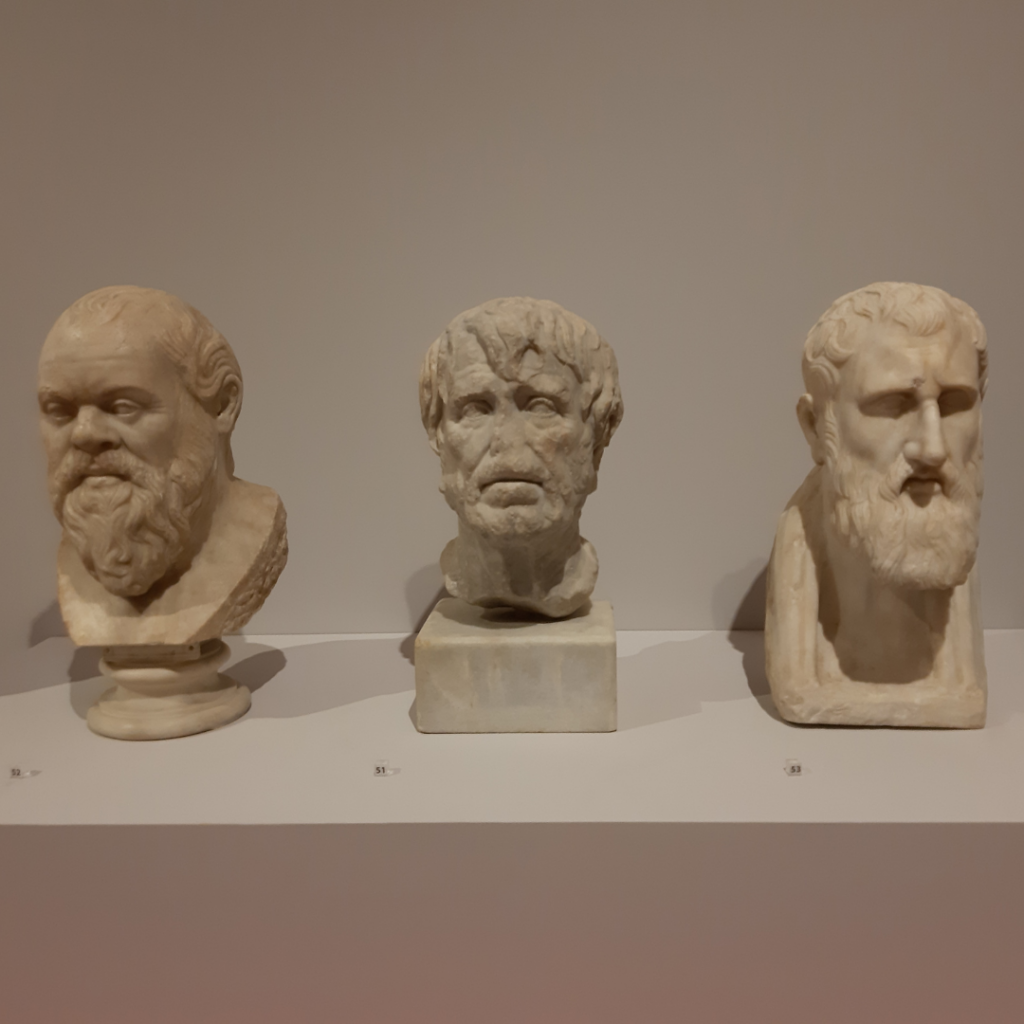
Definition of Stoicism
Stoicism is an ancient Hellenistic philosophy founded in Athens around 300 BC by Zeno of Citium. It teaches that virtue, arete in Greek, is the only thing we need to live a good life and reach Eudaimonia, a state of good character and spirit. To do so, we must apply reason to judge every event objectively, make the moral choice that fits our role within an interconnected universe, and live in accordance with Nature.
Stoicism, though ancient, remains relevant today. Whether the challenge is career stress, relationship issues, or a search for meaning, it offers grounded and actionable teachings. It is not about suppressing emotions or withdrawing from life, but about judging events clearly and acting well within them.
Watch the Via Stoica Podcast on What is Stoicism?
Jump to a section:
The Stoicism Definition: What It Really Means
Reduced to a single line, Stoicism asks us to live according to reason and virtue, though that line demands something substantial once we actually try to practise it. It is not a system built on personal improvement or a set of productivity tips. It is a complete philosophy of life, with its own logic, physics, and ethics, all pointing toward one question: what does it mean to live well?
Written lowercase, stoic describes a personality trait: someone who stays calm and undemonstrative under hardship, the popular sense of the word, someone who simply takes hardship without complaint. Capitalized, Stoicism names the entire philosophical school stretching from Zeno to Marcus Aurelius, complete with its own logic, physics, and ethics, and its meaning is nearly the opposite: a Stoic is someone actively engaged with the world, constantly examining impressions, exercising judgment, and making deliberate moral choices. The lowercase sense borrows its calm from the philosophy but strips out the reasoning that was meant to produce it.
This distinction is important to keep in mind because it changes how we approach the practice. Stoicism is not something we understand once and then apply from memory. It is something we do at every moment, to improve our character, change our habits, and become better cosmopolitans, a reach traced back to oikeiōsis, the process by which our sense of what is our own expands outward to all rational beings. Even the ancient Stoics rarely, if ever, became the sage, the perfect person, but they understood that they could make progress toward that goal.
A Brief History of Stoicism
Stoicism began with Zeno of Citium (c. 334–262 BC), who founded the school after losing everything in a shipwreck. Searching for a better way of life, he found inspiration either through a prophecy, possibly from the Oracle at Delphi, or by picking up a book on philosophy in an Athenian bookshop. There, he encountered Crates of Thebes, a well known Cynic philosopher, and began training under him. Diogenes Laertius records this account in his Lives of the Eminent Philosophers, Book 7, the primary ancient source for Zeno’s early life, his time with Crates, and the founding of the school.
Zeno also studied with the Academics and Megarians over time, combining these influences into his own system. He began teaching at the Stoa Poikile (“Painted Porch”) in Athens, and his followers came to be known as Stoics after that location.
Scholars typically divide Stoicism’s history into three phases: the Early Stoa, the Middle Stoa, and the Late Stoa, more commonly known as the Roman Stoics.
- Early Stoa: Zeno, Cleanthes, Chrysippus
- Middle Stoa: Panaetius, Posidonius
- Late Stoa (Roman Stoics): Seneca, Musonius Rufus, Epictetus, Marcus Aurelius
The Early Stoa
Zeno led the school until his death around 262 BC, after which Cleanthes succeeded him as its second head. Cleanthes had come to philosophy late, working as a boxer and a water carrier before he could afford to study, and he held the school together for over thirty years without matching Zeno’s originality. He is best remembered today for his Hymn to Zeus, the largest surviving fragment of his writing and, by several scholarly accounts, the only text from the early Stoa to survive close to intact. His most significant contribution to Stoic ethics was narrower but no less lasting: it was Cleanthes who added “with nature” to Zeno’s formula for living well, a phrase discussed further under The Goal of Stoicism below.
Enter Chrysippus
Chrysippus succeeded Cleanthes as the third head around 230 BC, and it was under him that Stoicism became the systematic body of thought later generations inherited. He organised its logic, physics, and ethics into a coherent whole and refined the founding formula further still, a task helped by sheer output: Diogenes Laertius credits him with more than 700 works, written at a self-imposed pace of 500 lines a day, though none survives complete. His impact was regarded as so decisive within the school itself that it produced one of antiquity’s most repeated lines about him:
"Had there been no Chrysippus, there would have been no Stoa."
Diogenes Laertius, Lives of the Eminent Philosophers, Book 7, 183 (on Chrysippus)
That claim came from within the school. Chrysippus’s influence reached its rival too. Carneades, the Academic Skeptic who built his entire career arguing against Stoic doctrine, is recorded making an even more personal admission about the opponent that career depended on:
"Had Chrysippus not existed, I would not have existed."
Diogenes Laertius, Lives of the Eminent Philosophers, Book 4, 62 (on Carneades)
Chrysippus’s most consequential piece of systematising addressed a problem the school could not avoid: if the cosmos runs entirely on fate, how can anything genuinely be up to us? He answered with an analogy. Push a cylinder and it starts rolling, but how it rolls, smoothly or awkwardly, depends on its own shape, not only the push. Fate supplies the initial cause, he argued, but our own character determines the response, which is what makes that response ours. The idea sits directly beneath the dichotomy of control covered later in this section: fate and what is up to us were never opposites for the Stoics, only two descriptions of the same event.
The Middle Stoa
The Middle Stoa shifted the school’s centre of gravity from Athens toward Rome. Panaetius, who led the school in the late second century BC, spent years in Rome as a close associate of the statesman Scipio Aemilianus, and it was largely through him that Stoic ethics reached the Roman elite who would later produce Seneca, Epictetus, and Marcus Aurelius. His student Posidonius went further still, running his own school on Rhodes and folding Stoic ethics into wide-ranging work on history, geography, and natural science. Neither figure’s major works survive complete, but their influence reached Cicero directly: he studied under Posidonius in Rhodes, and later drew heavily on Panaetius’s ethical writings when composing his own De Officiis.
The Roman Stoa
Most of what we know about Stoicism today comes from the Roman period. Key texts include Seneca’s Letters and essays, Musonius Rufus’s Discourses (recorded by his student Lucius and preserved by the later anthologist Stobaeus), Epictetus’ Discourses and Handbook (written down by his student Arrian), and Marcus Aurelius’ Meditations, a personal journal never intended for publication. Cicero’s De Finibus, Book III, though he was not a Stoic himself, also gives us deep insight into the philosophy, recording a full exposition of Stoic ethics in the voice of the Stoic senator Cato the Younger.
Nearly five centuries separate Zeno’s founding of Stoicism in Athens from the death of Marcus Aurelius, its last great voice in the ancient world.
Core Principles of Stoicism
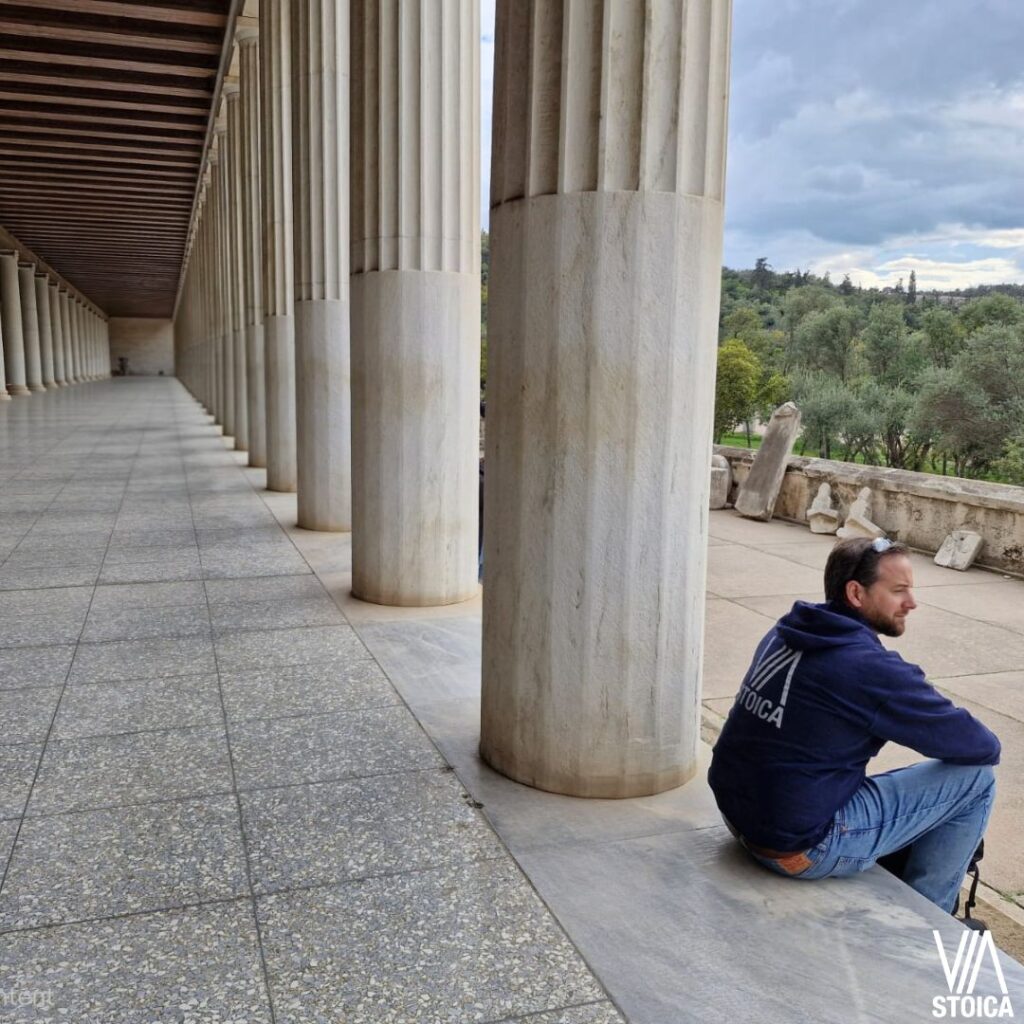
At its heart, Stoicism is a guide to living in alignment with Nature and Reason. Here are its core principles:
1. The Goal of Stoicism
Zeno’s own name for a genuinely happy life was a smooth flow of life, a life with no friction between what a person wants, decides, and does.
"Happiness is a smooth flow of life."
Zeno of Citium, as recorded by Diogenes Laertius, Lives of the Eminent Philosophers, Book 7, 88
This is what the Stoics meant by Eudaimonia. Reaching it, they argued, depends on two things working together. Virtue is the only good capable of producing it reliably, since health, wealth, and reputation can all be lost or denied by circumstance, while virtue cannot. And virtue itself only takes real shape when we live in accordance with nature, understanding both our own rational nature and the rational order of the wider cosmos we are part of. The rest of this section works through what each of those pieces actually means. For the fuller treatment of this concept and its Greek terminology, see What Is Telos?
2. Virtue Is the Only True Good
The Stoics taught that nothing outside of our character can lead us to the good life or help us reach a state of Eudaimonia. Health, wealth, and reputation are what the Stoics called preferred indifferents, covered in full under Indifferents below; we may reasonably pursue them, but they are not what make a life good. Only virtue does that. Virtue consists of:
- Wisdom: using experience and knowledge to seek the truth and make the best possible moral choice
- Courage: acting on a moral choice, even when it is difficult, dangerous, or frightening
- Justice: knowing what is fair and doing what is right in your relationships and your role in the world
- Temperance: knowing your limits and choosing balance in thoughts, emotions, and actions by living in a disciplined way
3. Living in Accordance with Nature
“Nature” here is easy to misread as living simply, going outdoors, or following instinct, that is not what the Stoics meant. It carries a double sense they held together deliberately: the rational order of the cosmos as a whole, and our own particular nature as rational, social beings. To live in accordance with nature means aligning both, thinking clearly, acting justly, and fulfilling our role within the larger whole. It is an active orientation, not a passive one.
Zeno’s own formula for the aim of Stoic life was simply to live in agreement, a life governed by one consistent line of reasoning rather than pulled between conflicting impulses. Cleanthes added the phrase that gives the formula its familiar shape: to live in agreement with nature. Chrysippus refined it further still, describing a life lived in accordance with experience of what happens by nature.
4. Logos and Reason
The rational structure of the universe, called Logos (λόγος) by the Stoics, exists both in the cosmos and in us. By using reason, we participate in this divine order.
5. Indifferents
Not everything outside virtue and vice carries equal weight, even though only virtue is good and only vice is bad. The Stoics called this middle category indifferents, things like health, wealth, and reputation, which have no bearing on whether we live well but are not therefore worthless.
Diogenes Laertius records that Zeno himself divided these into two groups: preferred indifferents, such as health, wealth, and a good reputation, which we may reasonably select and pursue, and dispreferred indifferents, such as sickness, poverty, and disgrace, which we may reasonably avoid. Neither group determines happiness. A wise person prefers health over sickness while remaining equally capable of living well in either state.
A third group sits alongside these: things that are simply neutral, with no pull toward or away from them at all, the classic ancient examples being whether the number of hairs on your head is odd or even, or which direction you point a finger. Preferred and dispreferred indifferents at least incline us one way before reason steps in. This third group does not incline us anywhere.
This distinction is what separated Zeno’s Stoicism from the Cynicism of his own teacher, Crates of Thebes. The Cynics agreed that virtue alone is good and treated everything else with genuine indifference, often rejecting convention, property, and social standing outright as a matter of practice. Zeno kept the Cynic core, that virtue alone is good, but broke from their asceticism by allowing that some externals could be rationally preferred and pursued as tools for living well, without ever confusing them with the good itself. That single move turned an ascetic protest movement into a workable philosophy of life.
6. The Dichotomy of Control
One of the most quoted ideas in all of Stoicism comes from Epictetus:
"Some things are in our control and others not. Things in our control are opinion, pursuit, desire, aversion, and, in a word, whatever is our own action. Things not in our control are body, property, reputation, command, and, in one word, whatever is not our action. The things that are up to us are by nature free, unhindered and unimpeded; but those that are not up to us are weak, servile, subject to hindrance, and not our own."
Epictetus, Handbook, 1
Some things are up to us: our judgments, desires, impulses, and actions. Others are not: our reputation, the behaviour of others, and the outcomes of events beyond our reach, much of it the same territory already covered under Indifferents above. Health, wealth, and reputation were preferred, never required, and the dichotomy of control is what explains why treating them as required was always the mistake.
Most people encounter this and feel relief, since there is genuine freedom in letting go of what was never yours to carry. But the dichotomy has a second side that rarely gets the same attention.
Everything in the first category is entirely your responsibility, with no exceptions and no excuses. The Stoic path is not about passivity or detachment. It is about redirecting your attention to what is vital to a good life, releasing what is outside your reach, and taking full ownership of what is within it. That second part is where character is built, and it is also the part most people choose to avoid.
7. The Three Disciplines
The Stoics organised the inner life into three disciplines, covering what we want, what we do, and how we see. Together they turn abstract principles into something we can actually work on moment to moment.
The Discipline of Desire
The discipline of desire governs what we want and fear. It asks us to direct our desire only toward what is truly good, virtue, and our aversion only toward what is truly bad, vice, rather than toward externals we cannot fully control.
The Discipline of Action
The discipline of action governs what we do. It asks us to act with justice, playing our role within the wider community with reason and care for others, rather than acting from impulse or self-interest alone.
The Discipline of Assent
The discipline of assent governs how we see, and it is where daily practice begins. When an event happens, we first receive an impression, what the Stoics called a phantasia, shaped by our beliefs, desires, and opinions. This impression arises in the hegemonikon, the ruling faculty of the mind. The Stoics held that some impressions carry their own guarantee of accuracy, what they called a kataleptic impression, one so clear and distinct that a rational mind can safely assent to it as true. An impression can also trigger propatheia, an instinctive first flicker of reaction, such as a flash of fear at a sudden loud noise, that the Stoics regarded as a natural bodily reflex rather than a genuine emotion.
The practice of prosoche, continuous attention to the self, is what allows us to catch the impression before we react to it, pausing to ask whether it is accurate and whether to assent to it. From that pause comes the moral choice, prohairesis, to do what the situation actually requires. The event itself is neither good nor bad; it is our judgment, and the moral choice we make in response, that defines our character.
Common Misconceptions About Stoicism
Three claims about Stoicism come up more than any others, and none of them survive contact with the ancient texts.
- “Stoics suppress emotions”: False. Stoicism teaches us to understand emotions, not eliminate them, since emotions are responses to our judgments and beliefs, and changing the judgment changes the emotion. The state the Stoics were actually describing, freedom from destructive passion rather than an absence of feeling, is what they called apatheia. The Stoics distinguished between pathē, the false value judgments they aimed to correct, and eupatheiai, the well reasoned emotional responses, such as joy and goodwill, that remain fully available to a virtuous person. Emotions are also mirrors that show us who we are and where our work lies.
- “Stoicism is passive”: Also false. Stoicism is an active philosophy that teaches us to fulfill our roles, engage with life, and take moral action in every situation we find ourselves in.
- “Stoics reject material things”: They do not. Stoics accept health, wealth, and success as preferred indifferents, meaning we may prefer them, but they are not necessary for a good life. We can have material things, as long as they do not have us.
How to Practice Stoicism Today
You do not need to be a philosopher or scholar to practice Stoicism. But it is worth being honest about what practice actually means. It is not a morning routine or a reading list, though those can support it. It is a daily commitment to examining how we see things, catching our impressions before they sweep us away, and making deliberate choices rather than automatic ones.
That said, here are some concrete places to start:
- Reflect daily: Use journaling or quiet reflection to examine your actions and thoughts at the end of each day
- Practice negative visualization: Imagine loss or difficulty to strengthen gratitude and loosen attachment
- Focus on what you can control: Let go of outcomes, focus on the quality of your choices and actions
- Embrace discomfort: Voluntarily challenge yourself in small ways to build resilience
- Read Stoic texts: Start with the ancients like Meditations, Handbook, or Letters from a Stoic, then move to modern guides. Our Stoic Reading List for Beginners covers where to start in more detail.
- Study your impressions: Pause before reacting. Ask yourself what is really going on, and whether your first reading of the situation is accurate.
Discover other practices here: How to Practice Stoicism
"To stop talking about what the good man is like, and just be one."
Marcus Aurelius, Meditations, Book 10.16
Frequently Asked Questions
What is Stoicism in one sentence?
Stoicism is an ancient Hellenistic philosophy that teaches us to live with reason and virtue, so we can reach a state of good character and spirit known as Eudaimonia. Zeno of Citium founded the school in Athens around 300 BC, and its central claim is that our own judgment and moral choice, not external circumstances, determine whether we live well.
What is the Stoicism definition?
The Stoicism definition, in philosophical terms, describes a school of Hellenistic philosophy founded by Zeno of Citium in Athens around 300 BC. It holds that virtue is the only true good, that we must live according to reason and Nature, and that we alone are responsible for our moral choices. A good life, in the Stoic sense, is one lived in accordance with virtue regardless of external circumstances.
What does stoic mean?
In everyday language, stoic (lowercase) means remaining calm and composed in the face of hardship or pain. In philosophy, a Stoic is someone who follows the teachings of Stoicism: applying reason to their impressions, pursuing virtue, and accepting what lies outside their control. The two meanings are related, but the philosophical one is richer and more active.
Do Stoics feel emotions?
Yes, and Stoicism never asks us to eliminate them. What it asks is that we examine the judgments behind our emotional responses, since a distorted judgment produces a distorted feeling. Correcting the judgment allows the emotion to settle into something closer to the truth of the situation.
Is Stoicism religious?
No. While it includes spiritual elements, such as Logos, Stoicism is a philosophy and is compatible with various worldviews.
Can anyone practice Stoicism?
Yes, whatever role or walk of life you find yourself in. Stoicism was practiced by an emperor, a former slave, and a wealthy statesman alike, which shows it does not depend on status or circumstance. What it asks for is a genuine commitment to examining your judgments and choices each day.
Where should I start reading?
Marcus Aurelius’ Meditations, Epictetus’ Handbook, and Seneca’s Letters to Lucilius are the classic starting points, each offering a different angle on the same philosophy. For a fuller guide, our Stoic Reading List for Beginners walks through where to begin based on your interests.
Be Inspired
Let yourself be inspired by the thoughts of the three famous Roman Stoics
Want to explore more Stoic practices?
Author Bio
Benny Voncken is the founder of Via Stoica, where he helps people apply Stoic philosophy to modern life. He is a Stoic coach, writer, and podcast host of The Via Stoica Podcast. With close to fifteen years of teaching experience and a daily Stoic practice, Benny creates resources, workshops, and reflections that make ancient wisdom practical today.
Here is the Via Stoica Podcast episode on What is Stoicism?


The Pause
A monthly Stoic newsletter
Sign up and get The Pause Framework free.
A practical Stoic tool for moments of tension. Observe what is happening. Reset your momentum. Decide with reason.
It arrives in your welcome email.
Then, once a month: one reflection, one practice, one Stoic idea.
Comments 0