
What Is Phantasia? How Impressions Shape Everything You Think and Do
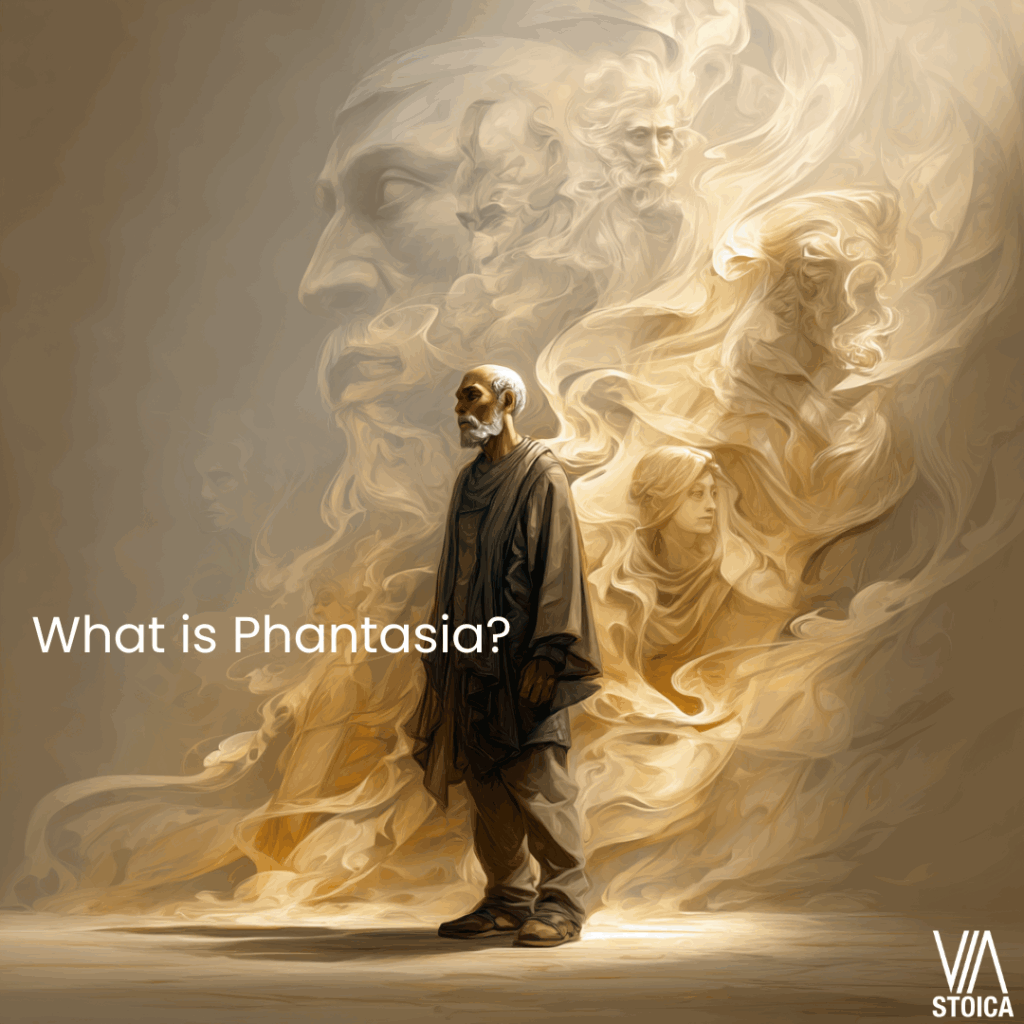
Term: Phantasia (φαντασία) | Translation: A mental impression before any judgment is applied | Language: Greek | Category: Mental Faculties
Phantasia (φαντασία) in Stoicism is the raw mental impression of something before any judgment has been applied to it. It is the immediate appearance that strikes the mind through the senses, memory, or imagination, before reason has had the chance to examine it. Every encounter with the world begins here. Every Stoic practice begins here too, because the impression is where the Stoics located both the origin of error and the opportunity for freedom.
Breaking Down the Word
The Greek etymology of phantasia connects it directly to the act of appearance. Understanding that connection explains why the Stoics placed it at the centre of their psychology.
- Greek: φαντασία
- Root: from phainō (φαίνω), to appear or to show
- Literal meaning: something that comes into view, an appearance
- Philosophical meaning: the raw mental impression of something before reason has evaluated whether it is true or how to respond to it
Zeno of Citium, the founder of Stoicism, described the impression using the image of a seal pressed into wax. The mind receives the impression as wax receives a shape, passively and automatically. This is simply how the mind works, and the Stoics saw no flaw in it. What happens next is what counts, and that is entirely up to us.
What Phantasia Actually Means
Phantasia is not the same as fantasy or imagination, and this distinction is worth holding carefully for understanding what the Stoics were actually asking us to do. Fantasy is something the mind constructs. A phantasia is something the mind receives: a flash of appearance that arrives before any constructive act of thought. You see a colleague’s expression and get an immediate sense of disapproval, or read a message and get an immediate sense of threat. Those are raw impressions, not conclusions, and the Stoics were careful about that difference.
Impressions arrive automatically and we do not control them. They come from external events, from memory, and from the imagination, carrying no inherent judgment about what they mean. The Stoics held that an impression is neutral at the moment of its arrival: neither true nor false until the mind engages with it. What is not neutral is what we do with it: we can examine it before accepting it, or let it pass directly into assent and action. That choice is where the entire Stoic practice of freedom lives.
One distinction worth holding onto: the first involuntary flicker of irritation, the flash of anxiety before a difficult conversation, the momentary flinch at bad news, is not yet a passion and requires no correction. Propatheia, these pre-emotional first movements, arrive with the impression and precede any act of assent. The impression is neutral; what carries moral weight is the judgment you give it.
"Practice, then, from the start to say to every harsh impression, 'You are an impression, and not at all the thing you appear to be.' Then examine it and test it by these rules which you have, and firstly, and chiefly, by this: Whether the impression has to do with things which are up to us, or those which are not, and, if it has to do with things that are not up to us, be ready to reply: 'It is nothing to me'."
Epictetus, The Handbook, 1
The Stoics also recognised that not all impressions are accurate. A phantasia can present something as genuinely threatening when it is merely unfamiliar, or as genuinely good when it only appears desirable. Every destructive passion begins with an impression accepted without examination, and the entire causal chain from impression to emotion to action runs through that single moment of unguarded assent.
Phantasia and Synkatathesis: What Is the Difference?
The two terms, Phantasia and synkatathesis (assent), are the two consecutive steps in the Stoic cognitive sequence. Distinguishing them is essential for understanding where Stoic practice actually operates. A phantasia is the impression itself: automatic, involuntary, and morally neutral at the moment of its arrival. Synkatathesis is what the mind does next, the act of accepting or rejecting that impression as true. The phantasia arrives; the assent is chosen.
A third term completes the sequence: katalēpsis, the cognitive grasp of a true impression. The Stoics called an impression that genuinely represented reality a katalēptikē phantasia, a graspable impression. The philosopher’s task is not to stop impressions from arriving. It is to develop the judgment to distinguish the graspable from the distorted, and to withhold assent from the latter. That is why phantasia is the beginning of this process, and the discipline of assent is its training ground.
Phantasia and Core Stoic Principles
It sits at the foundation of the Stoic ethical framework, the point at which the inner life and the outer world meet. Every application of reason (λόγος) begins with an impression: reason evaluates it, tests it, and determines whether it deserves assent. The impression is the raw material; reason is the process applied to it, and without that evaluative step reason has nothing to work on.
Virtue (ἀρετή) in the Stoic sense is expressed through how one responds to impressions. The virtuous person does not rush to assent to a distorted impression, nor suppress a true one. Wisdom (σοφία) is what makes that discrimination possible. The hegemonikon, the ruling faculty, is what the Stoics identified as the seat of this entire process: the place where impressions arrive and are evaluated. Chrysippus, who developed the systematic account of impressions as the third head of the Stoic school, located this faculty in the heart. Later Stoics, including Epictetus, made it the centre of practical teaching. Within it, prohairesis, the faculty of rational choice, is what operates, and it remains fully yours regardless of what impressions arrive.
How to Practice with Phantasia
Practicing with phantasia means learning to insert a pause between the arrival of an impression and the response to it. Epictetus gives the exact procedure in the Handbook: name the impression for what it is, then test it against whether it concerns something up to you or not. What follows from that test is where Stoic practice becomes concrete.
Stoic Exercise
Name the Impression
Rooted in phantasia: the impression arrives before any judgment has formed. You did not choose it. What you do next is entirely yours.
The next time something triggers a reaction, whether a message, a look, or a thought that arrives uninvited, stop before responding and say one thing, silently or aloud:
“This is an impression.”
Just that. An appearance that arrived before reason had a chance to examine it. Wait before responding, however briefly. You are not analysing it yet, and you are not deciding anything. You are simply putting a name between the appearance and your response.
That name is the pause. The pause is where everything begins.
Ready to go deeper? Discourses 1.27 takes this practice into its full form.
"Joy for humans lies in human actions. Human actions: Kindness to others, contempt for the senses, the interrogation of appearances, observation of nature and events in nature."
Marcus Aurelius, Meditations, Book 8.26
Why Phantasia Is Central to Stoic Practice
Phantasia is where everything starts. Every emotion, every judgment, and every action begins with an impression, which means every Stoic discipline, desire, assent, and action, has its roots here. Chrysippus developed the systematic account of impressions that later Stoics inherited, and Epictetus made it the centre of his practical teaching because it is not a technical detail of Stoic theory but the actual site of practice.
The Stoics held that all destructive emotions arise from faulty judgments of impressions. Anger comes from judging that something harmful has been done to you, fear from judging that something terrible is coming, grief from judging that something genuinely good has been lost. Correct the judgment of the impression and you correct the emotion. Do that consistently and you are on the path to apatheia and, through it, to eudaimonia.
Frequently Asked Questions
What does phantasia mean in Stoicism?
Phantasia in Stoicism is the raw mental impression of something before any judgment has been applied to it: the immediate appearance that strikes the mind through the senses, memory, or imagination. The Stoics held that impressions arrive automatically and remain morally neutral at the moment of arrival. Whether you examine them before accepting them as true is the hinge on which every Stoic practice of attention, assent, and self-examination turns.
Is phantasia the same as synkatathesis?
No. Phantasia is the impression itself: automatic, involuntary, and prior to any judgment. Synkatathesis is the act of assent, the mind’s acceptance or rejection of that impression as true. The impression arrives; the assent is chosen. Stoic practice operates in the space between these two: in the pause before assent is given.
Can we stop impressions from coming?
No, and the Stoics were clear on this. Impressions are automatic and involuntary, and trying to stop them is not the Stoic project. The project is to develop the habit of examining impressions before assenting to them. What you accept as true should pass through reason rather than arrive directly into belief. The impression itself carries no fault, but accepting it unexamined does.
Is phantasia the same as perception?
Not quite. Perception in modern usage often implies a reasonably accurate reading of reality. Phantasia is broader and more neutral: it includes sensory data but also impressions from memory, imagination, and internal states, and it carries no guarantee of accuracy. Some phantasiai match reality; others are distortions or projections. The Stoic term katalēpsis names the grasp of a genuinely accurate impression, the phantasia that actually corresponds to what is real.
How does phantasia relate to Stoic emotions?
Every Stoic emotion, both the destructive pathē and the rational eupatheiai, begins with a phantasia. The destructive emotions arise when an impression receives assent without examination and gets judged as presenting something genuinely good or bad. The eupatheiai arise when impressions are examined correctly and met with rational judgment. Phantasia is the starting point of both, and the difference lies entirely in what you do with it. You can read the full treatment of what Stoicism says about emotions for the complete picture.
Want to Learn More?
If this resonated and you are ready to start building your own philosophy of life, a conversation with Benny as your Stoic coach can be a good place to begin. Not to be told what to think, but to have the space to figure it out. You can also sign up for the newsletter, The Pause, or watch or listen to the Via Stoica Podcast on YouTube, Spotify, or Apple Podcasts.
About the Author
Benny Voncken is the founder of Via Stoica and host of The Via Stoica Podcast. He has practiced Stoicism as a way of life for over seven years and draws on almost 15 years of teaching experience to turn dense ancient ideas into daily practice. Since 2023 he has coached clients around the world through one-on-one Stoic coaching. He also leads Stoic walks across Europe, writes the monthly newsletter The Pause, and has spoken at Stoicon.



Comments 0