
Epictetus: The Slave Who Taught an Emperor
Who was Epictetus? Epictetus is one of the most famous Roman Stoics. Learn how he went from being a slave to becoming a tutor of an Emperor.

Philosopher: Epictetus | Lived: c. 55 to 135 AD | Born: Hierapolis, Phrygia (modern-day Turkey) | Status: Born a slave, later freed | School: Stoicism, founded his own school in Nicopolis, Greece | Teacher: Musonius Rufus | Known For: The Dichotomy of Control and the Three Stoic Disciplines
Epictetus (c. 55 to 135 AD) was a Stoic philosopher born into slavery who became one of Rome’s most influential teachers. He owned almost nothing and never wrote a word, yet his ideas reached the emperor of Rome, shaped the Meditations of Marcus Aurelius, and are still read two thousand years later. His philosophy was not something he theorised about. It was something he lived under conditions that would have broken most people.
Who Was Epictetus?
Epictetus (55 to 135 AD) is one of the most influential Stoic philosophers of the Roman era. He was born in Hierapolis, in what is now modern-day Turkey. His name, Epictetus, means “acquired” or “obtained,” given to him by his master, Epaphroditus, a secretary to Emperor Nero. His real name remains unknown, as do the exact dates of his birth and death.
From Slave to Student
Epictetus spent his early years during Nero’s reign. His master, Epaphroditus, served so close to the emperor that he assisted in Nero’s suicide, and later paid with his own life when Domitian ordered his execution. Somewhere between those events, Epictetus was freed. Whether granted liberty by his master or through circumstance, he became a freedman and devoted himself to philosophy.
He was also physically disabled, lame in one leg. The ancient sources, Origen and the later commentator Simplicius among them, record that his master twisted and broke it in a fit of rage, to which Epictetus is said to have calmly replied, “You will break my leg,” and when it happened, “I told you so.” Some modern scholars question this account and consider it more likely that the lameness came from illness or a congenital condition rather than a single act of cruelty. Whether legend, illness, or abuse, the story as it survives captures something essential about his character. It is a Stoic lesson before he ever sat down to teach one.
Even while enslaved, his master Epaphroditus allowed him to study under Musonius Rufus, one of the most respected Stoic teachers of the time. It was not unusual for slaves to be permitted to study, even philosophy. Rufus’s influence ran deep, and references to his teacher appear often in the surviving Discourses. This period of study would shape everything that followed.
Epictetus the Teacher
When Epictetus gained independence, he founded his own Stoic school in Rome. It soon became popular among students from across the empire. But in 89 AD, Emperor Domitian expelled all philosophers from Rome. Many were executed. Epictetus went into exile in Nicopolis, Greece, where he established a new school.
There, he taught Stoicism for the rest of his life. Even after Domitian’s death, he chose to remain in Greece. Students and travellers from across the Roman world came to hear him speak.
Of the Roman Stoics of whom we can still learn, each occupies a distinct position:
- Seneca was a statesman and writer.
- Marcus Aurelius was an emperor.
- Musonius Rufus was Epictetus’s own teacher, a Roman Stoic sometimes called the Roman Socrates.
- Epictetus was a former slave who became the philosopher of practice.
Epictetus and His Stoic Contemporaries
Epictetus did not teach in isolation. His life overlapped directly with Musonius Rufus, his own teacher, and briefly with Seneca. He never met Marcus Aurelius, but his teaching reached the emperor anyway, carried forward by Arrian and Rusticus. Zeno of Citium, who founded Stoicism nearly four centuries earlier, sets the scale. The timeline below shows how these five lives actually lined up.
Nearly four centuries separate Zeno’s founding of Stoicism from Epictetus’s own teaching. Epictetus and Marcus Aurelius never met, Epictetus died when Marcus was around 14, but his teaching reached the emperor through Arrian’s Discourses and Marcus’s own teacher, Junius Rusticus.
The Discourses and the Handbook
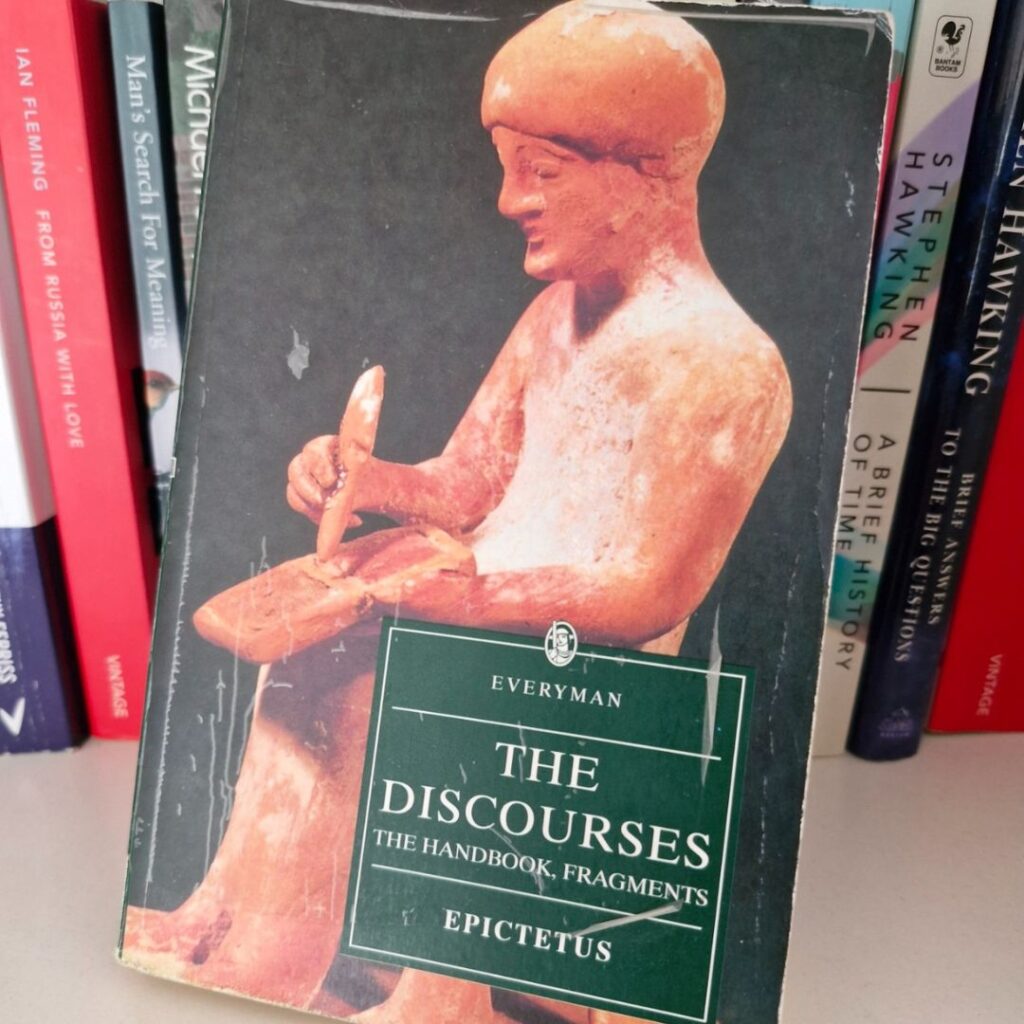
Epictetus himself wrote nothing. What survives comes from his student Arrian of Nicomedia, who recorded eight books of Discourses (four survive) and compiled a concise version known as the Enchiridion or Handbook.
The surviving Discourses capture the lively dialogues that took place in his school. His method was direct and Socratic: challenging assumptions until reason became clear. The Handbook distils his essential teachings into a form that can be carried and returned to daily. Explore the full chapter-by-chapter commentary in the Discourses hub, starting with Book 1.
Arrian’s Handbook begins with Epictetus’s most famous teaching, the Dichotomy of Control:
"Some things are up to us, and others are not."
Epictetus, Handbook, 1
This simple distinction defines Stoic practice: to focus on what lies within our power, our judgments, choices, and actions, and to accept all else with calm understanding.
The Life of a Stoic
Epictetus lived simply, almost ascetically. Ancient sources say he could leave his door open because he owned nothing worth stealing. Near the end of his life, he adopted a boy and took in a woman to help raise him, an act reflecting the belief, shared with his teacher Musonius Rufus, that family is the foundation of civilisation. The story comes down to us through the sixth-century commentator Simplicius, writing centuries after Epictetus died, so it survives through later hands rather than his own; the same caution is worth applying here as with the leg story above.
He also returned Stoicism to its more orthodox roots, closer to Zeno and the Cynics. His example reminded students that philosophy was not theory but a way of life, practised through askēsis, the disciplined training that turns philosophy into daily practice, alongside humility and duty.
Influence on Marcus Aurelius
Arrian, the faithful recorder of Epictetus’s words, later became a prominent Roman official and general in Cappadocia. Through him and through Junius Rusticus, the teachings of Epictetus reached Marcus Aurelius, who thanks his teacher Rusticus in his Meditations:
"And for introducing me to Epictetus's lectures, and loaning me his own copy."
Marcus Aurelius, Meditations, 1.7
Though they never met (Marcus was still a teenager when Epictetus died), their connection shows the reach of a philosophy passed through people rather than institutions. A former slave inspiring the emperor of Rome.
The Teachings of Epictetus

Epictetus taught that freedom rests on prohairesis, the faculty of moral choice within us that judges, decides, and acts. Whatever happens to the body, prohairesis itself cannot be touched by circumstance. He taught that virtue and reason are the only things truly ours. His Discourses and Handbook outline some of the most practical Stoic ideas, principles that form the foundation of the Three Disciplines of Stoicism.
- The Discipline of Desire (What to Seek or Avoid): learning to desire only what is truly good, meaning moral choice and virtue, which lie within us. External things such as health, wealth, or reputation are preferred indifferents. We may value them, but they are not necessary for a good life. This is the essence of the Dichotomy of Control, perhaps Epictetus’s most famous teaching.
- The Discipline of Assent (How to Think Clearly): examining our impressions, phantasia, before giving them our approval, synkatathesis, aligning our thoughts with nature and reason. This helps us distinguish appearance from reality and act only on sound judgment.
- The Discipline of Action (How to Live Well): acting with integrity, justice, and purpose. Doing what is right rather than what is convenient, and fulfilling our duties toward others and the community of humankind.
Epictetus also taught the role of reason in aligning our minds with nature and logic, the purpose of philosophy as living well rather than arguing finely, and the Divine Order (Logos) as a rational universe of which we are each a part.
For him, philosophy was not theoretical but deeply practical, a way of life to be lived, tested, and refined every day. He often referred to God or the gods, but in the Stoic sense: not as deities apart from us, but as the rational structure of the cosmos itself.
"Remember that you are an actor in a play, which is as the author wants it to be: short, if he wants it to be short; long, if he wants it to be long. If he wants you to act a poor man, a cripple, a public official, or a private person, see that you act it with skill."
Epictetus, Handbook, 17
You can explore his most powerful ideas in the Epictetus quotes collection and in this selection of 10 Epictetus quotes on control.
Why Epictetus Still Matters

There is something about Epictetus that none of the other Stoics quite match. Seneca wrote from wealth and political influence. Marcus Aurelius wrote from the throne of the most powerful empire in the world. Epictetus spoke from nothing, because he had no writing materials worth mentioning and no status worth protecting. What he had was a complete grasp of what actually belonged to him. And that, he argued, was enough.
We live in a time that encourages the opposite conclusion. We are surrounded by the idea that we are defined by what happens to us: the circumstances we were born into, the behaviour of other people, the systems we are embedded in. All of that is real. But Epictetus noticed something that sits alongside it: that how we meet those circumstances is still ours. Not as a comforting thought, but as a responsibility. The question he kept returning to was not what has been done to you, but what are you doing with your judgment right now.
That question lands differently today than it might have in a philosophy classroom. Most of us are not in slavery. But many of us have handed over our inner freedom voluntarily, to distraction, to the need for approval, to the habit of waiting for external conditions to improve before we take our lives seriously. Epictetus would have found that more troubling than chains. His Discourses are not gentle on this point. They ask us to stop performing philosophy and start doing it, at every moment, in every situation we find ourselves in.
Frequently Asked Questions
Who was Epictetus?
A former slave who became one of the most influential Stoic teachers of the Roman era, 55 to 135 AD. He founded a school in Nicopolis, Greece, where he taught Stoicism for the rest of his life. His student Arrian recorded his teachings in the Discourses and the Handbook.
What is Epictetus known for?
Above all, for the Dichotomy of Control, the principle that some things are up to us and others are not. He taught that our judgments, choices, and responses are the only things truly within our power, and that a good life depends on attending to those rather than to external circumstances. He is also known for having lived his philosophy under genuinely difficult conditions, which gives his words a weight that purely theoretical philosophy rarely carries.
What is the Enchiridion?
The Enchiridion, or Handbook, is a concise summary of Epictetus’s core teachings, compiled by his student Arrian. It distils the longer Discourses into a portable guide to Stoic practice, beginning with the Dichotomy of Control and covering how to handle desire, judgment, and relationships. It is one of the most direct and practical philosophical texts ever written, and a good place to begin.
Where did Epictetus live?
He was born in Hierapolis, in what is now Turkey. As a slave, he lived in Rome, where he was permitted to study and later teach Stoicism, until Domitian expelled all philosophers from the city in 89 AD. He then settled in Nicopolis, in what is now northwestern Greece, where he founded his school and lived for the rest of his life.
Why is Epictetus important today?
Because his core insight, that we cannot always choose what happens to us but we can always choose how we respond, remains one of the most honest and useful ideas in philosophy. He lived that idea under conditions most of us will never face, which makes it harder to dismiss.
Want to learn more?
Explore the full Discourses hub, or go deeper into Stoicism itself and the Stoic philosophy terms glossary. You can also listen to the Via Stoica Podcast on Spotify, Apple Podcasts, or YouTube.
Author Bio
Benny Voncken is the founder of Via Stoica and host of The Via Stoica Podcast. He has practiced Stoicism as a way of life for over seven years and draws on almost 15 years of teaching experience to turn dense ancient ideas into daily practice. Since 2023 he has coached clients around the world through one-on-one Stoic coaching. He also leads Stoic walks across Europe, writes the monthly newsletter The Pause, and has spoken at Stoicon.


Comments 0