
Epictetus Discourses Book 1: A Complete Commentary
Epictetus wrote nothing. What we have are the notes of his student Arrian, who recorded the teaching sessions at Epictetus’s school in Nicopolis in the early second century. These were not formal lectures. They were live exchanges: questions, challenges, and direct corrections delivered to students who were attempting to live Stoic philosophy rather than merely study it.
Of the original eight books, only four survived. The first book, which this commentary covers in full, establishes the philosophical foundations that everything else builds on. If you read one book of the Discourses, read this one.
I have written a commentary on every chapter of Book 1. Each one covers the philosophical argument, the Stoic vocabulary Epictetus uses, the connection to modern psychology, and a specific exercise drawn from that chapter’s teaching. This is not a paraphrase. It is a working through of what Epictetus is actually saying and why it still demands something from you.
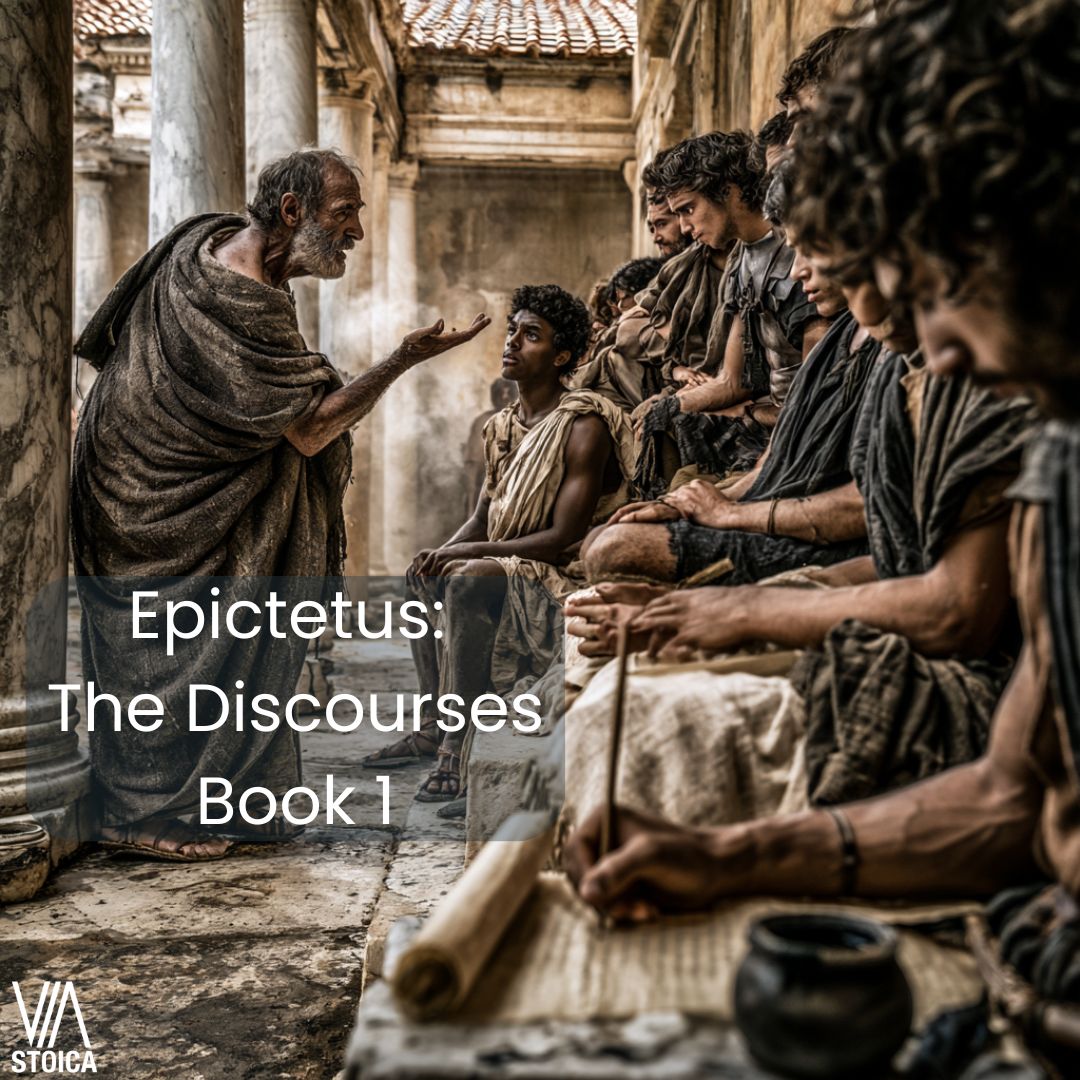
How the Discourses Survived
Originally, there would have been eight books, but only four survived. We know Marcus Aurelius read some of the missing books. His teacher Rusticus gave him a copy of Arrian’s notes. Marcus returned to these texts throughout the Meditations. That alone tells you how seriously the Discourses were taken, even by someone who had spent years studying Stoicism.
"If you want anything good, get it from yourself."
Epictetus, The Discourses, Book 1, Chapter 29.4
The question Epictetus returns to throughout Book 1 is not what Stoicism teaches in theory. It is whether you are actually living it. The Discourses are not comfortable texts. They are designed to expose the gap between what you claim to believe and how you are actually behaving. A key note throughout is that fluency in Stoic ideas without practice is worse than useless. It produces the kind of person who can lecture on virtue while being entirely ruled by fear, ambition, and opinion.
Epictetus Discourses Book 1: All 30 Chapters
Each commentary covers the philosophical argument of the chapter. It includes the key Stoic concepts in use and the modern psychological parallel. It concludes with a specific exercise drawn from that chapter’s teaching.
- Epictetus Discourses 1.1: What Is in Our Power: The fundamental distinction between what belongs to us and what does not. Epictetus argues that everything depends on getting this right first.
- Epictetus Discourses 1.2: How to Keep Your Character: How to act consistently with who you are across every role you play, even when circumstances press you to compromise.
- Epictetus Discourses 1.3: What Is the Stoic God: The Stoic God is not a separate being but the rational principle that is nature itself. What this means for how you see yourself and how you treat others.
- Epictetus Discourses 1.4: How to Make Progress Like a Stoic: What real progress in philosophy looks like, and why someone who reads Stoic texts fluently is not necessarily making any.
- Epictetus Discourses 1.5: How to Save the Soul: Epictetus takes on philosophical skepticism and argues that some things must be accepted as self-evident, or all reasoning collapses.
- Epictetus Discourses 1.6: How to View the World: Why the structure of the world as it is, including hardship, is evidence of providential design rather than indifference or chaos.
- Epictetus Discourses 1.7: How to Find the Truth: Why the Stoic must study logic carefully, and what happens when clever argument is used to obscure rather than clarify.
- Epictetus Discourses 1.8: The Danger of Uneducated Reasoning: Philosophical training without character development is dangerous. An untrained mind can use reason to rationalize anything.
- Epictetus Discourses 1.9: What is Stoic Cosmopolitanism?: If we share in the divine Logos, what follows for how we live? Epictetus pushes this kinship toward its uncomfortable practical conclusions.
- Epictetus Discourses 1.10: How to Spend Our Time: A direct challenge to those who pursue status and influence at the cost of their philosophical commitments.
- Epictetus Discourses 1.11: What Does it Mean to Love Well?: How natural affection fits within Stoic philosophy, and what to do when love and the discipline of desire appear to conflict.
- Epictetus Discourses 1.12: How to Be Content Like a Stoic: Contentment is not passive resignation. Epictetus shows how it is an active alignment with what is within your power.
- Epictetus Discourses 1.13: How to Treat Others Like a Stoic: What it means to live according to nature in everyday relationships and the responsibilities you carry.
- Epictetus Discourses 1.14: How Is It All Connected?: The Stoic view of divine providence is not a comfort. It is a demand. If everything is seen, how are you living?
- Epictetus Discourses 1.15: What Does Philosophy Promise?: Philosophy does not promise wealth or reputation. It promises peace of mind, and only by ceasing to ask for anything else.
- Epictetus Discourses 1.16: Why You Should Be Grateful: How we respond to what we are given: the body we inhabit, the circumstances we face, the role we are assigned.
- Epictetus Discourses 1.17: Why Stoic Logic Comes First: Logic is not abstract decoration. It is the tool by which we test whether our reasoning is sound and our judgments reliable.
- Epictetus Discourses 1.18: Why We Should Not Be Angry With Others: No one does wrong willingly. Epictetus returns to the Socratic principle and draws out its practical consequences for how you respond to others.
- Epictetus Discourses 1.19: How to Achieve Stoic Freedom: What the Stoic can and cannot be deprived of, and why a tyrant’s power ends exactly where your freedom begins.
- Epictetus Discourses 1.20: How Reason Contemplates Itself: A short but demanding discourse on the reflexive capacity of reason, and what it means to use reason to examine reason.
- Epictetus Discourses 1.21: On Seeking Admiration: The desire to be admired is one of the most corrosive attachments. It hands the keys of your inner life to other people.
- Epictetus Discourses 1.22: How Do We Know What is Good or Bad?: We all arrive with preconceptions about what is good, bad, and indifferent. The philosophical task is to examine whether those preconceptions hold up.
- Epictetus Discourses 1.23: Against Epicurus: Epictetus argues that the Epicurean position on the social nature of human beings is self-contradictory and practically untenable.
- Epictetus Discourses 1.24: How to Face Difficulties: Difficulties are not obstacles to the philosophical life. They are the material it works with.
- Epictetus Discourses 1.25: What We Should Worry About: A continuation of the previous discourse, pressing further into what it means to take difficulties as training rather than as punishment.
- Epictetus Discourses 1.26: What Is the Law of Life?: The law of life, as Epictetus understands it, is not a set of rules but a disposition: to hold everything external as neither good nor bad.
- Epictetus Discourses 1.27: The Four Types of Stoic Impressions: How impressions arise, why they mislead us, and what tools Epictetus recommends keeping at hand.
- Epictetus Discourses 1.28: Why We Should Never Be Angry With Others: A full treatment of why anger toward others rests on a philosophical error, and what replaces it.
- Epictetus Discourses 1.29: Where to Find the Good Life: What it means to hold your ground not through force of will but through clarity about what is and is not your own.
- Epictetus Discourses 1.30: How to Enter the World: A practical discourse on preparation: what the Stoic should have ready before facing the hardest moments.
The 30 Stoic Exercises
Each chapter commentary ends with a named exercise drawn directly from Epictetus’s teaching. The exercises range from a 5-minute morning practice in Phase 1 to a 30-minute integration exercise in Phase 4. They can be worked through in sequence as a complete 30-week programme or used individually when a specific situation calls for a specific practice. See all 30 in one place: 30 Stoic Exercises from Epictetus Discourses Book 1.
Related Reading
If you are new to Epictetus, the Epictetus biography covers his life, his time as a slave under Epaphroditus, and the school he founded in Nicopolis. The Enchiridion is Arrian’s companion handbook, which condenses the core teachings into a shorter and more portable form. Browse the curated Epictetus quotes collection for more passages drawn from across the Discourses and the Enchiridion.
Work With Benny on Stoic Practice
Reading the Discourses is the beginning, not the end. If you want to work through the teaching of Epictetus and apply it to life, I offer one-on-one Stoic coaching. Start with a free consultation. Or listen to The Via Stoica Podcast on Spotify, Apple Podcasts, or YouTube.
About the Author
Benny Voncken is the founder of Via Stoica and host of The Via Stoica Podcast. He has practiced Stoicism as a way of life for over seven years and draws on almost 15 years of teaching experience to turn dense ancient ideas into daily practice. Since 2023 he has coached clients around the world through one-on-one Stoic coaching. He also leads Stoic walks across Europe, writes the monthly newsletter The Pause, and has spoken at Stoicon.