
What Is Askesis? Stoic Training for Mind and Character
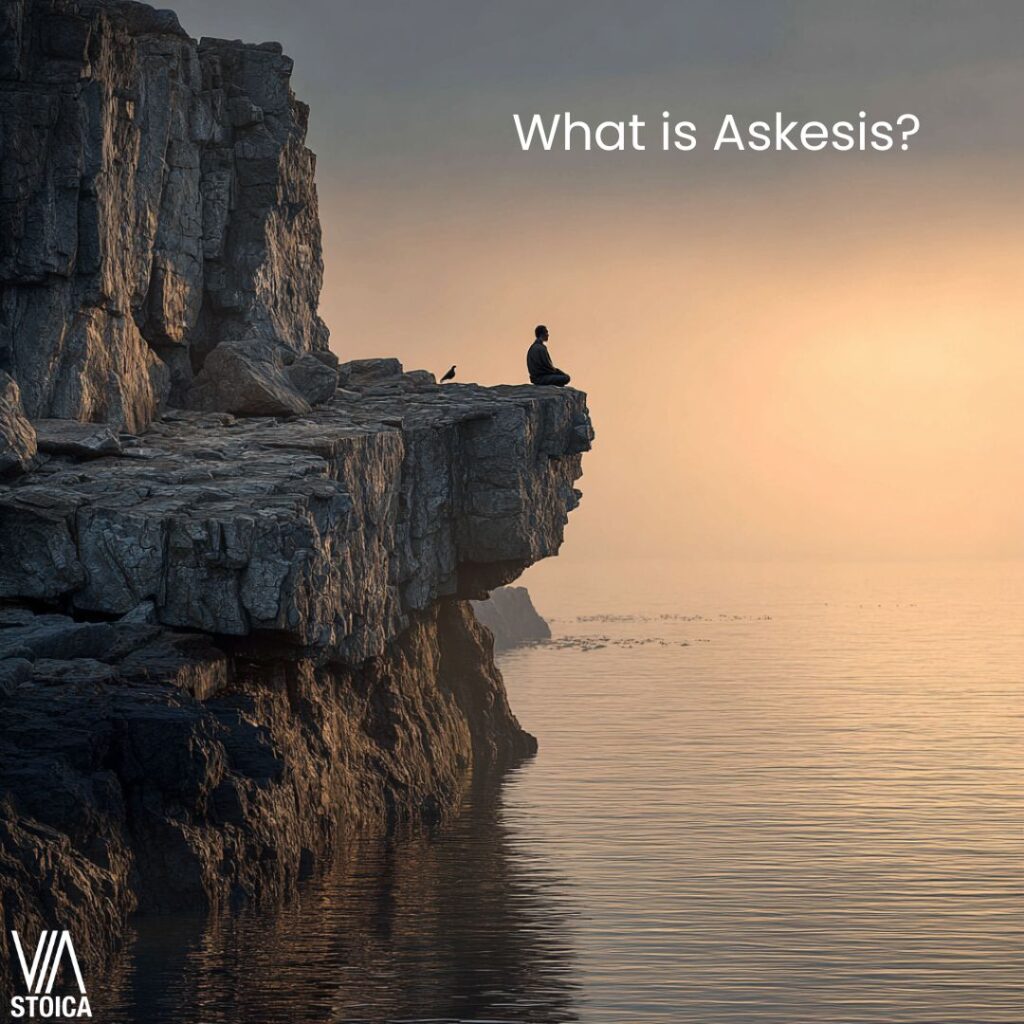
Term: Askēsis (ἄσκησις) | Translation: Practice / training | Language: Greek | Category: Progress & Development
Askēsis (ἄσκησις) in Stoicism is the deliberate, repeated practice of training the mind and character in service of virtue. It is the bridge between knowing what Stoicism teaches and actually living it: the daily discipline through which abstract philosophy becomes embodied habit. Where knowledge tells you what to do, askēsis is what builds the capacity to do it when it counts.
Breaking Down the Word
The etymology of askēsis carries the whole Stoic argument for why philosophy must be practised rather than merely studied.
- Greek: ἄσκησις
- Root: from the verb askeō, meaning “to exercise,” “to train,” or “to practise”
- Literal meaning: physical or mental training
- Philosophical meaning: continuous, deliberate exercise in moral and rational development, through which correct judgment becomes habit
In early Greek thought the word described athletic training. The Stoics extended it to the domain of character, and the athletic analogy remained central: just as an athlete does not become capable through watching sport or reading about it, the Stoic does not become virtuous through philosophy alone.
What Askēsis Actually Means
Askēsis is the active dimension of Stoic philosophy, the part that turns doctrine into character. Chrysippus, who systematised Stoic ethics, held that the soul’s dispositions form through repeated patterns of assent: every time you respond to an impression in a certain way, you reinforce the habit of responding that way again. Askēsis is the deliberate application of this insight, training those patterns rather than leaving them to chance.
The most common misreading is to confuse Stoic askēsis with asceticism, a life of denial or mortification. Stoic training is purposive, not punitive. Musonius Rufus, whose Lecture 6 is the most direct ancient treatment of askēsis, was clear that the goal is strengthening, not suppression. Voluntary discomfort, fasting, and physical endurance are not ends in themselves; they are the conditions under which the mind learns that it can hold its ground when circumstances are unfavourable.
"We will train both soul and body when we accustom ourselves to cold, heat, thirst, hunger, scarcity of food, hardness of bed, abstaining from pleasures, and enduring pains."
Musonius Rufus, Lectures and Sayings, Lecture 6
Askēsis operates across three reinforcing dimensions. The first is impression training: the repeated practice of pausing before assenting to an impression, catching the automatic response before it becomes action. Its second dimension is voluntary discomfort: deliberate exposure to conditions the mind habitually avoids, building the understanding that comfort and discomfort are indifferent, neither good nor bad in themselves. Habit consolidation is the third: the gradual encoding of virtue through consistent small acts, so that courage, temperance, and justice become the default rather than the effortful choice.
Askēsis and Prokopē: What Is the Difference?
Both terms are closely connected but describe different things. Askēsis is the practice: the deliberate training of mind and character through repeated effort. Prokopē is the measure of that practice: the progress that accumulates as a result of sustained askēsis. You cannot have prokopē without askēsis, and askēsis without prokopē is mere repetition without direction.
The Stoics were explicit that the standard is progress, not perfection. The prokoptōn, the person making progress, is the realistic model for Stoic practice: someone who trains consistently, falls short, examines why, and trains again. Epictetus makes this precise in Discourses 1.4: the measure of philosophical progress is not how many texts you have read but how you actually live. Askēsis is what produces the life Epictetus is pointing at.
Askēsis and Core Stoic Principles
It is the mechanism through which Stoic doctrine becomes Stoic character, connecting directly to each of the three disciplines Epictetus identified as the structure of practice.
The discipline of assent is where askēsis begins: training the habit of examining impressions before accepting them, so that false value judgments lose their grip. Virtue (ἀρετή) is both the aim and the content of training, because for the Stoics askēsis has no purpose outside its contribution to living well. Reason (λόγος) is the standard that governs the training: not every practice counts as askēsis, only those oriented by correct understanding of what is genuinely good. And living according to nature (φύσις) is the orientation: training teaches you to act from your rational nature rather than from impulse, habit, or the uncritical adoption of social convention.
How to Practice Askēsis
Askēsis is built through specific, repeatable practices applied to ordinary conditions. The Stoics were clear on this: training requires both mental exercises and physical ones, and the physical ones work because they give the mind real conditions to respond to rather than hypothetical ones.
Morning and evening review
Begin each day by setting an intention: what virtue does today require of you, and what are the conditions most likely to test it? Close each day with a review: where did you act in accordance with that intention, where did you fall short, and what was the difference between those moments? Seneca describes this practice in his letters to Lucilius as the mechanism by which the soul examines and corrects itself. The practice is simple; the consistency is the training.
Voluntary discomfort
Periodically forgo something you habitually reach for: a meal, a comfort, a convenience. The purpose is to rehearse the judgment that comfort is not a necessity, that the absence of it does not threaten anything genuinely good. Musonius Rufus was explicit that this kind of training serves both body and soul: the body learns it can endure, and the mind learns it does not need to fear the conditions it has been avoiding.
Impression training
When a strong reaction arises, pause before acting on it. Name the impression: what did you take this situation to mean? Ask whether that meaning was in the event itself or something you added. This is the core of the discipline of assent as a training practice, applied not just once but as a consistent habit across every day. Epictetus considered this the foundational exercise: without it, every other Stoic practice lacks its grounding.
Premeditatio malorum
One of the most distinctly Stoic forms of askēsis, premeditatio malorum is the premeditation of adversity: rehearsing in imagination what could go wrong, before it does, so that the mind’s response is prepared in advance. Marcus Aurelius used this throughout the Meditations: beginning the day with an expectation of difficulty, so that when difficulty arrived, it did not find him unprepared. The training is in the rehearsal, not the outcome.
Stoic Exercise
The One-Degree Shift
Rooted in askēsis: character is not changed through grand gestures but through the accumulation of small, repeated choices that gradually realign habit with intention.
Choose one situation that recurs in your daily life where your habitual response falls short of how you want to act. It might be how you respond to a particular kind of interruption, how you handle a recurring frustration, or the ease with which you reach for a specific comfort. Name it plainly. Then identify one concrete shift, not a wholesale change in character but a single degree of movement. The pause before the reaction, the sentence left unsaid, the moment of choosing differently in the place where you usually do not. Practise that one shift, in that one situation, for one week. Do not aim for a different person at the end of it. Aim for evidence that the shift is possible. That evidence is the training, and the training is what askēsis means.
Ready to go deeper? Discourses 1.4 takes this practice into its full form.
"Show me that it is not the things that disturb men, but their judgments about things. Prove it by practice."
Epictetus, Discourses, Book 2, Chapter 18
Why Askēsis Is Central to Stoic Practice
Askēsis is what makes Stoicism a philosophy rather than a theory. Epictetus returned to this throughout the Discourses because it is structural: without training, every other Stoic insight remains inert. You can understand the dichotomy of control perfectly and still be carried away by the first difficult impression of the day. Musonius Rufus puts the logic directly in Lecture 6: the soul is strengthened by enduring hardships and trained for self-control by abstaining from pleasures, just as the body is strengthened through exercise. Knowledge without askēsis produces, at best, a person who knows what they should do and consistently fails to do it.
Askēsis closes that gap, gradually and without drama, through the accumulation of right choices in ordinary moments. John Sellars, in The Art of Living, describes Stoic philosophy as a set of spiritual exercises rather than a theoretical system. Askēsis is the word the Stoics used for that: the lived practice through which eudaimonia becomes not an ideal but a condition.
"First say to yourself what you would be, and then do what you have to do."
Epictetus, Discourses, Book 3, Chapter 23
Frequently Asked Questions
What does askēsis mean in Stoicism?
Askēsis in Stoicism is the deliberate practice of training the mind and character toward virtue. It is what bridges the gap between knowing Stoic philosophy and living it: the repeated, purposive effort through which correct judgment becomes habit and habit becomes character. Without askēsis, Stoic philosophy remains theory. With it, it becomes a way of life.
Is askēsis the same as asceticism?
They share a root but describe different things. Asceticism in the religious sense involves denial or mortification as ends in themselves. Stoic askēsis is purposive: voluntary discomfort, fasting, and physical endurance are training tools, not moral acts in themselves. The goal is to build the mind’s freedom from dependency on comfortable conditions, not to reject comfort as sinful. The distinction is clear in Musonius Rufus, who insisted that training serves strength, not suffering.
How did Epictetus describe askēsis?
Epictetus consistently defined philosophical progress in terms of how you live rather than how much you know. In Discourses 1.4, he states that the measure of progress is not texts read but life lived. In Discourses 2.18, he calls on students to prove their understanding through practice, not argument. For Epictetus, askēsis was not a supplement to philosophy; it was what philosophy was for. You can also explore this further in the Stoic philosophy terms glossary.
How does askēsis relate to prokopē?
Prokopē is the Stoic term for moral progress: the gradual movement toward virtue that the Stoics recognised as real and meaningful even short of the sage’s perfection. Askēsis is what produces prokopē. Without sustained practice, progress has no mechanism. Without a measure of progress, practice has no direction. The two are inseparable, and both are addressed directly in Stoic coaching as the framework through which real change happens.
Can askēsis be practised without discomfort?
Yes. The most important forms of askēsis, impression training, the evening review, and premeditatio malorum, involve no physical discomfort at all. They train the mind’s relationship to impressions, judgments, and expectations. Physical training is one strand of askēsis, not the whole of it. Musonius Rufus emphasised both mental and physical exercise, but the Stoics were clear that mental training is primary, because it is the mind that applies whatever the body endures.
Want to Learn More?
If this resonated and you are ready to start building your own philosophy of life, a conversation with Benny as your Stoic coach can be a good place to begin. Not to be told what to think, but to have the space to figure it out. You can also sign up for the newsletter, The Pause, or watch or listen to the Via Stoica Podcast on YouTube, Spotify, or Apple Podcasts.
About the Author
Benny Voncken is the founder of Via Stoica and host of The Via Stoica Podcast. He has practiced Stoicism as a way of life for over seven years and draws on almost 15 years of teaching experience to turn dense ancient ideas into daily practice. Since 2023 he has coached clients around the world through one-on-one Stoic coaching. He also leads Stoic walks across Europe, writes the monthly newsletter The Pause, and has spoken at Stoicon.


Comments 0