
What Is Prokopē? The Stoic Bridge From the Ideal to Reality
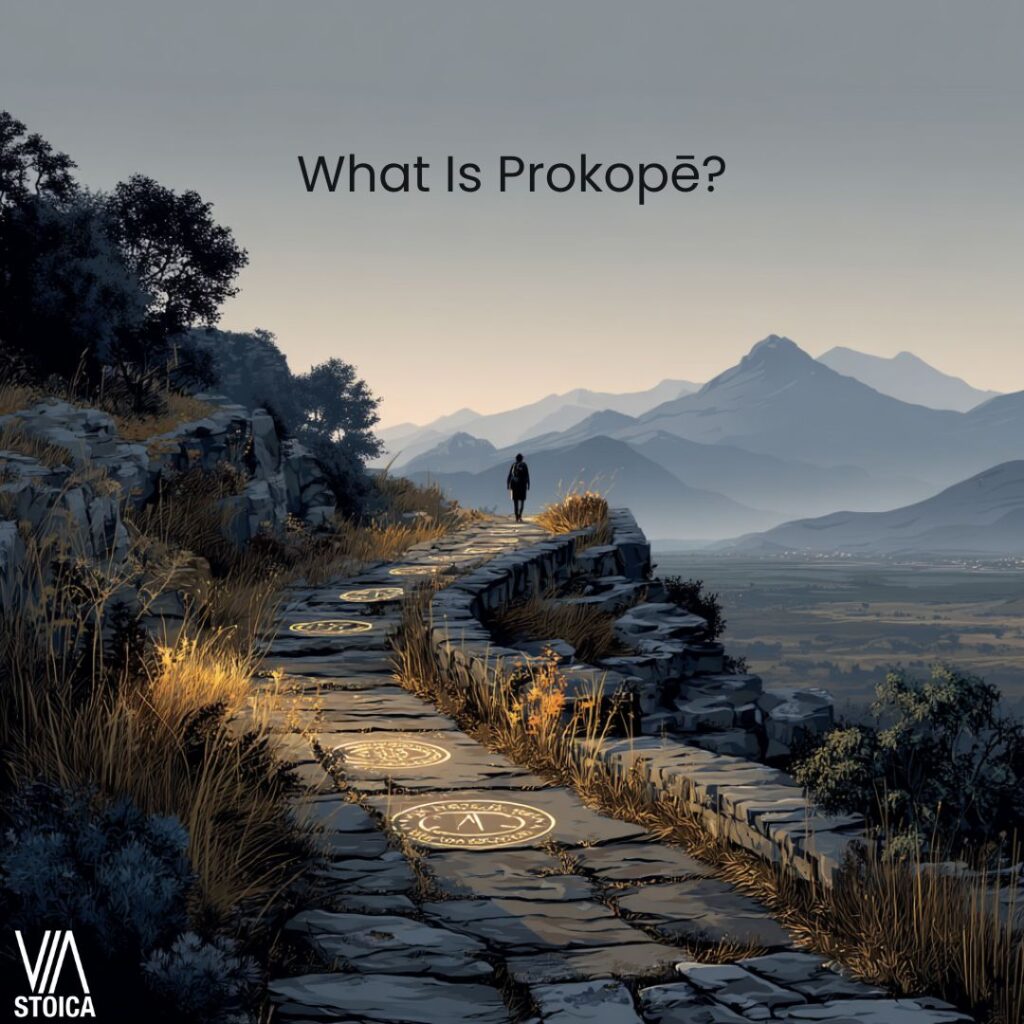
Term: Prokopē (προκοπή) | Translation: Ongoing progress toward wisdom and virtue, measured in evidence rather than intention | Language: Greek | Category: Progress & Development
Prokopē (προκοπή) in Stoicism is the steady advancement toward wisdom and virtue, the standard the Stoics actually asked people to live by. The ideal of the true sage is out of reach for most of us, but we can make sure that we are on the path toward one, and prokopē is how the Stoics measured that path. Not by wealth, status, or outward success, but by whether our judgment, desire, and action are quietly getting closer to reason.
Breaking Down the Word
The Greek root of prokopē points forward, and that direction is the entire point of the concept.
- Greek: προκοπή
- Root: from prokoptō (προκόπτω), to advance or to make headway
- Literal meaning: moving forward, making progress
- Philosophical meaning: advancement toward wisdom and living according to nature, measured in daily conduct rather than abstract achievement
This idea of advancement is key because the Stoic sage was close to a theoretical ideal, someone almost impossible to actually meet. Prokopē gave everyone else something achievable. Progress, not perfection, became the daily standard, and someone actively pursuing it earned a name of their own: the prokoptōn, the one advancing.
What Prokopē Actually Means
Prokopē is easy to confuse with modern self-improvement, and untangling that confusion is worth doing directly. Self-improvement usually points outward: a new skill, a career milestone, a fitness target. Prokopē points inward, at the judgments, desires, and actions that shape character. Stoic progress cannot be measured in numbers on a dashboard. It shows up in the steadiness of how someone actually meets a difficult day, which is a much harder thing to fake.
"For whatever is the definitive end to which the perfection of a thing leads, progress is always an approach towards it."
Epictetus, The Discourses, Book 1, Chapter 4.4
Epictetus was blunt about the difference between talking about progress and actually making it. He pressed his students who could quote philosophical treatises but had never tested those ideas against their own desires, impulses, or assent. Reciting a text is not evidence of anything. What you actually want, what you actually do, and what you actually believe are the only honest measurements available.
"If you are acting in harmony with nature, give me evidence of that, and I will say that you are making progress."
Epictetus, The Discourses, Book 1, Chapter 4.14
Prokopē and Eudaimonia: What Is the Difference?
The terms prokopē and eudaimonia describe the same journey from two different vantage points. Eudaimonia is the destination, the flourishing life that comes from living fully in accordance with virtue. Prokopē is the road itself, the actual movement of someone who has not arrived but is genuinely closer than they were. Nobody experiences eudaimonia as a finished state they simply possess. What people experience, if they are doing the work at all, is prokopē: incremental, uneven, and real.
This is part of what makes Stoicism livable rather than merely aspirational. If eudaimonia were the only unit of measurement, almost everyone would fail by definition. Prokopē gives the philosophy a scale that ordinary effort can actually register on.
Prokopē and Core Stoic Principles
Progress means moving closer to virtue (ἀρετή), the only thing the Stoics considered genuinely good. Each real step of prokopē involves clearer reasoning (λόγος) and more accurate choices, aligning daily conduct more closely with the order of nature (φύσις). Complete wisdom (σοφία) belongs only to the sage, but every honest act of self-examination narrows the gap.
Epictetus was specific about where evidence of progress actually appears. Not in what someone can recite. It shows up in three concrete places: how they manage desire and aversion, how they exercise the impulse to act, and how carefully they give or withhold assent. These three map directly onto the three Stoic disciplines, and each is checkable in a way that good intentions are not.
"Prokopē means making progress toward wisdom and virtue, not reaching it. For the Stoics, the journey itself was where the work happened. Seek it in that place, wretch, where your task lies. And where does your task lie? In desire and aversion, that you may neither fail to attain what you desire, nor fall into what you want to avoid; in exerting your impulse to act and not to act, that you may not be liable to error; in assent and the withholding of assent, that you may not be liable to be deceived."
Epictetus, The Discourses, Book 1, Chapter 4.10–11
How to Practice with Prokopē
Prokopē is not something you check in a single moment. It only becomes visible when you compare across time, which means the practices here work at a longer horizon than most Stoic exercises.
Compare your present self to your past self
Measure growth against who you were a month or a year ago, never against someone else. Progress is personal by nature, and comparison with other people tells you nothing true about your own movement toward virtue.
Treat frustration as material, not failure
When anger or frustration arises, treat the moment as an opportunity to practise self-control rather than evidence that the work has failed. In Stoic coaching, the clients who progress fastest stop expecting the difficult moments to disappear. They start using them as the actual training ground instead.
Stoic Exercise
The Evidence of Progress
Rooted in prokopē: Epictetus asked for evidence, not intention. Progress only counts where it can actually be checked.
Once a week, review the three places Epictetus said progress actually shows itself.
Desire and aversion: what have you actually wanted or avoided this week? Impulse to act: what have you actually done, not planned to do? Assent: what have you accepted as true without checking it first?
Compare each answer to a month ago. Look for a real shift, not a hoped-for one. Where you find it, that is your evidence. Where you do not, that is simply where the work continues.
Ready to go deeper? Discourses 1.4, Epictetus’s own chapter on progress, takes this practice into its full form.
Why Prokopē Is Central to Stoic Practice
Prokopē is what keeps Stoicism from collapsing into an abstract ideal nobody can reach. Epictetus devoted an entire discourse to the subject. He treated daily progress as the actual task of philosophy, not a preliminary stage before the real work began. Seneca told Lucilius the same thing in letter after letter: philosophy is not grand theory, it is daily improvement, tracked honestly. Marcus Aurelius wrote the Meditations not as a finished book of wisdom but as a running record of his own attempt at it. Without prokopē, Stoicism stays a theory. With it, philosophy becomes something a person actually lives inside.
Frequently Asked Questions
What does prokopē mean in Stoicism?
Prokopē means progress: the ongoing, daily advancement toward virtue and wisdom. It gave the Stoics a livable standard for almost everyone, since almost nobody is a sage. Progress was measured in desire, action, and belief rather than in outward achievement.
Is prokopē the same as self-improvement?
Not really. Self-improvement usually targets external skills or measurable goals. Prokopē is strictly inward, tracking moral and philosophical growth in judgment, desire, and action rather than in career milestones or fitness targets.
How is prokopē different from eudaimonia?
Eudaimonia is the destination, the flourishing life lived fully according to virtue. Prokopē is the road toward it, the incremental movement most people actually experience. Nearly everyone practising Stoicism lives inside prokopē rather than eudaimonia.
Can anyone develop prokopē?
Yes. Becoming a sage may be rare to the point of being theoretical. Daily progress in thought and action, though, is available to anyone willing to check their own desires, impulses, and beliefs honestly.
How do the Stoics measure progress?
Epictetus named three checkable places: desire and aversion, the impulse to act, and assent. Progress in any of these three shows up as evidence, not as a feeling of having grown. The Stoics distrusted self-reported improvement that had never been tested against actual conduct.
Want to Learn More?
If this resonated and you are ready to start building your own philosophy of life, a conversation with Benny as your Stoic coach can be a good place to begin. Not to be told what to think, but to have the space to figure it out. You can also sign up for the newsletter, The Pause, or watch or listen to the Via Stoica Podcast on YouTube, Spotify, or Apple Podcasts.
About the Author
Benny Voncken is the founder of Via Stoica and host of The Via Stoica Podcast. He has practiced Stoicism as a way of life for over seven years and draws on almost 15 years of teaching experience to turn dense ancient ideas into daily practice. Since 2023 he has coached clients around the world through one-on-one Stoic coaching. He also leads Stoic walks across Europe, writes the monthly newsletter The Pause, and has spoken at Stoicon.


Comments 0