
What Is Synkatathesis? The Stoic Act of Giving Assent
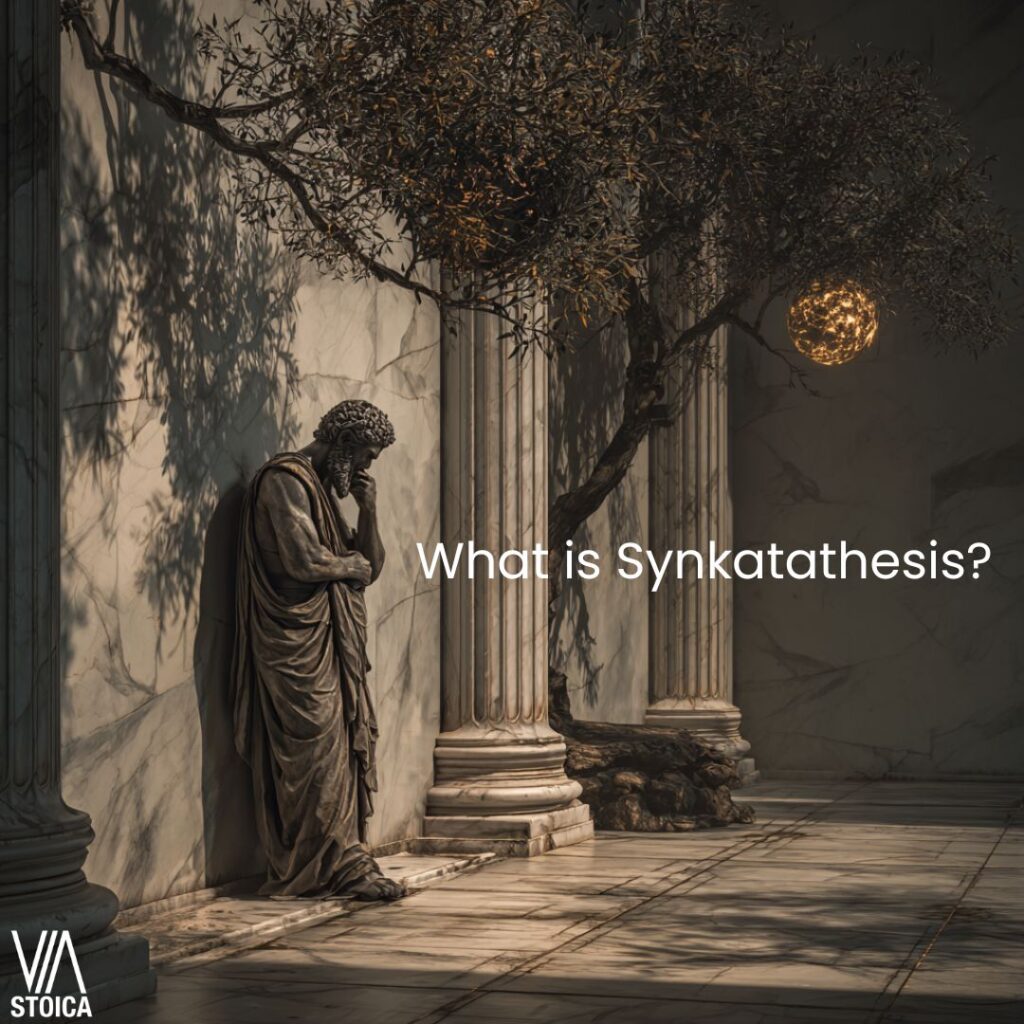
Term: Synkatathesis (συγκατάθεσις) | Translation: The voluntary act of accepting an impression as true | Language: Greek | Category: Decision & Action
Synkatathesis (συγκατάθεσις) in Stoicism is the moment of choice that decides whether an impression becomes a belief: the inner nod you give, or withhold, to whatever appears before your mind. Every belief you hold, every emotion you feel, and every action you take begins here. If self-mastery has a single hinge point, this is it.
Breaking Down the Word
The Greek construction of synkatathesis describes what the act actually involves: a placing together, not a passive reception.
- Greek: συγκατάθεσις
- Root: from syn- (with, together) and katathesis (κατάθεσις, placing down, depositing)
- Literal meaning: placing something down together, agreeing to
- Philosophical meaning: the voluntary act of endorsing a mental impression as true, the point where the will joins itself to a thought
Not every impression deserves this endorsement. The Stoics held that only impressions which are accurate, rational, and aligned with nature and virtue merit assent. Withholding synkatathesis from a false or unclear impression is not indecision. It is the mind protecting itself.
What Synkatathesis Actually Means
Synkatathesis is easy to confuse with instinct or gut feeling, and this is the misunderstanding most worth clearing up. Instinct is automatic and unexamined. Synkatathesis is deliberate, the product of conscious judgment applied to something that has already arrived. It is also not the same as emotional validation. Emotions are real, but not every emotion rests on a true belief, and the Stoics never suggested suppressing them. They asked a harder question: is the belief underneath this feeling actually accurate?
The sequence is key to understanding this concept. Phantasia, the impression, arrives without your permission and is not yet a belief or a truth. Synkatathesis is what you choose to do with it. According to the Stoics, emotions are themselves judgments that have already received assent: fear, anger, and jealousy take hold only once you have believed something harmful or unjust has occurred. No assent, no emotion. This is also where freedom actually lives. Even inside a world governed by cause and effect, the capacity to assent, reject, or withhold assent remains fully yours.
"When any one, then, assents to what is false, be assured that he does not wilfully assent to it as false, but what is false appears to him to be true."
Epictetus, The Discourses, Book 1, Chapter 28.4
Withholding Assent: What Is Epoche?
The Stoics never taught that assent should always be given. Zeno, the founder of Stoicism, held that when an impression is unclear, the wise response is to withhold it entirely. This suspension is called epoche (ἐποχή): neither accepting nor rejecting the impression, but letting it pass without folding it into what you believe.
Modern life produces a constant stream of impressions demanding an instant verdict: headlines, messages, feelings that arrive fully formed. The instinct is to agree or disagree immediately. The wiser move is frequently to do neither. When you are unsure of someone’s motives, unsure whether a story is true, or unsure what actually caused an emotion, withholding assent is a mark of discipline rather than uncertainty. Epoche is not passivity. It gives reason the time it needs to finish its work.
"Freedom from precipitancy is a knowledge when to give or withhold the mind's assent to impressions."
Diogenes Laertius, Lives of Eminent Philosophers, Book 7.46
Synkatathesis and Core Stoic Principles
Assenting only to what is true and good is how virtue (ἀρετή) actually gets expressed. Without wise assent, virtuous action has nothing to stand on. Reason (λόγος) is synkatathesis in motion, the rational faculty doing the work of deciding what is worth believing and acting on. Wisdom (σοφία) is not the accumulation of knowledge but the perfected skill of assenting only to what genuinely aligns with truth and virtue. The sage is wise because they have mastered this single act, repeated correctly, thousands of times.
How to Practice with Synkatathesis
Training synkatathesis is not about examining every thought that crosses your mind. It is about catching the ones that carry real weight before you have already agreed with them.
Question before you believe
When something provokes you, a headline, a message, a sudden feeling, pause before treating it as fact. Ask directly: is this actually true, or does it simply feel true right now? The question alone is often enough to loosen an impression’s grip before it hardens into belief.
Trace the belief behind the emotion
When anger or fear rises, ask what belief the feeling depends on. In Stoic coaching, this question routinely reveals that the emotion is standing on a belief the person has never actually tested. Once the belief is visible, you can ask whether it holds up.
Stoic Exercise
Wait for Me a Little
Rooted in synkatathesis: the moment of choice sits between the impression and the belief. Nothing forces you to say yes the instant something arrives.
The next time an impression arrives with real force behind it, something you are about to treat as settled fact, say to it directly: impression, wait for me a little.
Then ask one question: would this still look true once the feeling behind it has passed? If the answer is yes, let the assent stand. If you are not sure, withhold it. Let the impression sit unresolved rather than rushing it into belief.
Ready to go deeper? Discourses 1.27 takes this practice into its full form.
Why Synkatathesis Is Central to Stoic Practice
Synkatathesis is not a side-topic within Stoicism. It is the mechanism through which rational agency actually operates, the single hinge that every other Stoic discipline swings on. Epictetus returned to this moment constantly, teaching his students to address the impression directly rather than be carried off by it. Marcus Aurelius practised the same discipline daily throughout the Meditations, checking his impressions before allowing them to settle. Seneca advised examining a thought before letting it shape a life. For all three, synkatathesis was the gatekeeper of the soul, and nobody, however wise, is exempt from needing one.
"Impression, wait for me a little. Let me see what you are and what you represent."
Epictetus, Discourses, Book 2, Chapter 18.24
Frequently Asked Questions
What does synkatathesis mean in Stoicism?
Synkatathesis in Stoicism is assent: the voluntary act of accepting a mental impression as true. It is the moment you say yes to a thought and allow it to shape your beliefs, emotions, and actions. Everything the Stoics taught about self-mastery ultimately points back to this single act.
Is synkatathesis the same as instinct?
No. Instinct is automatic and unexamined. Synkatathesis is deliberate and rational, requiring conscious judgment applied to an impression that has already arrived. The two happen in sequence, not as substitutes for each other.
What is the difference between synkatathesis and phantasia?
Phantasia is the impression itself, automatic and involuntary. Synkatathesis is the response to it, the voluntary decision to accept or reject that impression as true. The impression arrives on its own; the assent is always chosen.
What if I am not sure whether to assent?
Then withhold it. This is epoche, the suspension of judgment Zeno recommended whenever an impression is unclear. Withholding assent is not indecision. It is the discipline of letting reason finish its work before belief settles in.
Can anyone develop synkatathesis?
Yes. Every rational being has the capacity to assent, reject, or withhold assent. It is a skill sharpened through self-awareness and consistent practice, not a talent reserved for the philosophically gifted.
Want to Learn More?
If this resonated and you are ready to start building your own philosophy of life, a conversation with Benny as your Stoic coach can be a good place to begin. Not to be told what to think, but to have the space to figure it out. You can also sign up for the newsletter, The Pause, or watch or listen to the Via Stoica Podcast on YouTube, Spotify, or Apple Podcasts.
About the Author
Benny Voncken is the founder of Via Stoica and host of the Via Stoica Podcast. He has practiced Stoicism as a way of life for over six years, spoken at Stoicon, and led Stoic walks across Europe. Through Stoic coaching, he helps people use Stoic principles and practices to develop their own philosophy of life: one that gives them the tools to face obstacles, navigate change, and find more balance and peace. He writes, teaches, and walks wherever the philosophy takes him.



Comments 0