
Musonius Rufus: The Roman Socrates Who Shared a Stoicism for All
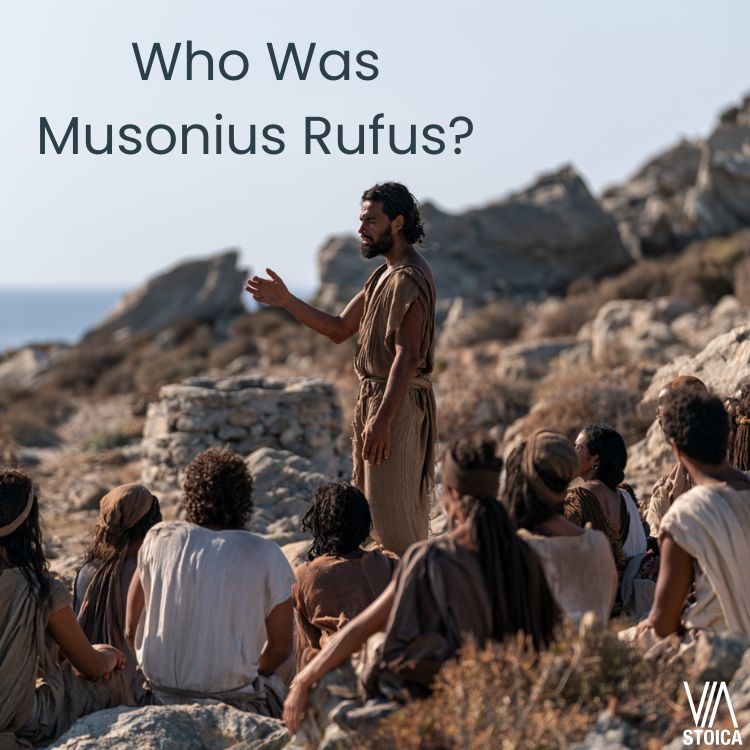
Philosopher: Gaius Musonius Rufus | Lived: c. 30 AD to before 101 or 102 AD | Born: Volsinii, Etruria (modern-day Bolsena, Italy) | Status: Born into a family of equestrian (knight) rank | School: Rome, with periods of exile including the island of Gyaros | Teacher: Unknown, no ancient source names one | Known For: The Roman Socrates who taught Stoicism as a way of life
Gaius Musonius Rufus (c. 30 to before 101 or 102 AD) was a Roman Stoic philosopher of equestrian rank, exiled three times under two emperors, and the teacher of Epictetus. Later writers called him the Roman Socrates. The comparison was earned less by what he wrote, since almost nothing survives in his own hand, and more by how he lived: teaching from a barren island in exile, arguing that women deserved the same philosophical education as men, and insisting that a philosopher’s proper trade was farming, not lecturing.
Who Was Musonius Rufus?
Gaius Musonius Rufus (c. 30 to before 101 or 102 AD) was born in Volsinii, a small Etruscan town now known as Bolsena, in modern-day Italy. His father, a Roman knight named Capito, gave him a start well above the ordinary citizen. It was still a rank below Rome’s senatorial elite. No source records exact dates for his birth and death. What we know of his death comes only indirectly. Pliny the Younger mentions Musonius’s son-in-law Artemidorus in a letter written in 101 or 102 AD, in a way that implies Musonius was no longer alive by then.
No ancient source names a teacher of his own. Unlike Epictetus, who names Musonius as his teacher, or Marcus Aurelius, who names Junius Rusticus, Musonius appears in the record already a mature philosopher, the same way Socrates does. It is one of several genuine blank spots in his biography, alongside the identity of his mother and his wife. Much of his early life, before he emerges as an established teacher in Rome, is missing too.
A Roman Knight in Nero’s Rome
A Roman knight, or eques, belonged to the second tier of Rome’s aristocracy, ranked just below the senatorial class. The order began centuries earlier as the citizens wealthy enough to serve as cavalry. By Musonius’s lifetime it had settled into a formal rank tied to property and birth. It was comfortable, respectable, and eligible for real influence, but a step below the senators who actually governed the state.
By the reign of Nero, Musonius had already built a reputation as a teacher in Rome. He moved in the same circles as the senators and equestrians who grew uneasy with the emperor’s rule. That association would define most of the rest of his public life.
Musonius the Teacher and the Years of Exile
Musonius was banished three times, under two different emperors.
First Exile: Following a Friend
Around 60 AD, Nero exiled the senator Rubellius Plautus. Musonius, Plautus’s friend, followed him into exile in Asia Minor. He returned to Rome after Plautus died in 62 AD, but his renewed teaching soon drew fresh suspicion at Nero’s court.
The Pisonian Conspiracy and Gyaros
In 65 AD, a wide coalition of senators, knights, and military officers plotted to assassinate Nero. Senator Gaius Calpurnius Piso led them. Someone betrayed the plot, known as the Pisonian conspiracy, before the conspirators could carry it out. Nero responded with a sweeping purge: he executed nineteen conspirators and exiled thirteen more.
Musonius had no part in the plot itself, but his ties to the senators involved were enough to condemn him. Cassius Dio confirms the connection directly: the conspiracy, he writes, led to the banishment of Musonius (Roman History, 62.27). Tacitus names him too, paired with the rhetorician Verginius Flavus:
"Verginius Flavus and Musonius Rufus were banished for their renown. Verginius encouraged the enthusiasms of the young with eloquence; Musonius with his philosophical teachings."
Tacitus, Annals, 15.71
Nero sent him to Gyaros, an island later writers describe as harsh and empty of any culture.
The same purge reached Seneca. Nero’s former tutor and chief advisor had withdrawn from court years earlier. He probably had no real hand in the conspiracy, but Nero suspected him anyway and ordered him to take his own life. Seneca died at his villa outside Rome. He opened his veins, then took poison when the bleeding slowed, then finally entered a warm bath. Set beside that, Musonius’s banishment to a remote island reads as lenient, the outcome of a purge that killed one of Rome’s most powerful men.
On Gyaros, ancient anecdotes claim Musonius kept teaching and discovered a well, a real benefit for local people on an island known for its dryness. The source is Philostratus, Life of Apollonius, 7.16, where he calls him “Musonius the Tyrrhenian.” We cannot confirm these stories as literal fact. But they show how his contemporaries remembered him: someone who treated exile as a change of scenery rather than a loss of anything that mattered.
Musonius Digging a Canal
Nero’s attempt to dig a canal across the Isthmus of Corinth put Musonius to forced labor in chains alongside other prisoners. Philostratus reports that the Cynic philosopher Demetrius found him there and offered his sympathy. Musonius kept digging and looked up only long enough to answer him:
"You are distressed, Demetrius, to see me digging through the Isthmus for Greece; but if you saw me playing the harp like Nero, what would you feel then?"
Musonius Rufus, as recorded by Philostratus, Life of Apollonius, Book 4 (exact chapter to confirm, commonly cited as 4.35)
As with the spring on Gyaros, this comes to us through Philostratus, writing more than a century later. It reaches us by way of Demetrius’s own account rather than a firsthand record. It carries more weight than the letters Philostratus records between Musonius and Apollonius, which most scholars doubt are genuine correspondence at all. This at least claims to be secondhand testimony from a named contemporary rather than invented documents. But it remains an anecdote, not a verified event.
Return, Civil War, and a Final Exile
Musonius returned to Rome under Galba in 68 AD. The following year, during the civil war between the forces of Vitellius and Vespasian, he joined a delegation of envoys. He went among armed soldiers to argue for peace over war. According to Tacitus, many laughed at him and more found him simply tiresome. A few were ready to knock him down, until warnings from the more disciplined soldiers made him abandon the attempt.
That same year, he successfully prosecuted the philosopher Publius Egnatius Celer for perjury. Celer had betrayed and helped condemn his own friend, the senator Barea Soranus.
Vespasian later banished all philosophers from Rome in 71 AD. Musonius alone kept his place, a real mark of the esteem in which people held him. Vespasian exiled him anyway around 75 AD, and Musonius returned only after Vespasian’s death in 79 AD.
Of the Roman Stoics of whom we can still learn, each occupies a distinct position:
- Seneca was a statesman and writer.
- Marcus Aurelius was an emperor.
- Musonius Rufus was a Roman knight who taught in Rome and, when exiled, wherever he found himself.
- Epictetus was Musonius’s own student, a former slave who became the philosopher of practice.
Musonius and His Stoic Contemporaries
Musonius overlapped directly with Seneca in Rome, though no record confirms they ever met. He taught Epictetus while Epictetus was still enslaved. Musonius died before Marcus Aurelius was even born. He was closer in time to Seneca than to the emperor his own student would go on to influence. Zeno of Citium, who founded Stoicism nearly four centuries earlier, sets the scale.
Nearly three and a half centuries separate Zeno’s founding of Stoicism from Musonius’s own teaching. Musonius overlapped with Seneca in Rome, though no record confirms they met, and taught Epictetus directly. He died decades before Marcus Aurelius was even born.
What Survives
Musonius, like Socrates, appears to have written nothing himself, or nothing that survived. What we have comes through three of his students, though in different ways. Lucius, one student, recorded one collection of lectures, and the later anthologist Stobaeus preserved it, forming the basis of the twenty-one discourses we have today. Pollio, another student, compiled a second collection, now lost, though fragments survive in quotations by later writers. Among them is the Roman miscellanist Aulus Gellius, who preserved several of Musonius’s sayings in Latin in his Attic Nights. Epictetus offers a third route: he never compiled a dedicated record of his teacher, but preserves his words and habits scattered across his own Discourses, reminiscence rather than transcription.
Beyond his own students, three independent ancient voices confirm his reputation. The Christian theologian Origen names Musonius alongside Heracles, Odysseus, and Socrates as a representative of the best life, writing around 248 AD in Contra Celsum. The historian Tacitus calls him the foremost Stoic of his day. And Aulus Gellius, in the Attic Nights, preserves both his sayings and a portrait of how he was received, not always favorably, by his contemporaries.
Influence on Epictetus
Musonius’s influence on Epictetus runs through the entire surviving Discourses. Early in Book 1, in the chapter How to Keep Your Character, Epictetus recalls Musonius testing him. Musonius warned that some hardship would befall him at his master’s hands. Epictetus records his own reply, that such things happen in the ordinary course of life.
Elsewhere, in Book 3, Epictetus preserves one of Musonius’s own sayings directly:
"Like a stone, if you cast it upward, will be brought down to the earth by its own nature, so the man whose mind is naturally good, the more you repel him, the more he turns toward that to which he is naturally inclined."
Musonius Rufus, as recorded by Epictetus, Discourses, Book 3, Chapter 6
Elsewhere, in discourse 1.7, later titled “Of the Use of Sophistical Arguments,” Musonius rebuked Epictetus for missing a step in a syllogism during a logic lesson.
"This is the very thing that I myself said to Rufus, when he reproved me for not finding the single missing step in some syllogism. Why, said I, have I burned down the Capitol then? Slave, answered he, what was missed out here is the Capitol!"
Epictetus, Discourses, Book 1, Chapter 7.32
Musonius’s point wasn’t really about logic. A missing step in an argument and a great crime are the same kind of failure at different scales. Both come from a mind that hasn’t learned to examine what it’s given before accepting it. You can read a full treatment of this chapter in Epictetus Discourses 1.7: How to Find the Truth.
The Teachings of Musonius Rufus
Musonius’s teaching rests on one foundational claim: that everyone, not a gifted few, is naturally equipped to live without error and nobly.
"All of us are so fashioned by nature that we can live our lives free from error and nobly, not that one can and another cannot, but all."
Musonius Rufus, That One Should Disdain Hardship, Discourse 2, p. 7
Philosophy as Deeds, Not Doctrine
For Musonius, merely learning philosophical doctrine and listening to lectures accomplishes nothing on its own. What matters is whether the student interiorizes the teaching and applies it to daily life.
"Philosophy is nothing else than to search out by reason what is right and proper and by deeds to put it into practice."
Musonius Rufus, Is Marriage a Handicap for the Pursuit of Philosophy?
He held that a teacher demonstrates virtue by living it, not by describing it. That is why he thought the ideal relationship between teacher and pupil belonged in an agrarian setting rather than a lecture hall.
Farming and the Simple Life
Musonius recommended farming or shepherding as the best way of life for a philosopher, someone who should work with his own hands like anyone else. The work needed to be balanced with enough leisure for study.
"Earning a living by farming seems to be most suitable for a philosopher."
Musonius Rufus, That One Should Disdain Hardship, Discourse 11, p. 57
Roman elites of his time would occasionally flirt with their own version of the pastoral idyll, not unlike wealthy people today who romanticize simple living. Musonius’s recommendation was not decorative. It called for a complete overhaul of lifestyle. He backed this with an emphasis on habituation and askēsis, disciplined training, of two kinds, one for the soul alone, the other for soul and body together. Whether Musonius farmed by choice is not recorded, though ancient writers claim he did find a well and dug a canal. Unlike his stance on marriage, where an anecdote shows him choosing a husband for his daughter on the same terms he taught, no equivalent story confirms he lived out this particular teaching.
Diet, Clothing, and Appearance
The same simplicity Musonius asked of work, he asked of the body. He treated self-control over eating and drinking as the starting point for the virtue of temperance itself.
"He believed that the beginning and foundation of temperance lay in self-control in eating and drinking."
Musonius Rufus, That One Should Disdain Hardship, Discourse 18A
He preferred plain food over expensive food, and what was easy to obtain over what was scarce, arguing that what is natural for people should win out over what is merely fashionable.
"One should prefer inexpensive food to expensive and what is abundant to what is scarce, so one should prefer what is natural for men to what is not."
Musonius Rufus, That One Should Disdain Hardship, Discourse 18A
The same logic carried over to clothing and shelter. Musonius compared clothes and shoes to armor: their purpose was protection, not display.
"He also thought it best to provide moderate covering for the body, not expensive and superfluous, for he said that one ought to use clothing and shoes in exactly the same way as armor, that is, for the protection of the body and not for display."
Musonius Rufus, That One Should Disdain Hardship, Discourse 19
Even grooming followed the same principle. Musonius compared cutting hair to pruning a vine: remove only what serves no purpose, and nothing more.
"He used to say that a man should cut the hair from the head for the same reason that we prune a vine, that is, merely to remove what is useless."
Musonius Rufus, That One Should Disdain Hardship, Discourse 21
The same test runs through food, clothing, and appearance alike: does this serve a genuine need, or does it exist only to be seen? For Musonius, philosophy showed up in these small daily choices as much as it did in exile or teaching.
Women and Philosophy
Musonius argued, virtue by virtue, that women need reason, justice, courage, and temperance just as much as men.
"Women as well as men have received from the gods the gift of reason, which we use in our dealings with one another and by which we judge whether a thing is good or bad, right or wrong."
Musonius Rufus, That One Should Disdain Hardship, Discourse 3
That claim reads as unusually progressive for the period, and it was. In antiquity, a real and pervasive anxiety held that education led women into arrogance or neglect of the household. Seneca’s own father acted on that fear by limiting his mother’s studies. This is a large part of why Musonius has found a new audience today. A Roman philosopher insisting that women deserved the same philosophical education as men stands out sharply against the rest of ancient thought.
Shared and Separate Work
On everyday tasks, Musonius drew a narrower distinction. He did not expect men to spin or women to wrestle. He held instead that work should suit each person’s constitution: heavier tasks for the stronger, lighter tasks for the weaker.
"But I do say that, since in the human race man's constitution is stronger and woman's weaker, tasks should be assigned which are suited to the nature of each; that is, heavier tasks should be given to the stronger and lighter ones to the weaker."
Musonius Rufus, That One Should Disdain Hardship, Discourse 4
He did not treat this as fixed by sex alone. Some men, he said, suit lighter tasks usually considered women’s work. Some women, in turn, can rightly take on heavier tasks generally left to men, whenever strength, need, or circumstance calls for it. For Musonius, the underlying principle was closer to a shared pool of labor divided by aptitude than a strict rule by gender:
"All human tasks, I am inclined to believe, are a common obligation and are common for men and women, and none is necessarily appointed for either one exclusively, but some pursuits are more suited to the nature of one, some to the other, and for this reason some are called men's work and some women's."
Musonius Rufus, That One Should Disdain Hardship, Discourse 4
At the same time, Musonius framed the benefit of philosophy for women largely within their traditional roles: better housekeepers, better wives, better mothers. Read against modern feminism, that outcome is a modest one. It would be a mistake to present Musonius as arriving at a contemporary conclusion. The fairest reading is that he argued women need the same virtues as men, while still working within, rather than against, Rome’s domestic expectations for them. He was progressive for his own time on its own terms, not a preview of ours. His lecture on whether daughters should receive the same education as sons pushes further into this tension. It defends shared education even while acknowledging that men and women carried out different daily tasks.
Marriage and Family
Musonius held that marriage’s chief purpose is companionship and mutual care. Spouses should treat everything, even their own bodies, as shared rather than private. He favored large families, argued against the exposure of unwanted children as an unnatural custom, and restricted legitimate sexual activity to marriage, a more conservative counterweight to his views on gender.
He appears to have practiced what he taught. An anecdote records that he chose the foreigner and philosopher Artemidorus as a husband for his own daughter. He valued Artemidorus for his virtue, simple lifestyle, and endurance, rather than wealth or family standing, the same qualities he recommended elsewhere for anyone choosing a partner.
Exile and the Community of Gods and Men
In his lecture on exile, Musonius argued that wherever a person finds themselves, they remain a member of the community of gods and human beings. Epictetus himself would later address this directly in What Is Stoic Cosmopolitanism?. This belonging traces back to oikeiōsis, the natural process by which our sense of what is our own expands outward. It moves from ourselves to family, community, and eventually all rational beings. Exile takes away place, standing, and familiar company. It cannot touch the one thing entirely within a person’s control: the free use of prohairesis, our own faculty of reasoned choice.
He made the same case even about a father’s authority over a son who wants to pursue philosophy. If a father locked his son up to stop him, Musonius argued, the son could still live according to Stoic teaching. Imprisonment cannot touch the free use of reason, the only matter genuinely under a person’s own control.
Musonius in Action
Several anecdotes about Musonius survive, and we cannot take them at face value as historical fact. What they reliably tell us is how his contemporaries perceived him as a philosopher, not necessarily what literally happened.
Silence Over Applause
Musonius held that the proper response to a genuinely philosophical lecture was silence, not applause. He pointed to the seriousness of the subject and our own awareness of the state we are in. Aulus Gellius, in the Attic Nights, records this attitude directly, and elsewhere preserves a sharper scene. Someone criticized a fraud posing as a philosopher in front of Musonius, calling him a rascal deserving nothing. Musonius ordered that the man receive a substantial sum of money anyway. He replied with a smile that the man deserved payment: a dry, deadpan joke, pay the fraud in the coin he was actually trafficking in, not in respect.
Two Paths From One Teacher
That refusal of easy acclaim sets Musonius apart from his own students. His pupil Euphrates won great enthusiasm for his elegant, eloquent public speeches, the kind of applause Musonius rejected on principle. Musonius aimed at a lofty, largely unsuccessful pacifism, risking life and limb to lecture soldiers on peace. His student Dio of Prusa took the opposite path. Dio achieved real political influence by embracing the very status markers his teacher had set aside. Two students, two opposite answers to the same question: does philosophy succeed by staying uncompromised, or by working within the systems of power it critiques?
Why Musonius Deserves More Attention
If Epictetus is the direct, verbal challenge that introduces practical Stoicism to a new reader, Musonius reads more like the figure standing behind him. He is the wise grandfather Epictetus keeps circling back to, decades after their lessons ended. Despite his equestrian rank, Musonius resembles the countryside more than the city. He was born outside Rome and recommended farming as a philosopher’s proper trade. He favored only what nature directly provides in food, clothing, and shelter. Even in exile, he chose to dig a well rather than long for the capital.
Where his own students climbed toward influence and acclaim, Musonius pulled the other way, toward soil rather than status. That direction is worth sitting with. Most philosophy that reaches us from antiquity comes from people close to power, or at least people writing for those close to power. Musonius spent a working life proving the argument works just as well from a farm, or an island with no culture on it at all.
Frequently Asked Questions
Who was Musonius Rufus?
A Roman Stoic philosopher of equestrian rank, active from around 30 AD to before 101 or 102 AD, remembered as the Roman Socrates and known today mainly as the teacher of Epictetus. He was exiled three times for his philosophical and political associations.
What is Musonius Rufus known for?
Above all, for insisting that philosophy is deeds, not doctrine, and for two positions unusual for his time: that women deserve the same philosophical education as men, and that farming, not lecturing, is the most suitable livelihood for a philosopher.
What did Musonius teach about diet and daily habits?
He treated self-control in eating as the foundation of temperance, and applied the same standard to clothing and grooming: use what serves a genuine need, and nothing more. He compared clothes and shoes to armor and hair-cutting to pruning a vine, removing only what is useless.
What writings of Musonius survive?
Musonius wrote nothing himself, or nothing survived. What we have are twenty-one discourses recorded by his student Lucius and preserved by the anthologist Stobaeus, plus fragments and sayings quoted by later writers, including Aulus Gellius.
Where did Musonius live?
He was born in Volsinii, in Etruria, and taught primarily in Rome. His teaching was interrupted by three separate exiles, including a lengthy period on the island of Gyaros.
Why is Musonius Rufus important today?
Because he pushed harder than almost any other Stoic against treating philosophy as something to be merely studied. His insistence that teaching must be interiorized and applied, tested against real hardship, real exile, and real daily labor, gives his ideas a weight that purely theoretical philosophy rarely carries.
Want to learn more?
Explore the full Discourses hub to see how Musonius’s teaching reached the next generation, or go deeper into Stoicism itself and the Stoic philosophy terms glossary. You can also listen to the Via Stoica Podcast on Spotify, Apple Podcasts, or YouTube.
Author Bio
Benny Voncken is the founder of Via Stoica and host of The Via Stoica Podcast. He has practiced Stoicism as a way of life for over seven years and draws on almost 15 years of teaching experience to turn dense ancient ideas into daily practice. Since 2023 he has coached clients around the world through one-on-one Stoic coaching. He also leads Stoic walks across Europe, writes the monthly newsletter The Pause, and has spoken at Stoicon.



Comments 0