
Montaigne’s Tower: The Epictetus Quote on His Library Ceiling
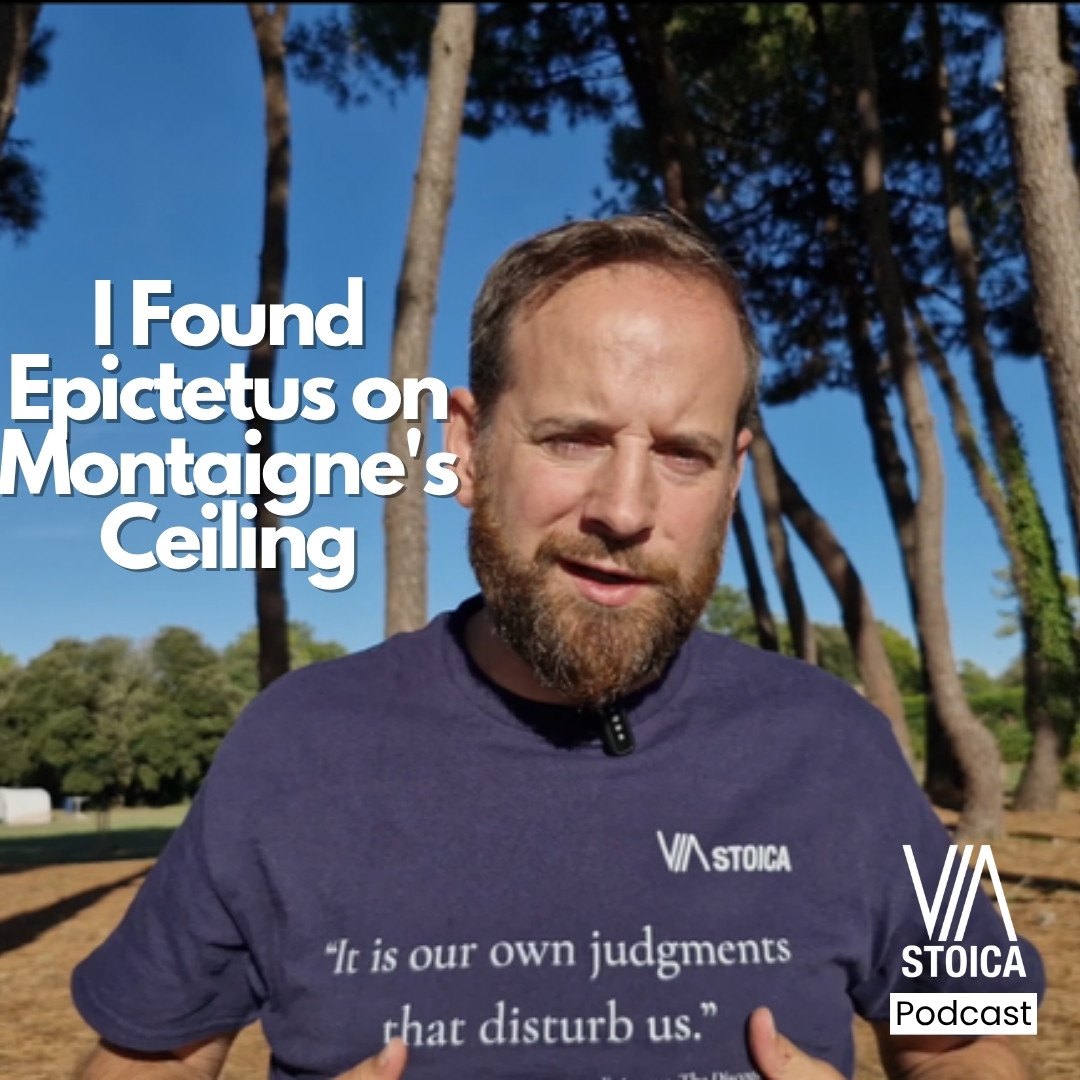
Montaigne’s tower in France holds a library whose ceiling beams carry painted quotations from the ancient philosophers. One of them is a line from Epictetus saying that our judgments, and not events themselves, disturb us. I visited the tower near Bordeaux for the podcast, but mainly because it had been a destination I wanted to see for a long time, and it did not disappoint. That one line stayed with me more than any other.
Here I look at why Michel de Montaigne chose these words for his ceiling and what they reveal about how he lived. I also show how you can use the same idea when life hands you a setback.
The Inscriptions on the Beams
Montaigne had his favourite sayings painted onto the beams of his library. What struck me most was the way he wrote them. Some lines run from left to right, others from right to left, and some sit upside down. He wanted to read them while he strolled around the room, so he could find inspiration from every angle.
From the centre of the room he dictated his thoughts to a scribe who wrote them down. Every quotation around him worked as a reminder to look at a question from a different side. That alone says a lot about his attitude to knowledge. The guide who showed me around the tower tells more about the library and its painted beams in a separate podcast episode.
The Epictetus Quote on Montaigne’s Ceiling
One of the sayings comes from a philosopher we know well on Via Stoica. It is the fifth passage of the Enchiridion, the handbook that Arrian compiled from the teaching of Epictetus. In plain words it says that things do not disturb us, but our opinions and views about those things do.
I wear a t-shirt with the same idea, so it felt strange and wonderful to find it overhead in the place where Montaigne wrote. You can read more of the teacher’s sayings in our collection of Epictetus quotes.
Who Was Michel de Montaigne?
Montaigne lived from 1533 to 1592. He wrote late in life. He withdrew into his tower and began to write at around the age of 38, after the death of a very close friend and later of his father. He did serve as mayor of Bordeaux and he travelled for a while, but he spent his best years alone with his thoughts.
He took himself as his main subject. He did not see himself as a philosopher in the academic sense. He wanted to learn how to live better, and he thought he was the one subject he could study as an expert. His essays are personal accounts of how he experienced his body and his mind.
He wrote in French so that ordinary readers, women included, could study him. He had grown up speaking Latin, because his tutor spoke only Latin to him and his parents did not know the language. His essays draw on Seneca, Epictetus and Cicero, so they carry a strong Stoic undertone, although he moved toward scepticism later in life. Our full profile of Michel de Montaigne tells more of his story, and the page of Montaigne quotes collects his words.
Why This Line Fits the Mind
Montaigne gives an example of the idea in one of his essays. He describes a man whose body worked perfectly, yet his mind shut it down at the moment he wanted to be intimate with the woman he loved. The mind is powerful enough to affect the body. Stress and worry can unbalance us in the same way.
This is also the root of modern cognitive behavioural therapy. Our thoughts come from earlier experiences, beliefs, upbringing and nature. Once we understand where they come from, we can give them a better direction. That is where Stoic philosophy becomes practical.
We Add Labels to What Happens
Life brings losses, setbacks, successes and failures. Our mind then attaches a label to each of them.
"Our mind adds labels to it. Our mind says like, this is a catastrophe. This is the worst thing that ever happened to me. And that is not necessary."
Benny Voncken, Via Stoica Podcast, I Found Epictetus on Montaigne’s Ceiling (7:19)
We do not have to add that label. The event still happens, and we still have agency over what we do with it. It may not be what we wanted, but once we are in the moment we can ask what we need to do. That question gives some control back, and it points us to the chance to do the right thing. For a practical walk through this approach, see how to handle a bad day the Stoic way.
Why Montaigne Needed the Reminder
Montaigne doubted what he knew, and he lived closer to death than most of us do today. The Epictetus line showed him that this struggle is a common human condition. Changing his mindset toward death, money and life gave him a practical tool.
The inscriptions kept him humble. They reminded him to look at a topic from different angles and not to feel too secure in his knowledge. Even if you love Stoic philosophy, that attitude helps. We should keep questioning and testing it, especially for how well it helps us live.
How to Carry the Beams Inside You
You do not need a tower or a library of a thousand books. You also do not need a shirt with a quote on it, though I enjoy mine. You can keep the reminder inside you.
"We can all wear that inside of us. We can all keep these reminders of, okay, let me just explore what is happening. Let me not jump to conclusions."
Benny Voncken, Via Stoica Podcast, I Found Epictetus on Montaigne’s Ceiling (9:41)
These simple practices turn the quote into a habit.
Pause when something upsets you, and give yourself a moment to see what is really happening before you react.
Separate the facts from your opinion of them. Write down what occurred in one line, and then write down the story your mind added.
Ask what you can still do right now. The best course of action lives in the present moment, and you can choose it even when you feel that something is wrong.
Test your opinions the way Montaigne tested his. Look at a question from another angle, and be willing to find that you were wrong.
None of this is easy, and it takes practice. We can train the mind to look at the facts, set our opinions aside and then choose what seems best for the moment. A reflection on memento mori can help keep your reactions in proportion.
Frequently Asked Questions
What is Montaigne’s tower?
Montaigne’s tower is the library tower of his chateau near Bordeaux in France. He retreated there to read and write his essays, and he had quotations painted on the ceiling beams.
Which Epictetus quote is on Montaigne’s ceiling?
It is the fifth passage of the Enchiridion, which Arrian compiled from the teaching of Epictetus. It says that people are disturbed by their opinions about things and not by the things themselves.
Why did Montaigne write the inscriptions upside down?
He wrote some lines left to right, some right to left and some upside down so that he could read them while strolling around the room. That way he found inspiration from every angle.
Was Montaigne a Stoic?
Montaigne drew on Seneca, Epictetus and Cicero, so his essays carry a strong Stoic undertone. Later in life he moved toward scepticism, and he took ideas from many schools.
What does Epictetus mean by judgments disturb us?
Epictetus means that events do not upset us on their own. Our opinions about them create the distress, and when we change those opinions we regain choice over how we respond.
A Question Worth Asking Yourself
Standing in Montaigne’s tower, I asked myself whether I live by other people’s opinions or by my own. The same question works for you. Think about the thoughts and opinions you add to events, and decide which of them disturb you.
"Think about the thoughts and opinions that you are adding and which ones are disturbing you. And are they true? Are they based on facts? Are you just adding it? Are you colouring it in yourself?"
Benny Voncken, Via Stoica Podcast, I Found Epictetus on Montaigne’s Ceiling (11:09)
Watch the full episode on YouTube.
Want to Learn More?
If this resonated, a conversation with Benny as your Stoic coach can be a good place to begin. You can also sign up for the newsletter, The Pause, or follow the Via Stoica Podcast on YouTube, Spotify, or Apple Podcasts.
About the Author
Benny Voncken is the founder of Via Stoica and host of the Via Stoica Podcast. He has practiced Stoicism for over six years, spoken at Stoicon, and led Stoic walks across Europe. Through Stoic coaching, he helps people develop their own philosophy of life. It gives them the tools to face obstacles, navigate change, and find balance. He writes, teaches, and walks wherever the philosophy takes him.

Comments 0