
How to Practice Memento Mori: The Stoic Daily Discipline
This page is about the practice behind the phrase: what the Stoics actually did with their awareness of death, how they structured it as a daily discipline, and what it produces in a person who takes it seriously. If you want to understand what memento mori means and where it comes from, start with What Is Memento Mori. If you are ready to practice it, read on.
What Does Memento Mori Mean?
Memento mori, “remember you must die,” is one of the most striking phrases associated with Stoicism. Strictly speaking, the Stoics never used these words. The expression itself appears centuries later, first in Christian and medieval contexts. But the practice behind it, reflecting daily on mortality, is as old as philosophy itself.
We can go all the way back to Plato, where he has Socrates declare in the Phaedo:
“The true philosophers are always occupied in the practice of dying, and to them least of all men is death terrible.”
Plato, Phaedo, 64a
For Plato, this practice was about the soul’s preparation for a separate existence after death. The Stoics took the same practice in a different direction entirely. There is no transcendence on offer in Stoic philosophy, no afterlife to prepare for. The Stoic meditation on death is about this life, this moment, and this character. The purpose is not to make peace with what comes after but to live more fully with what is here now.
Cicero later called philosophy a commentatio mortis, a rehearsal for death. And Montaigne, drawing from both, put it plainly:
“To philosophize is to learn how to die.”
Michel de Montaigne, The Essays, To Philosophize is to Learn How to Die
The Stoics absorbed this tradition and made it practical. Epictetus urged his students:
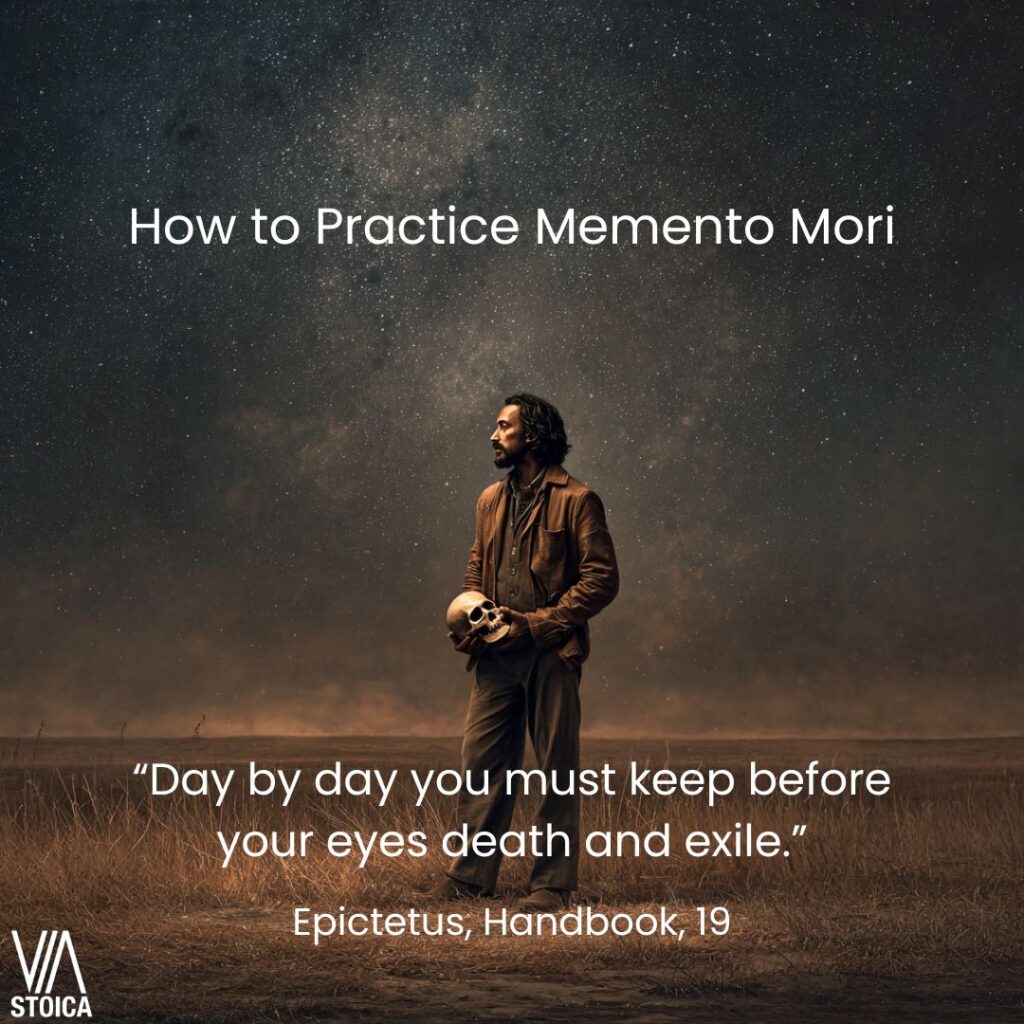
“Day by day you must keep before your eyes death and exile, and everything that seems terrible, but death above all; and then you will never have any abject thought, or desire anything beyond due measure.”
Epictetus, Handbook, 19
Notice the instruction: day by day. Not when you feel like it. Not in response to a crisis. Every day, as a discipline, the way you train is any other capacity. For the Stoics, remembering death is not morbid. It is a way of staying close to the essence of nature and life itself, focusing on the present moment with gratitude and urgency.
Philosophical Grounding: Death in Stoic Thought
Death as Natural Change
Seneca insists that death is not to be feared, because it is simply part of nature:
“What is death? It is either the end, or a process of change. I have no fear of ceasing to exist; it is the same as not having begun.”
Seneca, Moral Letters, 65.24
This line is not just theory. It is an exercise in perspective. When you repeat it to yourself, you are training your soul to see death as nothing alien, nothing hostile, but the same natural process that governs birth, growth, and decline.
Seneca returns to this again elsewhere, with even greater directness:
“We do not suddenly fall on death, but advance towards it by slight degrees; we die every day.”
Seneca, Moral Letters, 24.20
Marcus Aurelius echoes this with his characteristic economy:
“The world is nothing but change. Our life is only perception.”
Marcus Aurelius, Meditations, Book 4.3

The practice here is to look at life through this lens: everything is flux, and our life is nothing more than a stream of impressions. Death is simply the end of that stream. We are floating on a river that is Nature, and we get to observe, through our senses, what that world is. And while the stream will keep flowing, our journey will end and will make way for something else.
Death as Indifferent
The Stoics place death among the indifferents. It is not good, it is not bad. Only virtue is good, only vice is bad. If death is not in our control, then fearing it is useless. Epictetus challenges us bluntly:
“Death, for instance, is nothing terrible, or else it would have appeared so to Socrates too. But the terror lies in our own judgment about death, that death is terrible.”
Epictetus, Discourses, Book 2, Chapter 1.23
Epictetus does not comfort here. He demands that you examine the belief behind your fear. Do you think death is evil? If so, you are contradicting Socrates and the very order of nature. This is why Epictetus so often repeats: philosophy is not about fine words, but about changing the judgments that enslave us.
Meditation as Transformation
Pierre Hadot reminds us that for Marcus and the other Stoics, these were not abstract doctrines:
“We must meditate ceaselessly on death, because this meditation radically changes our way of acting, of thinking, and of feeling.”
Pierre Hadot, The Inner Citadel, Ch. 8, p. 203
This is the heart of memento mori: the practice is transformative. To recall death is to reorder your priorities. The fear of death dissolves, and life becomes urgent, precious, and aligned with nature. Hadot calls this a spiritual exercise, not an idea to admire, but a drill to repeat, a way of living. The Stoic meditation on death is meant to change the texture of your days, not just your understanding of mortality as a concept. If it is not changing how you actually live, it has not yet become a practice.
Application and Relevance Today
Why should we practice this now? Because our culture hides death. We cover it with distractions, avoid it with euphemisms, and waste our days as if we were immortal. Seneca writes:
“It is not that we have a brief length of time to live, but that we squander a great deal of that time.”
Seneca, Dialogues and Essays, On the Shortness of Life, 1
How much of your day is lost in trivial pursuits, idle scrolling, and pointless arguments? If you remembered that you are dying, not in some distant future, but today, this hour, how would you live differently? And notice that is not a rhetorical question. It is the actual exercise. If you cannot answer it specifically, you have not yet done the practice.
Donald Robertson puts it sharply:
“From the moment we’re born we’re constantly dying, not only with each stage of life but also one day at a time.”
Donald Robertson, How to Think Like a Roman Emperor, Chapter 1, p. 21
Modern psychology agrees. Research on mortality awareness shows that reflecting on death can increase gratitude, sharpen focus, and bring values into clearer view. But the Stoics already knew this: death reminds us not to waste life. The research simply confirms what two thousand years of practice have already demonstrated.
Practical Exercises for Memento Mori
1. Daily Reminder of Mortality
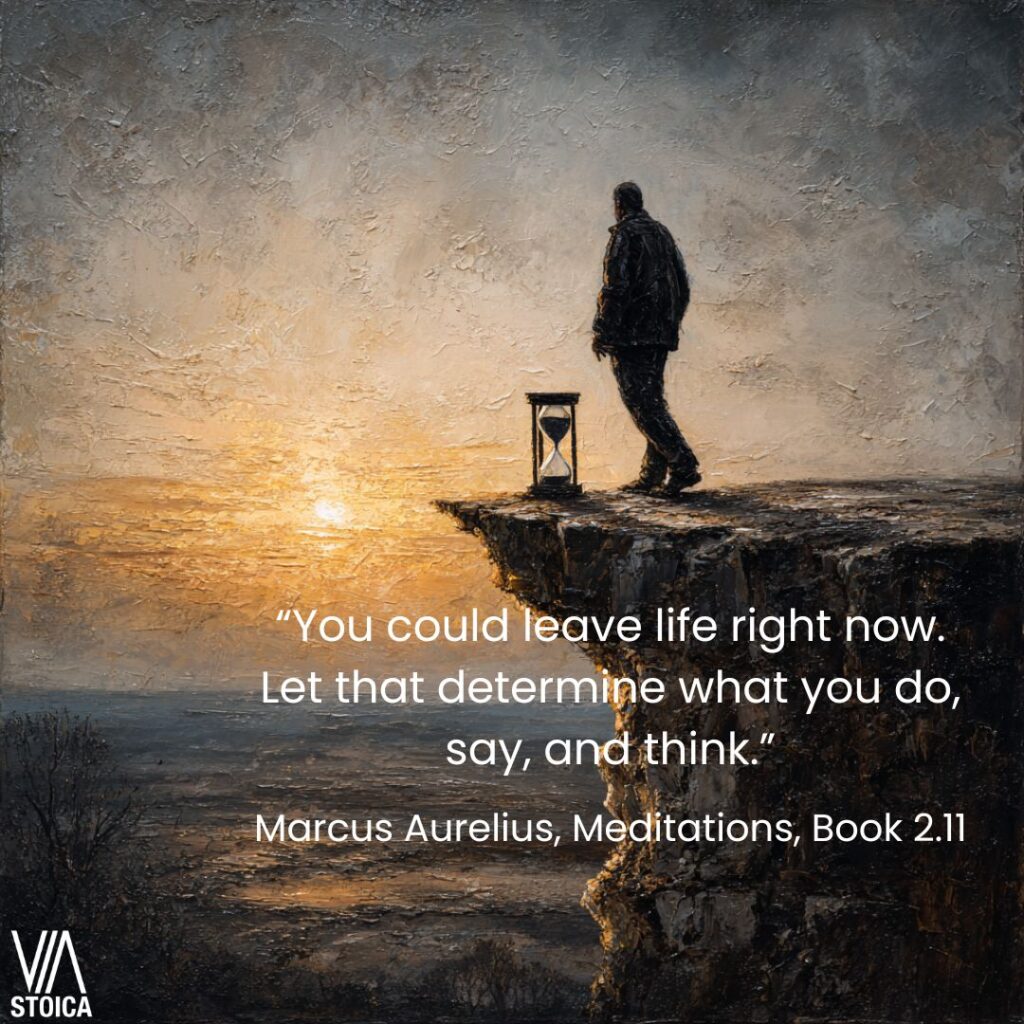
Marcus tells himself:
“You could leave life right now. Let that determine what you do, say, and think.”
Marcus Aurelius, Meditations, Book 2.11
Practice: Each morning, write this in your journal or hold it in mind before the day begins. Then ask yourself: if today were my last day, what would I actually do differently? Not as a fantasy, but as a specific question. If the answer reveals something you have been postponing, that postponement is today’s work. The point of the exercise is not to feel urgency but to act on it.
2. Contemplate the Mortality of Externals
Epictetus extends this meditation beyond ourselves to everything we love:
“In a similar way, you too should remind yourself that what you love is mortal, that what you love is not your own. It is granted to you for the present while, and not irrevocably, nor for ever, but like a fig or a bunch of grapes in the appointed season; and if you long for it in the winter, you are a fool.”
Epictetus, The Discourses, Book 3, Chapter 24.86
He continues in the very next passage:
“What harm is there while you are kissing your child to say softly, ‘Tomorrow you will die’.”
Epictetus, The Discourses, Book 3, Chapter 24.87
And in the Handbook, he puts the same idea in its simplest form:
“If you kiss your child, or your wife, say to yourself that it is a human being that you are kissing; and then you will not be disturbed if either of them dies.”
Epictetus, Handbook, 3
Practice: When with a loved one, remember their mortality alongside your love for them. This is not coldness. It is tenderness sharpened by awareness. Nothing deepens gratitude more than knowing it will not last. The awareness of loss, held lightly, is what transforms an ordinary moment into something worth being fully present for.
3. The View from Above
Hadot highlights Marcus’s cosmic exercise:
“When we view things from the perspective of death, it is impossible to let a single one of life’s instants pass by lightly.”
Pierre Hadot, The Inner Citadel, Chapter 7, p. 203
Practice: Imagine your life from above, as part of the vast unfolding of nature. From this perspective, death is neither tragedy nor injustice. It is simply the recycling of matter, the return of your body to the whole. And from this vantage point, something else becomes visible: that your life is not only yours. You are embedded in a community of people, all of them mortal, all of them navigating the same finite span. What you do with your time affects them. The Stoics understood that the good life is never a private achievement; it is expressed outward, in how you show up for the people around you.
Final Reflection
Memento mori is not about gloom. It is about freedom. To meditate on death is to train for life. It strips away the trivial and leaves what is essential. Seneca tells us:
“He who has learned to die has unlearned slavery.”
Seneca, Moral Letters, 26.10
Epictetus would add: stop nodding in agreement and begin practicing. Philosophy is not here to soothe, but to liberate. If you meditate on death daily, not occasionally, not when you remember to, but as a discipline that you return to every morning the way you return to any other practice you take seriously, you will live with urgency, gratitude, and courage. And that is the heart of Stoicism: to live in accordance with nature, unafraid of its end.
Go Deeper
For a reflection on Epictetus’s invitation to hold the mortality of those you love alongside your love for them, watch the Via Stoica discussion on YouTube: What harm is there while you are kissing your child to say softly, Tomorrow you will die — Epictetus.
Browse the full collection of 20 Marcus Aurelius quotes on death for further reading from the primary source. For the full context of what memento mori means and where it comes from, read What Is Memento Mori.
Common Questions About Practicing Memento Mori
No. The phrase is later, appearing in Christian and medieval contexts. But the practice of reflecting on death is central to Stoic thought from the beginning, present throughout the writings of Epictetus, Seneca, and Marcus Aurelius.
Not for the Stoics. They used it specifically to reduce the fear of death and to sharpen gratitude for life. Avoidance of the thought of death tends to amplify anxiety about it. Regular, honest engagement diminishes it.
Daily. Epictetus is explicit: day by day, you must keep before your eyes death and exile. The practice only produces its effects through consistent repetition over time, not through occasional reflection.
Christianity framed it as preparation for judgment after death. Stoicism uses it as preparation for living rightly here and now. There is no afterlife to prepare for in Stoic philosophy. The purpose is this life, this moment, and this character.
For Plato, practicing dying was about the soul’s preparation for a separate existence after death. For the Stoics, there is no transcendence on offer. The meditation on death is about transforming how you live now, not preparing for what comes after.
Want to explore more Stoic practices?
Book a free consultation with Benny or explore more Stoic philosophy terms. You can also listen to The Via Stoica Podcast on Spotify or Apple Podcasts, or watch it on YouTube.
About the Author
Benny Voncken is the founder of Via Stoica and host of The Via Stoica Podcast. He has practiced Stoicism as a way of life for over seven years and draws on almost 15 years of teaching experience to turn dense ancient ideas into daily practice. Since 2023 he has coached clients around the world through one-on-one Stoic coaching. He also leads Stoic walks across Europe, writes the monthly newsletter The Pause, and has spoken at Stoicon.



Comments 0