How to Practice Stoicism
-
How to Practice Stoicism
How to Practice Amor Fati: The Stoic Art of Loving Your Fate
What Does It Mean to Love Your Fate? To practice Amor Fati means to love one’s fate, not just to accept it, but to embrace and love it. To affirm everything that happens as necessary and good for the whole. The phrase, meaning “love of fate,” comes from Friedrich Nietzsche, who described it as the […]
Read morePosted on 23/10/2025 by Benny Voncken / 0 comments

-
How to Practice Stoicism
How to Practice Stoic Voluntary Discomfort
What Is Voluntary Discomfort? Voluntary discomfort is the Stoic practice of deliberately choosing small hardships to strengthen both body and mind. It teaches freedom from desire and aversion and prepares us to face life’s inevitable challenges with wisdom and courage. Seneca described this training clearly: “Set aside a certain number of days, during which you […]
Read morePosted on 09/10/2025 by Benny Voncken / 0 comments
-
How to Practice Stoicism
How to Practice the Stoic Reserve Clause
Practice the Stoic Reserve Clause In the writings of Marcus Aurelius, Epictetus, and Seneca, we encounter a deceptively simple yet profound practice: the Stoic reserve clause. Known in Greek as hupexhairesis and in Latin as exceptio, the reserve clause is the habit of acting while mentally adding a condition; “if nothing prevents it,” “fate permitting,” […]
Read morePosted on 01/10/2025 by Benny Voncken / 0 comments
-
How to Practice Stoicism
How to Practice the Stoic View from Above
What Is the View from Above? The Stoics taught us many ways to step back from our daily anxieties and see life as it truly is. One of their most striking practices is the Stoic View from Above (sometimes called the cosmic perspective). This exercise asks us to imagine ourselves lifted high above the earth, […]
Read morePosted on 18/09/2025 by Benny Voncken / 0 comments
-
How to Practice Stoicism
How to Practice the Dichotomy of Control: The Exercise of the Delimitation of the Self
What is the Dichotomy of Control “Some things are in our control and others not. Things in our control are opinion, pursuit, desire, aversion, and, in a word, whatever is our own action. Things not in our control are body, property, reputation, command, and, in one word, whatever is not our action.” Epictetus, Handbook, 1 […]
Read morePosted on 09/09/2025 by Benny Voncken / 0 comments
-
How to Practice Stoicism
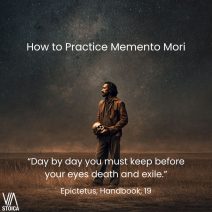
How to Practice Memento Mori: The Stoic Daily Discipline
This page is about the practice behind the phrase: what the Stoics actually did with their awareness of death, how they structured it as a daily discipline, and what it produces in a person who takes it seriously. If you want to understand what memento mori means and where it comes from, start with What […]
Read morePosted on 02/09/2025 by Benny Voncken / 0 comments
-
How to Practice Stoicism
How to Practice Premeditatio Malorum: Preparing for Life
What is Premeditatio Malorum? Premeditatio malorum is the Stoic practice of rehearsing adversity in advance, so that when misfortune comes, you can meet it with calm and virtue. Often described today as negative visualization (a modern phrase popularized by William Irvine), the practice literally means “the premeditation of evils.” It asks us to anticipate difficulties […]
Read morePosted on 26/08/2025 by Benny Voncken / 0 comments
-
How to Practice Stoicism
How to Practice the Stoic Discipline of Action
Introduction: Living in Accord with Human Nature The Stoic discipline of action (Greek: hormē, Latin: actio) is about how we live in relation to others and the world. While the discipline of desire governs how we orient ourselves toward what is and is not under our control, and the discipline of assent concerns how we […]
Read morePosted on 19/08/2025 by Benny Voncken / 0 comments
-
How to Practice Stoicism
How to Practice the Stoic Discipline of Desire: A Practical Guide
What is the Discipline of Desire? The Discipline of Desire is one of three core Stoic practices, along with the Disciplines of Assent and Action. These three disciplines form the framework through which the Stoic trains perception, emotion, and behavior. Try the exercises below. In Stoic philosophy, the Discipline of Desire (Greek: askēsis tou orektikou) […]
Read morePosted on 05/08/2025 by Benny Voncken / 0 comments