
20 Marcus Aurelius Quotes on Death: Mortality and How to Live

Marcus Aurelius on Death
He wrote about death more than almost any other subject in the Meditations, and for good reason. For the Stoics, death is not something to be feared or avoided. It is something to prepare for, to hold in mind daily, so that life is lived with urgency, gratitude, and virtue.
Most people live as if death is distant, but for Marcus Aurelius, it was always present. These 20 quotes show that. They come from the private journal he never intended to publish, which is why they carry an unusual directness. He was not writing for an audience. He was training himself.
By meditating on death and learning to accept it, we live more fully. We stop wasting time, let go of petty worries, and begin to act with integrity, not later, but now. This is the practice of memento mori. For more passages from the Meditations, browse the full Marcus Aurelius quotes collection.
Accepting the Presence of Death
1. Live before you die
"Not to live as if you had endless years ahead of you. Death overshadows you. While you're alive and able – be good."
Marcus Aurelius, Meditations, Book 4.17
Reflection: So many of us live as if we are immortal and have all the time in the world. Yet death, as Marcus tells himself, overshadows us. That reminder is what tells us to make the best of the time we have. For a Stoic, that means living it well, using reason to apply virtue.
The ending of this quote is the point: be good. This is something we can all do. No matter what the external circumstances are, we can still be good. We should not wait to start.
Practice: Write down three ways you can be good today. Then do them.
2. Memento Mori
"You could leave life right now. Let that determine what you do and say and think."
Marcus Aurelius, Meditations, Book 2.11
Reflection: This could be your last breath, the last time you went to sleep, or the last time you saw your loved ones. These reminders are not meant to be morbid. It is the second part of the quote that carries the meaning. By understanding that all of this can be gone the next moment, we should be grateful and appreciative that we are here now.
We should enjoy the time we get to spend with our loved ones and experience life. If we give these moments our full attention and learn to be virtuous within them, they will make our lives good.
Practice: Start your morning by saying: “I may not finish this day. So let me live it well.”
3. You’ve already lived
"Think of yourself as dead. You have lived your life. Now take what's left and live it properly."
Marcus Aurelius, Meditations, Book 7.56
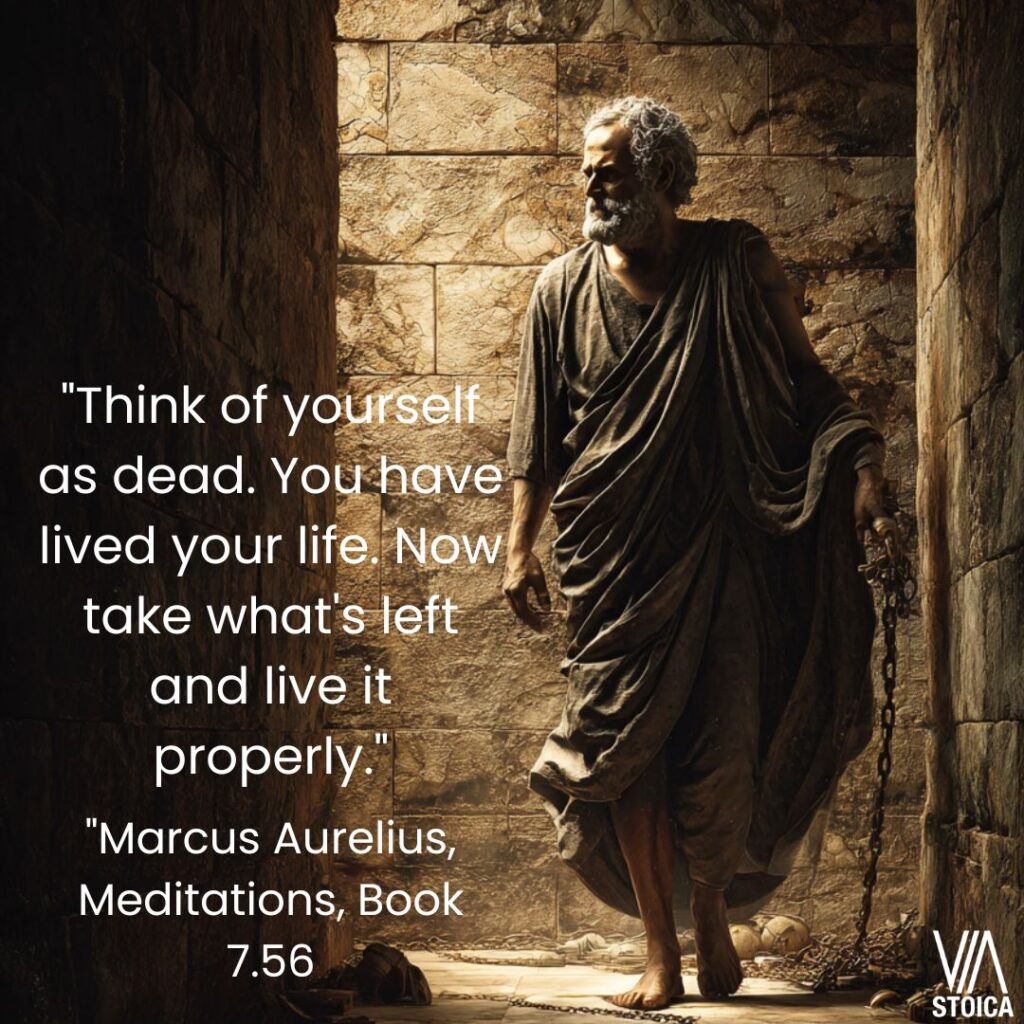
Reflection: Instead of trying to prolong life, cheat death, or avoid it, think of yourself as dead already. Take the sting out of it and start living properly, as Marcus Aurelius tells himself. This moment will soon be gone, and that is all that we can lose. Whether we get another moment is uncertain.
We have this moment; that is what is left. How you make the most of it is up to you, by following reason and not external forces.
Practice: End your day with this question: Did I live today like it was a second chance?
4. Give it up without complaint
"To pass through this brief life as nature demands. To give it up without complaint."
Marcus Aurelius, Meditations, Book 4.48
Reflection: If we learn to live as nature has given us life, by being rational beings, we can see how wonderful it is. All the obstacles will turn into tests and ways to practise being virtuous. Apply virtue in all of these situations, and we can experience joy and Eudaimonia, the Stoic goal.
When death meets us, and if we live well, we can let it go without complaint and in peace, knowing we did it well. If it is natural to happen, how can it be a bad thing? Say our farewells and exit with grace.
Practice: When something ends today, a moment, a task, a conversation, practise saying: “Thank you. I release it with gratitude.”
Death as Part of Nature
5. Welcome it
"Don't look down on death, but welcome it. It too is one of the things required by nature."
Marcus Aurelius, Meditations, Book 9.3
Reflection: How can we welcome death when it means the end of our existence? As we go through these 20 Marcus Aurelius quotes on death, we learn to see that there is no other way to approach it. If we fear or reject it, we can never experience life as it was meant to be. The two go hand in hand.
By learning to embrace death, we meet it with a positive mindset rather than as something evil. We can remind ourselves of this fact every time we go to sleep and reflect on how well we spent the day. A Stoic will meet death with joy if it is done virtuously.
Practice: When the thought of death comes, say: “You too belong, and I welcome you.”
6. Nothing to be afraid of
"What dying is – and that if you look at it in the abstract and break down your imaginary ideas of it by logical analysis, you realize that it's nothing but a process of nature, which only children can be afraid of."
Marcus Aurelius, Meditations, Book 2.12
Reflection: Ask yourself what it is that you fear about death. Make it as specific as possible. Is it the pain you might feel, the uncertainty of what lies beyond, or giving up life? Apply logic to each one. If it is the pain, then it will be temporary. If you live well, whatever happens after is nothing to worry about. Giving up life is a natural part of it.
Practice: Visualize your fears of death and examine them. Don’t let them grow in your imagination. If you would like support with this, Stoic coaching may help.
7. If it were harmful, nature would have warned us
"If there were anything harmful on the other side of death, they would have made sure that the ability to avoid it was within you."
Marcus Aurelius, Meditations, Book 2.11
Reflection: Marcus Aurelius keeps reminding himself that death is natural and not a bad thing. He refers to the gods here, which the ancient Stoics used interchangeably with nature or the rational universe. Because nature is pure logic and reason, death is one more moment of change.
If death had been something bad, we would have been able to avoid it. We would have seen people live as immortals. Since we see everything around us drop out of existence, so too must we.
Practice: Notice something dying in nature today, a leaf, a fruit, a cloud. See its quiet wisdom.
8. What happens at death
"The condition of soul and body when death comes for us. – Shortness of life – Vastness of time before and after – Fragility of matter"
Marcus Aurelius, Meditations, Book 12.7

Reflection: Marcus invites us to reflect on death not emotionally, but analytically. Time stretches infinitely beyond us. Life is brief. Matter is fragile. He zooms out to give perspective, reflecting on the eternal time before and after our existence. This little speck in time we occupy is trivial to the grand scheme of things, and yet we are here now to make the most of it.
Practice: Sit silently and visualize this: a short flicker of flame in an eternal dark field. That is life.
9. End of the body’s rule
"Death, the end of sense-perception, of being controlled by our emotions, of mental activity, of enslavement to our bodies."
Marcus Aurelius, Meditations, Book 6.28
Reflection: We experience life through our senses. The Stoics were aware of this. We feel, taste, touch, see, and hear the world around us. When we die, those sense-perceptions will be gone. We will be set free, and with that, the soul, the pneuma we carry. Our body will dissolve into nature, and our soul too. This is why the Stoics placed such responsibility on us to return the soul in the best possible state, a peaceful and eudaimonic one.
Practice: Appreciate the body today without identifying with it. You are more than the vessel.
Impermanence and the Passing of All Things
10. You will be forgotten
"Close to forgetting it all, close to being forgotten."
Marcus Aurelius, Meditations, Book 7.21
Reflection: Many people live for their legacy, for what they leave behind. In doing so, they sacrifice experiencing life in the present. The problem with this approach is that they will not be aware of what legacy they actually leave, and whether it is what they had in mind. Even that legacy will, at one point, be forgotten. Just go far enough into the future.
It is ironic that Marcus Aurelius writes this about himself, given that almost 2,000 years after his death he remains one of the most widely read emperors in history. But he saw, correctly, that even that would end.
Practice: Let go of one thing done today for image or legacy. Do something kind in silence instead.
11. Ashes and echoes
"Soon you'll be ashes, or bones. A mere name, at most – and even that is just a sound, an echo. The things we want in life are empty, stale, and trivial."
Marcus Aurelius, Meditations, Book 5.33
Reflection: All that we desire and chase will be gone at one point, and in the end, we will be gone. We cannot bring any of it with us. Here, Marcus, who had access to more riches than most people can imagine, reminds himself how little it all means. He returns to the Cynic foundation of Stoicism: the only good is virtue; all the externals are meaningless.
In Stoicism, only one thing matters: what is up to you, your choices to apply reason and virtue. By following this, you can live a fulfilled and meaningful life.
Practice: Ask: What am I clinging to today that will mean nothing when I die?
12. No advantage in longevity
"All that you see will soon have vanished, and those who see it vanish will vanish themselves, and the ones who reached old age have no advantage over the untimely dead."
Marcus Aurelius, Meditations, Book 9.33
Reflection: There are many recurring topics in these 20 Marcus Aurelius quotes on death, because the subject was always on his mind. He had seen emperors die, a plague wreak havoc in the Roman Empire, and wars cause death and destruction. He knew all too well that even his empire would at one point fall. Just as our civilisation will cease to exist at one moment in time.
Practice: Count the meaningful moments today, not the hours.
13. Everything is passing
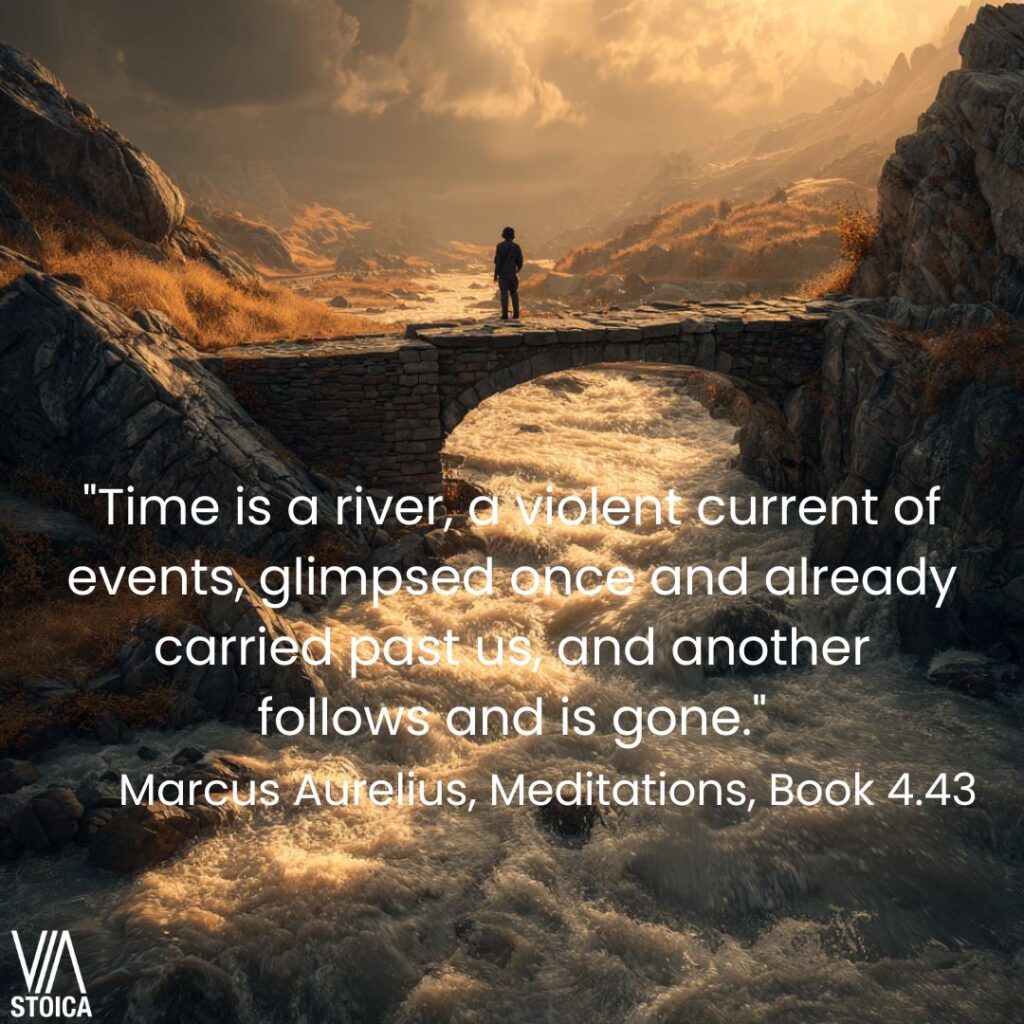
"Time is a river, a violent current of events, glimpsed once and already carried past us, and another follows and is gone."
Marcus Aurelius, Meditations, Book 4.43
Reflection: Time passes so fast that it seems to be gone within a blink. Before we can open our eyes, the next moment is there. Time to adjust is almost never given to us. It is the impermanence of nature in which we have to swim along.
The Stoics remind us that we need to accept this constant flow of change. We are floating towards the vast sea in which we will dissolve, so let’s make the most of the ride. Resistance makes it a long and torturous journey with the same end.
Practice: Notice what has already passed today, and let it go.
14. Transitory
"Everything transitory – the knower and the known."
Marcus Aurelius, Meditations, Book 4.35
Reflection: Change is a key concept for Marcus Aurelius. Nothing stays the same, not even the one who observes. Everything changes; that is the nature of Nature. This should give us peace and help us release the clutch we try to keep on life.
When we understand the truth about the world around us, we can start to find peace with it. Change is not something to fight against, but something to welcome. The same applies to death.
Practice: Spend a moment watching your thoughts. See how they rise and vanish.
15. Just a soul carrying a body
"A little wisp of soul carrying a corpse. – Epictetus"
Marcus Aurelius, Meditations, Book 4.41
Reflection: This is one of the examples in which we see the influence Epictetus had on Marcus Aurelius. Marcus was given a copy of the Discourses by his teacher Rusticus (Meditations, Book 1.7). He probably had more volumes than the four that survive.
The separation between body and soul is stark here. Calling the body a corpse gives a clear indication of where life is found and why the soul matters so much. It is here where we should put our focus: to guard that soul and keep it well. Forget the externals; character and soul are all that matter.
Practice: Ask yourself: “How am I taking care of my soul today?”
Detachment from Recognition and Legacy
16. The illusion of fame
"People who are excited by posthumous fame forget that the people who remember them will soon die too… until their memory, passed from one to another like a candle flame, gutters and goes out."
Marcus Aurelius, Meditations, Book 4.19
Reflection: Marcus Aurelius saw most of his predecessors and noblemen preoccupied with leaving something behind. He kept reminding himself that a legacy is like a flame going out. We cannot control our legacy or what happens in the future, and clinging to leaving something behind makes us miss the beauty and wonderful things we have around us in the present.
Practice: Set one goal today that is inward, not outward. Let it be enough.
17. Memory doesn’t last
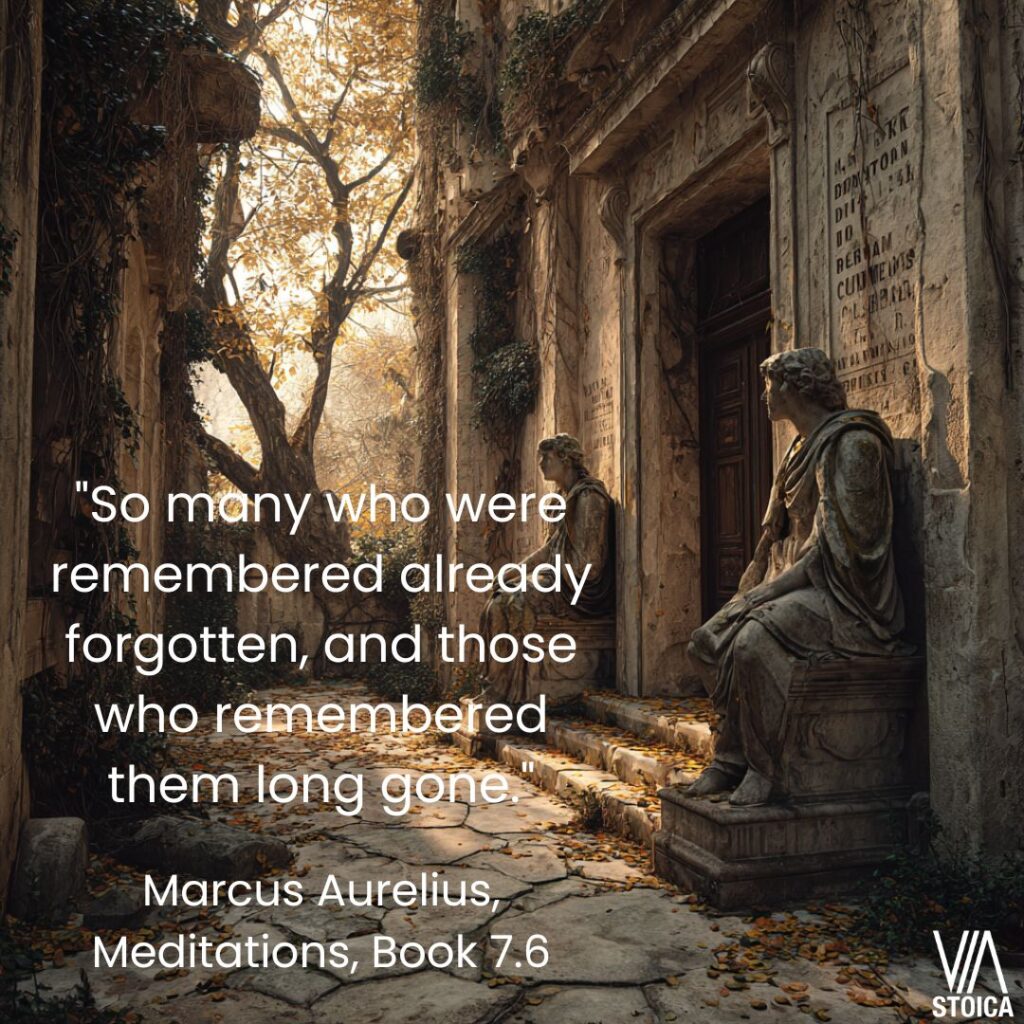
"So many who were remembered already forgotten, and those who remembered them long gone."
Marcus Aurelius, Meditations, Book 7.6
Reflection: The fear of being forgotten or of forgetting others is a common one. What those people often tend to forget is to appreciate their loved ones fully when they are present. They take them for granted instead. It is not about remembering or being remembered; the most important part is being aware in the moment.
Our memories are but memories of memories, built from the parts we can recall. If we experience the moments we have, we can remember the joy those times gave us.
Practice: Live one moment today with your full attention, no distractions, just presence.
Awareness in the Face of Death
18. Awareness before death
"Not just because we move daily closer to death but also because our understanding – our grasp of the world – may be gone before we get there."
Marcus Aurelius, Meditations, Book 3.1
Reflection: The tragedy is not death, but living unaware, confused, and lost. With old age, our grasp of the world can diminish, but many of us never had this grasp to begin with. They live on cruise control, directed and guided by externals and the opinions of others.
Having a grasp of the world gives us peace. We understand our existence on a deeper level. It is better to lose something than to never have had it at all, especially when it comes to the mind and soul.
Practice: Start questioning your actions, opinions, and judgments to increase your awareness.
19. You only lose the present
"You cannot lose another life than the one you're living now… the present is the same for everyone… and it should be clear that a brief instant is all that is lost."
Marcus Aurelius, Meditations, Book 2.14
Reflection: We never lose as much as we think we do, yet we lose it all. What do we lose? This moment. Every snapshot of life that is gone can be seen as a mini-death. That version of me and of the world is gone, never to come back.
This is one reason why we should be able to deal with death better than we tend to. We experience it all the time. Learn to see the change for what it is, a practice in dying. See the present as a practice in living.
Practice: Ask yourself every hour: What have I said goodbye to?
20. Death is neither good nor bad
"Death and life, success and failure, pain and pleasure, wealth and poverty, all these happen to good and bad alike, and they are neither noble nor shameful – and hence neither good or bad."
Marcus Aurelius, Meditations, Book 2.11
Reflection: As we close these 20 Marcus Aurelius quotes on death, we need to accept the fact that this will happen to everyone. Those who lived well and those who lived badly. There is no difference at the end; we will all meet the same fate. How we meet it is up to us, and how well we live and hand over our soul to the Logos is our responsibility.
There is no need to label death as good or bad because it is natural. If we meet our end with virtue, we will meet it with joy, one of the good emotions, the Eupatheiai. This is how the Stoic sage can be joyous even on the rack.
Practice: When facing something hard today, ask: Am I labelling this as good or bad, or am I judging it wisely?
Conclusion: Death, the greatest reminder
Marcus Aurelius did not see death as the end. He saw it as the great equalizer, the most powerful mirror, and the ultimate reminder to live. Every day you avoid thinking about death is a day you might avoid living fully. The goal is not to be morbid but to be awake, to instil gratitude and attention to the present moment.
To take this practice further, read What Is Memento Mori for the full philosophical context, or How to Practice Memento Mori for the specific daily exercises the Stoics used.
Journaling prompt: What would I do differently if I truly accepted that I could leave life right now?
Frequently Asked Questions
What did Marcus Aurelius say about death?
He believed death was a natural part of life, not something to be feared. In Meditations, he writes: “You could leave life right now. Let that determine what you do and say and think.” He saw death as a reminder to live with virtue and presence, and he returned to the subject repeatedly throughout his private journal as a form of ongoing self-training.
What is the Stoic view on death?
Stoics see death as neither good nor bad. It is a natural event that lies outside our control. What matters is how we live before death and how we face it: with acceptance, peace, and virtue. Death is part of nature’s design, not something to resist. For the full Stoic framework on this, read the dedicated guide on how to practice memento mori.
Why did Marcus Aurelius write so much about death?
Meditations was Marcus Aurelius’s personal journal, never intended for publication. He wrote about death as a way to strengthen his character and reduce fear. Reminding himself of life’s brevity helped him focus on what truly mattered: virtue, duty, and reason. He was also writing as an emperor who had witnessed plague, war, and the deaths of predecessors; death was a daily reality, not a distant abstraction.
Is “You could leave life right now” really from Marcus Aurelius?
Yes. The quote comes from Meditations, Book 2.11. It reflects the Stoic practice of memento mori, remembering death to live wisely and with full attention to the present. Every quote on this page is taken directly from the Meditations with the book and passage number included.
How can I apply Stoic teachings on death in daily life?
Reflect on death regularly, practise gratitude for the present moment, and focus on living with intention. The Stoics recommend journaling, meditating on mortality, and reminding yourself that only the present is yours to shape. The practices at the end of each quote above are a good starting point. For a structured approach, read How to Practice Stoicism.
Continue the Practice
The Pause is a monthly letter on Stoic practice. One idea, one exercise, one reflection from the ancient sources, delivered to your inbox each month.
About the Author
Benny Voncken is the founder of Via Stoica and host of the Via Stoica Podcast. He has practiced Stoicism as a way of life for over seven years, spoken at Stoicon, and led Stoic walks across Europe. Through Stoic coaching, he helps people use Stoic principles and practices to develop their own philosophy of life: one that gives them the tools to face obstacles, navigate change, and find more balance and peace. He writes, teaches, and walks wherever the philosophy takes him.


The Pause
A monthly Stoic newsletter
Sign up and get The Pause Framework free.
A practical Stoic tool for moments of tension. Observe what is happening. Reset your momentum. Decide with reason.
It arrives in your welcome email.
Then, once a month: one reflection, one practice, one Stoic idea.
Comments 0