
What Is Sophia? The Stoic Virtue of Wisdom
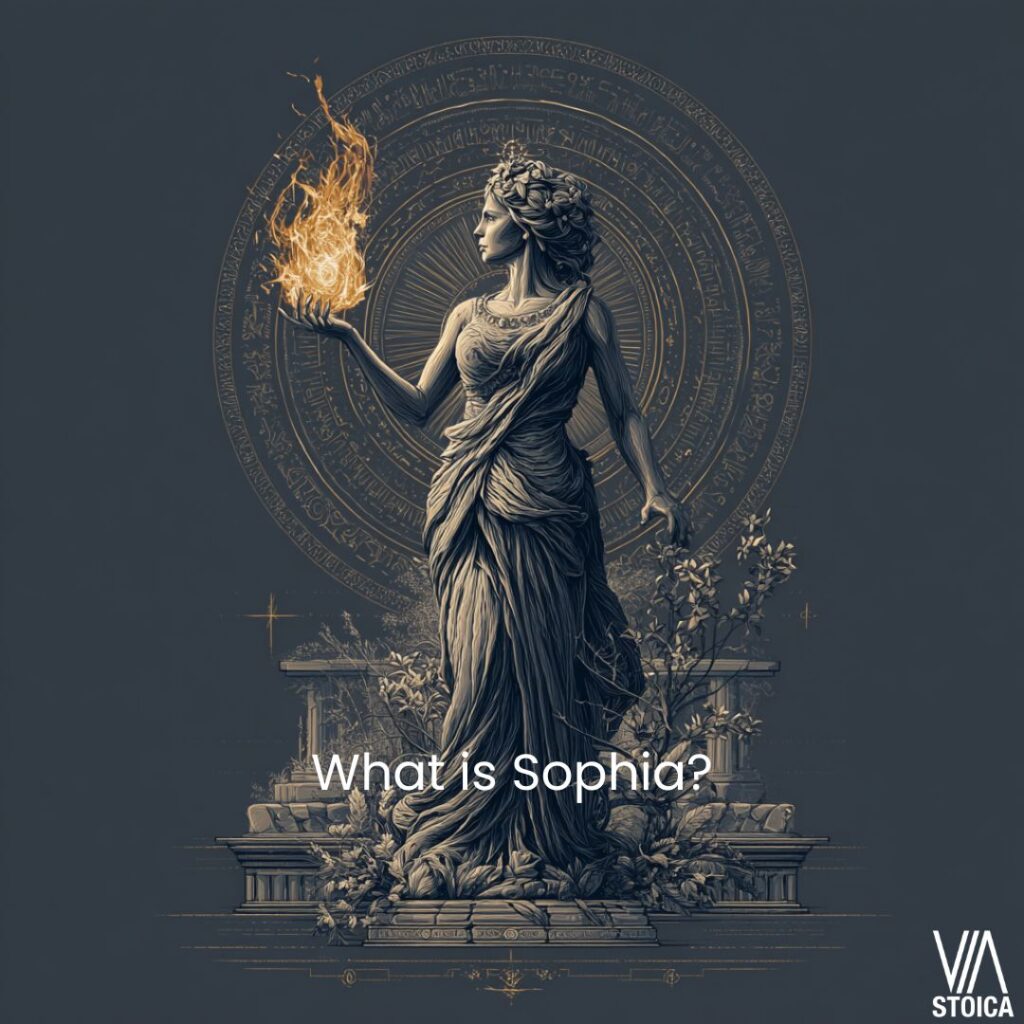
Term: Sophia (σοφία) | Translation: Wisdom, the correct understanding of what is good, bad, and indifferent | Language: Greek | Category: Ethics & Virtue
Sophia (σοφία) in Stoicism is the virtue of wisdom: the deep, correct understanding of what is genuinely good, genuinely bad, and neither. It is the highest of the four cardinal virtues, the one the other three depend on. Courage without sophia does not know what is actually worth facing. Justice without sophia does not know what fairness actually requires. Sophia is what tells the other virtues where to point.
Breaking Down the Word
The Greek root of sophia points to a specific kind of knowing, not the accumulation of facts.
- Greek: σοφία
- Root: connected to sophos (σοφός), wise, skilled, clear-minded
- Literal meaning: wisdom, skill, knowledge gained through genuine understanding
- Philosophical meaning: the moral and philosophical wisdom that lets a person see the world correctly, as distinct from mere technical skill
Sophia sits at the base of Stoic ethics because right living begins with right seeing. A wise person does not simply accumulate information. Their judgments align with nature, reason, and virtue, and that alignment becomes the foundation everything else is built on.
What Sophia Actually Means
Sophia is easy to mistake for intelligence, talent, or simply having a lot of information, and the Stoics were clear that all three miss the point. Someone can be intellectually brilliant and still unwise. Quick problem-solving, intuition, academic knowledge, and emotional detachment all get mistaken for sophia at different points, but none of them are it. Sophia is a moral skill: the ability to see the world truthfully and live accordingly. Sound judgment, not cleverness, is the actual measure.
Modern life tends to chase productivity hacks, shortcuts, and information overload as substitutes for wisdom. The Stoics would say this misreads the problem entirely. Wisdom is not about knowing more. It is about correctly identifying what actually matters, which is a much smaller and more specific task than most people assume.
"The essence of the good is a certain disposition of our choice, and the essence of evil likewise."
Epictetus, The Discourses, Book 1, Chapter 29.1
Sophia and Phronēsis: What Is the Difference?
The terms sophia and phronēsis are both translated as wisdom, and the two are closely related but not identical. Sophia is theoretical: understanding what is genuinely good, bad, and indifferent at the level of principle. Phronēsis is that understanding applied to a specific situation in real time. Sophia tells you what is actually true. Phronēsis tells you what to do about it right now.
Neither functions well without the other. Sophia gives phronēsis something accurate to work from. Phronēsis gives sophia a way to actually matter in a life rather than remaining an idea someone holds. The Stoics wanted both operating together, at every level from the abstract to the immediate.
Sophia and Core Stoic Principles
This virtue is what allows a person to see logos (λόγος), the rational structure of the world, and live in harmony with it rather than against it. The Stoics held that virtue (ἀρετή) is one, but sophia is its intellectual foundation, the understanding that guides every other expression of virtue. It also strengthens prohairesis (προαίρεσις), Epictetus’s central concept of moral choice, by clarifying what is genuinely worth choosing in the first place.
Sophia also connects directly to adiaphora, the indifferents: wealth, health, reputation, and outcomes, all the things the Stoics considered neither good nor bad in themselves. Correctly sorting an event into good, bad, or indifferent is the actual work sophia does. Most disturbance traces back to sorting something into the wrong category.
How to Practice with Sophia
Sophia is not built by reading more. It is built by repeatedly testing whether your categories of good, bad, and indifferent actually hold up.
Ask what is actually in my control
Each morning, ask directly: what is genuinely up to me today? The question sounds simple, but most confusion in a day traces back to treating something outside your control as though it belonged to you, or the reverse.
Pause before you assent
When an impression arrives, delay judgment long enough to examine it. This is the core mechanism of the discipline of assent, and sophia is what makes the examination accurate rather than just slower.
Stoic Exercise
The Three-Box Sort
Rooted in sophia: most disturbance does not come from what happened. It comes from sorting what happened into the wrong category.
When something today stirs a strong reaction, sort it honestly into one of three boxes. Genuinely good: something that reflects your own virtue, your own right action. Genuinely bad: something that reflects your own vice, your own wrongdoing. Indifferent: everything else, including health, money, reputation, and how things turned out.
Most strong reactions come from something landing in the wrong box. Check which box you actually put it in before the reaction arrived, and whether that placement was correct.
Ready to go deeper? Discourses 1.29 takes this practice into its full form.
Why Sophia Is Central to Stoic Practice
Sophia shapes how you judge everything that happens in a life. When understanding is clear, choices become steadier and reactions become grounded in something real rather than in habit or fear. Epictetus pushed this further than most: he argued that only the wise person genuinely has the capacity to love, because loving anything requires first knowing what is actually good, and confusing something indifferent for something good corrupts the love itself. Wisdom is not a distant intellectual ideal in Stoicism. It is the ground everything else, from courage to justice to the capacity for genuine attachment, actually stands on.
"What a man sets his heart on, that he naturally loves… Whoever, therefore, has knowledge of good things would also know how to love them; and he who cannot distinguish good things from evil, and things that are neither good nor evil from both of these, how could he still have power to love? It follows that the wise man alone has the power to love."
Epictetus, The Discourses, Book 2, Chapter 22.1
Frequently Asked Questions
What does sophia mean in Stoicism?
Sophia in Stoicism is the virtue of wisdom: the correct understanding of what is genuinely good, genuinely bad, and indifferent. It is the highest of the four cardinal virtues and the foundation on which the other three, courage, justice, and temperance, all depend.
How is sophia different from phronēsis?
Sophia is theoretical wisdom, understanding of general principles. Phronēsis is that understanding applied to a specific moment. Sophia tells you what is true; phronēsis decides what to do about it right now.
Why is sophia important in Stoic practice?
Because right living depends on right judgment, and sophia is the virtue that aligns judgment with nature and reason. Without it, the other virtues have no accurate basis to act on.
Is sophia the same as intelligence?
No. The Stoics were explicit that someone can be intellectually brilliant and still unwise. Sophia is a moral skill, the ability to see the world truthfully and live accordingly, not a measure of raw intellect or accumulated information.
How does sophia connect to the indifferents?
Sophia is what correctly sorts events into good, bad, or indifferent. Most disturbance in daily life traces back to something indifferent: wealth, reputation, an outcome, being mistakenly treated as genuinely good or bad.
Want to Learn More?
If this resonated and you are ready to start building your own philosophy of life, a conversation with Benny as your Stoic coach can be a good place to begin. Not to be told what to think, but to have the space to figure it out. You can also sign up for the newsletter, The Pause, or watch or listen to the Via Stoica Podcast on YouTube, Spotify, or Apple Podcasts.
About the Author
Benny Voncken is the founder of Via Stoica and host of The Via Stoica Podcast. He has practiced Stoicism as a way of life for over seven years and draws on almost 15 years of teaching experience to turn dense ancient ideas into daily practice. Since 2023 he has coached clients around the world through one-on-one Stoic coaching. He also leads Stoic walks across Europe, writes the monthly newsletter The Pause, and has spoken at Stoicon.


Comments 0