
How to Stop Procrastinating With Stoicism
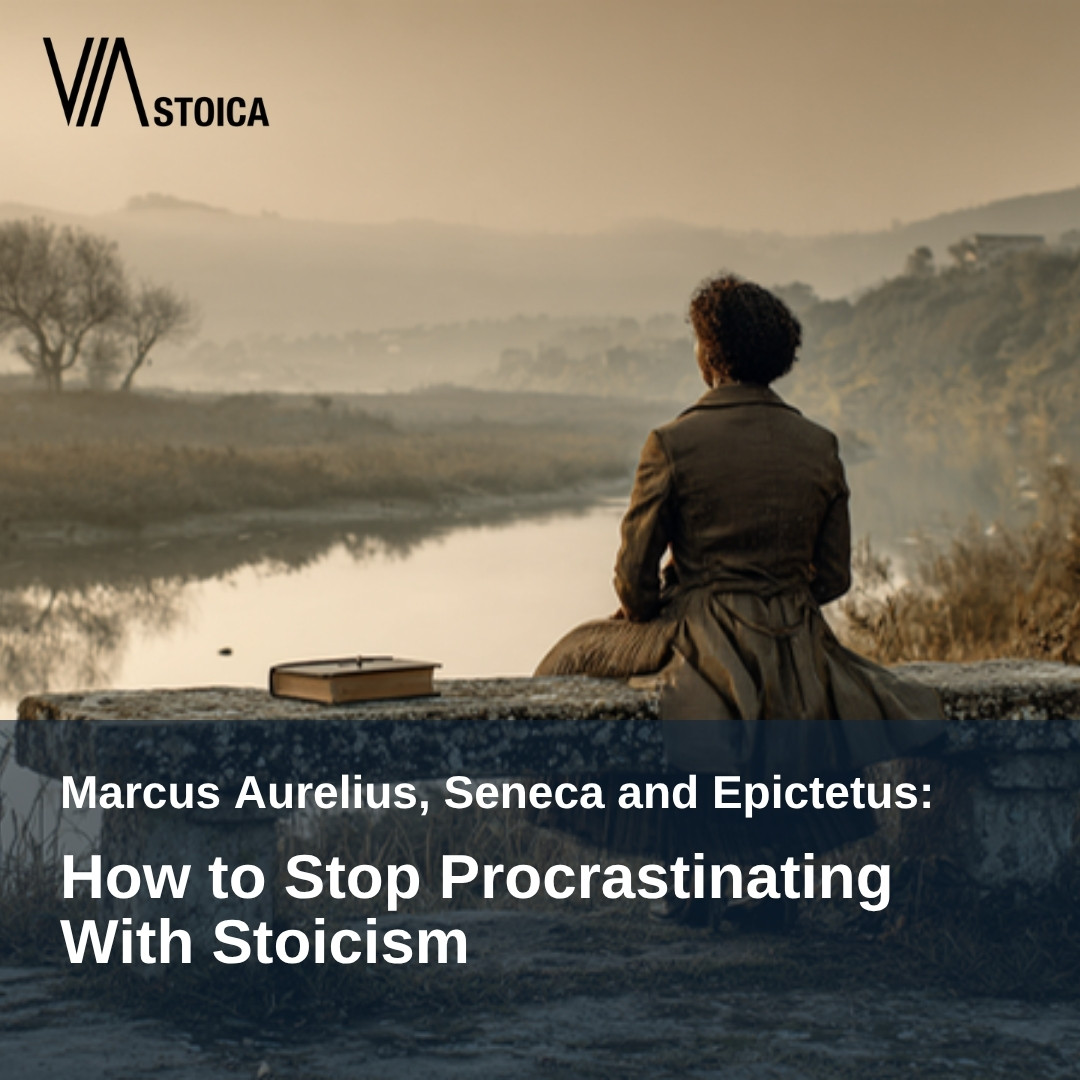
You stop procrastinating with Stoicism by treating the task in front of you as part of your work as a human being. Marcus Aurelius told himself this on mornings when he struggled to get up.
I know this from experience, because I have always been very good at procrastinating. For years I waited for life to happen to me instead of acting on it. My divorce showed me what that costs, since I saw it coming and did nothing. The Stoics gave me words for it, because Seneca, Epictetus and Marcus Aurelius each wrote about putting things off. Seneca names what waiting costs, Epictetus shows how one lapse carries into tomorrow, and Marcus Aurelius names the work that waits for you. A five minute practice at the end turns those three answers into a first step.
Why Marcus Aurelius Treated Getting Out of Bed as a Duty
Marcus Aurelius answered his own reluctance to get up by reminding himself that a human being has work to do.
"At dawn, when you have trouble getting out of bed, tell yourself: 'I have to go to work – as a human being.'"
Marcus Aurelius, Meditations, 5.1
He wrote this in the private notebook we now call the Meditations. He addressed it to himself as an order, not as advice for readers. The work he names belongs to him as a human being, since he never says he goes to work as an emperor. That reading makes the instruction available to anyone who has a task they would rather avoid.
A few lines later he measures himself against a standard.
"There you are still below your quota. You don't love yourself enough. Or you'd love your nature too, and what it demands of you. People who love what they do wear themselves down doing it, they even forget to wash or eat."
Marcus Aurelius, Meditations, 5.1
His yardstick is the quota his own nature sets, and he finds himself below it. He also observes that people who love their work wear themselves down doing it. He sets his own reluctance beside theirs. The Stoics gather this kind of practical duty under the discipline of action, the training of acting well in daily duties.
10 Marcus Aurelius quotes on Stoic discipline collects more of his notes on discipline, and the Marcus Aurelius page introduces the man himself.
What Waiting Costs, According to Seneca
Seneca describes postponement as something that happens while life carries on without us.
"While we are postponing, life speeds by."
Seneca, Letters to Lucilius, 1.2
Seneca presents this in his first letter to Lucilius as a fact about how life behaves while we wait. The cost of a delay shows up in the calendar, not in guilt. His essay On the Shortness of Life names the form of delay most of us recognise.
"The greatest obstacle to living is expectation, which depends on tomorrow and wastes today."
Seneca, On the Shortness of Life, 9
That form is the task that waits for a calmer week, a better mood or a less busy season. Seneca’s phrase for the result is that expectation wastes today. In Letter 101 he offers a different footing for the same instruction.
"Let us so order our minds as if we had come to the very end. Let us postpone nothing."
Seneca, Letters to Lucilius, 101.7
Letter 101 reflects on how little warning life gives, and the instruction to postpone nothing rests on that uncertainty. Keeping that uncertainty in view is the practice of memento mori, a reason to begin and not a reason to worry. 10 Seneca quotes on time collects more of his writing, and the Seneca quotes page holds the wider set.
How Epictetus Ties Today’s Delay to Tomorrow’s Habits
Epictetus warns that a lapse of attention today leaves a person’s affairs in worse condition on later occasions.
"When you relax your attention for a while, do not fancy you will recover it whenever you please; but remember this: because of your fault today your affairs must necessarily be in a worse condition on future occasions."
Epictetus, Discourses, 4.12.1
Discourses 4.12 is Epictetus’s chapter on attention, the discipline the Stoics call prosoche. He treats each lapse as a cost that carries forward, which answers the thought that a task can start later at no loss. In Handbook 51 he turns the same point into a question.
"How much longer will you wait before you think yourself worthy of the best things and transgress in nothing the distinctions laid down by reason?"
Epictetus, Handbook, 51
The question assumes the reader has been waiting by choice, and Epictetus places that choice with the reader. That fits the dichotomy of control, because starting a task is an action and actions are up to us. The Epictetus page introduces the teacher behind both passages.
What Procrastination Taught Me After My Divorce
Marcus Aurelius reminded himself that he was a human being with human duties to fulfil, a reminder I needed long before I knew his words. The lesson that shaped my view of action most came after my divorce.
The divorce happened to me, yet I saw it coming and did nothing. That showed me what follows when you do not learn to live according to who you are. You drift along the river that other people float on, fall into the victim role before fate, and resent later that you never acted.
Since then I have taken back control over my actions. I still procrastinate on plenty of things. On the parts of my life I care about, I go out and act, even when it lies far outside my comfort zone. The podcast, the Stoic walks and the workshops I host are things I would never have imagined doing. Now that I have a message I believe in, one that can help others live better lives, I feel an internal push to do them.
What I Ask Myself When I Do Not Feel Like Acting
On days when I do not feel like doing anything, I ask myself what life requires of me right now. Sometimes the answer is nothing, so I go for a walk, read a book or watch a series. Sometimes something needs doing, so I look at it and go do it.
There are also moments when I know I should act but feel off. I take that as my nature telling me this is not the moment for that task, so I do something else until I am ready. To tell that signal from plain avoidance, I use the habit Epictetus taught of testing an impression before accepting it: I start for five minutes, and if the reluctance stays, I ask whether this is the wrong task for now or only one I would rather avoid. It rarely takes long before I return and finish it.
I now read procrastination as information about how I relate to a certain activity. When you catch yourself saying you do not need to do it, pause and ask what you are really doing. Are you neglecting your human duty, as Marcus told himself? Are you watching life speed by, as Seneca described? Picture the impact that today’s decision will have on your future, and then choose to act in the present moment on the right task. Sometimes what you put off simply is not what you should be doing.
A Five Minute Practice: Start the Smallest Piece
A five minute start borrows the move in Meditations 5.1. Marcus Aurelius names the work first and does not wait for the mood to change. Tonight, pick the one task you are most likely to put off tomorrow, such as the email you have rewritten in your head for a week. Write it on a card beside your bed. Under it, list two things that are up to you, such as opening the document and writing the first sentence. Add one that is not, such as how the reader will respond.
When you wake, say his sentence in your own words, for example ‘I have to answer that email, as a human being.’ Then work on the first item for five minutes before you check your phone. In the evening, ask what you postponed and what you did instead, as Seneca’s instruction to postpone nothing asks. If waiting reaches beyond one task, how to stop waiting and start living takes the same question to the whole of life.
Frequently Asked Questions
How do Stoics stop procrastinating?
They treat starting as a duty that belongs to them as human beings. Life keeps moving while they wait, and each lapse of attention counts as a cost that carries forward. Marcus Aurelius, Seneca and Epictetus each supply one of those three habits, and the five minute practice above combines them. For a wider set of daily habits, see how to practice Stoicism.
What did Marcus Aurelius say about getting out of bed?
In Meditations 5.1 he tells himself that he has to go to work as a human being. He asks why he is not running to do what his nature demands. The passage answers reluctance with a reminder of his function, not with an argument for staying in bed.
Does Stoicism ever recommend delay?
Seneca recommends delay as a remedy for anger in On Anger 2.29. Epictetus advises letting an impulse toward pleasure wait in Handbook 34. In both cases delay serves judgment. Procrastination uses delay to avoid work you have already judged worth doing, so the Stoic praise of delay does not cover it.
What if I do not feel motivated?
Marcus Aurelius does not wait for motivation. In Meditations 5.1 he asks whether he was born to feel nice and then names the work his nature demands. The five minute practice borrows that move by tying the start to a time of day and a small task. If the reluctance stays after those five minutes, ask whether this is the right task for now.
Want to Learn More?
If this resonated and you are ready to start building your own philosophy of life, a conversation with Benny as your Stoic coach can be a good place to begin. You can also sign up for the newsletter, The Pause, or watch or listen to the Via Stoica Podcast on YouTube, Spotify, or Apple Podcasts.
About the Author
Benny Voncken is the founder of Via Stoica and host of The Via Stoica Podcast. He has practiced Stoicism as a way of life for over seven years and draws on almost 15 years of teaching experience to turn dense ancient ideas into daily practice. Since 2023 he has coached clients around the world through one-on-one Stoic coaching. He also leads Stoic walks across Europe, writes the monthly newsletter The Pause, and has spoken at Stoicon.


Comments 0