
What Is Pathos? The Passions the Stoics Warned You About

Term: Pathos (πάθος) | Translation: Passion, destructive emotion | Language: Greek | Category: Psychological States
Pathos (plural: pathē) in Stoic philosophy is a destructive emotion produced by a false judgment about what is genuinely good or bad for you. In modern usage the word suggests emotion or sympathy. In rhetoric it means an appeal to feeling. Stoicism means something more specific and more demanding, and understanding what pathos actually is, and is not, changes how the whole Stoic project looks.
What Pathos Means
The Greek πάθος comes from the root pascho (πάσχω), meaning “to suffer” or “to undergo.” It describes something that happens to us, a passive state, rather than something we do. The Stoics used it to name a specific kind of inner disturbance: not every strong feeling, but the disordered feelings that arise when we make false judgments about value.
Chrysippus, one of the Stoic founders, described pathos as an excessive impulse that disobeys reason: a movement of the soul rooted in faulty judgment rather than clear thinking. The pathos is not the feeling itself but the feeling produced by agreeing with a false proposition about what is genuinely good or bad. When you feel rage at an insult, the rage is not the pathos. The false judgment that your worth depends on how others treat you is.
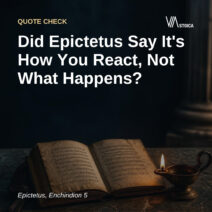
"It is not the things themselves that disturb people but their judgements about those things."
Epictetus, The Handbook, 5
The Four Pathē
Stoic thought classifies the destructive passions into four main types. What makes each of them destructive is not that they feel unpleasant but that they prevent you from thinking and acting rationally. Each pathos pulls you away from the moment of moral choice and makes a virtuous response harder, sometimes impossible.
Distress (lupē)
A contraction of the soul around the belief that something genuinely bad is present. The false judgment underneath is that external circumstances, loss, failure, pain, or the opinions of others, constitute real harm to who you are. In this contracted state, rational response to any situation becomes harder to reach.
Fear (phobos)
The anticipation of something believed to be genuinely bad. Worry and anxiety count as fear in the Stoic sense, because the question is not intensity but the cognitive structure underneath: the belief that something approaching could genuinely damage your wellbeing. Fear narrows attention and forecloses the moral imagination that virtue requires.
Desire (epithumia)
A reaching toward something believed genuinely good when that thing is in fact external and indifferent. Craving approval, status, or a particular outcome each rests on the false belief that this external thing is necessary for your flourishing. When desire runs the response, the action serves the craving rather than the right thing.
Irrational pleasure (hēdonē)
An expansion of the soul around something not genuinely good. Satisfaction at having the right opinion of others, or pleasure at winning an argument, are not wrong to notice. But once they become what we aim for, the underlying belief has gone wrong, and the action that follows serves that false aim.
How a Pathos Actually Forms
A pathos does not arrive fully formed. It follows a sequence, and every stage of that sequence except the last is something you can catch. First, an impression arrives: something happens, and a raw appearance strikes the mind. Second, the mind forms a value judgment about that impression, deciding whether it represents something genuinely good or genuinely bad. Third, the mind gives assent to that judgment, accepting it as true. Fourth, and only then, the pathos itself arises: the excessive, irrational impulse that follows once the false judgment has been accepted.
This is why the Stoics located the entire problem, and the entire solution, in the second and third stages. The impression itself is not up to you. The pathos, once it has taken hold, is difficult to stop mid-motion. But the judgment and the assent sit between those two points, and that is where the whole of Stoic practice operates.
Pathos and the Stoic Philosophers
Seneca, Epictetus, and Marcus Aurelius all return to the same diagnosis: the wise person is not cold, but clear. The pathē do not make you human. They make you confused. The Stoic project is not to feel less but to feel accurately, replacing the four destructive passions with their rational counterparts, the eupatheiai.
"There are more things, Lucilius, likely to frighten us than there are to crush us; we suffer more often in imagination than in reality."
Seneca, Moral Letters to Lucilius, Letter 13.4
Marcus Aurelius puts the same point in practical terms in the Meditations, returning to it repeatedly as a reminder to himself in the middle of a demanding life: the event is neutral. The judgment is mine. The pathos follows the judgment, not the event, which means the pathos is, in a deeper sense, something I produced. That is not a comforting thought in the moment, but it is the most empowering one available over time.
What Pathos Is Not
Three distinctions are worth holding clearly before working with this concept.
Pathos is not the same as all emotion. The Stoics recognised good emotions, the eupatheiai, grounded in true judgments. Joy, caution, and genuine wishing are not pathē. The distinction is not between feeling and not feeling but between emotions that rest on truth and those that rest on falsehood.
Pathos is not the same as propatheia. The involuntary flinch, the startle, the flush of heat before reason has arrived: these are not pathē. The Stoics called them propatheiai and considered them morally neutral. Even the Stoic sage can tremble at sudden news. The pathos begins only when you assent to the impression that produced the flinch.
Pathos is not your identity. Modern discourse tends to treat emotions as the truest expression of who we are. The Stoics held the opposite: you are the one who judges, not the one who flinches. What it tells you is something about your current beliefs, not about your permanent nature.
The Stoics and the Peripatetics
Aristotle and the Peripatetics argued for metriopatheia, moderation of emotion, where the goal is to feel the right amount in the right circumstances. The Stoics rejected this entirely. Rather than moderating the pathē, their aim was to replace false value judgments with true ones, producing genuinely different emotions rather than quieter versions of the same ones. A moderate amount of irrational fear is still irrational fear. The Stoic cure is not reduction but revision of the belief underneath.
How to Work With Pathos
The Stoic approach to pathos is not suppression or management but examination. The goal is to find the false judgment underneath the destructive emotion and revise it. This takes time, and the Stoics knew it. Chrysippus used the image of a runner going downhill: once the emotion is in motion, you cannot stop it instantly. The work happens before and after, not in the eye of the storm.
Catch the impression before assenting
The discipline of assent trains the gap between impression and response. When you feel a strong emotion arriving, the first question is not “is this feeling valid?” but “what am I agreeing with right now?”
Work backwards from the reaction
After the emotion has passed, ask what the feeling required to be true. What was the false judgment that produced it? That judgment is the belief worth examining, and examining it once makes the next instance easier to catch.
Use the evening review
At the end of each day, ask three questions: where did a pathos run the response today? What false judgment was underneath it? What would the wiser version of me have done? This practice has roots in both Pythagorean and Stoic tradition and is one of the most consistent tools for belief revision over time.
Stoic Exercise
The Four-Stage Trace
Rooted in pathos: a passion never arrives on its own. It follows a sequence, from impression to judgment to assent to passion, and the sequence can be traced backward to find where the false belief entered.
Choose one recent moment when a pathos ran the response: a flash of anger, a wave of anxiety, a craving you acted on, grief that would not let go. Now walk the sequence backward, one stage at a time. Name the pathos itself first: what was the exact feeling, and what did it push you to do? Then find the assent: what did you accept as true in that moment, without questioning it? Then find the judgment underneath the assent: what did you decide was genuinely good or bad, worth chasing or worth fearing? Finally, name the impression that started it: what actually happened, stripped of everything you added to it? Write one sentence for each stage. When you finish, the whole sequence will be laid out in order. The false judgment, the one stage that was never true, is usually the easiest one to spot once it stands on its own.
Ready to go deeper? Discourses 1.18 takes this practice into its full form.
For the full five-practice sequence, including actionable prompts for each step, see What Does Stoicism Say About Emotions?
Frequently Asked Questions
What does pathos mean in Stoicism?
In Stoicism, pathos refers to a destructive emotion produced by a false judgment about what is good or bad. It is not all emotion but specifically the disordered kind: the feelings that arise when we mistake externals for genuine goods or evils and that prevent us from thinking and acting rationally. You can explore related concepts in the Stoic philosophy terms glossary.
Is pathos the same as emotions?
No. Pathos refers specifically to the destructive emotions grounded in false judgments. The Stoics recognised good emotions, eupatheiai, grounded in true judgments. Joy, caution, and genuine wishing are not pathē. The distinction is between what the emotion rests on, not how strongly it is felt.
What is the difference between pathos and propatheia?
Propatheia is the involuntary pre-emotion: the startle, the flush, the racing heart that arrives before reason has examined the impression. It is not blameworthy and not a pathos. The pathos begins only when you assent to the impression that produced the propatheia. One is automatic. The other involves your judgment.
Can anyone overcome pathos?
The Stoics held that pathos can be reduced through philosophical practice, not in a single effort but gradually, as the beliefs underneath are examined and revised. Nobody reaches the standard of the Stoic Sage, whose beliefs are fully aligned with reality, but progress is real and measurable. The pause gets shorter. The reactions become less disproportionate. That is the practice working.
What is the difference between the Stoics and Aristotle on pathos?
Aristotle argued for metriopatheia, feeling the right amount of emotion in the right circumstances. The Stoics rejected this. Rather than moderating the pathē, their aim was to replace the false judgments producing them with true ones. A moderate amount of irrational fear is still built on a false judgment. The Stoic cure is not a quieter pathos but a different emotion altogether, grounded in reality.
Want to Learn More?
If this resonated and you are ready to start building your own philosophy of life, a conversation with Benny as your Stoic coach can be a good place to begin. Not to be told what to think, but to have the space to figure it out. For the involuntary first movements that precede pathos, see What Is Propatheia, and for the good emotions that replace it, What Is Eupatheia. You can also sign up for the newsletter, The Pause, or watch or listen to the Via Stoica Podcast on YouTube, Spotify, or Apple Podcasts.
About the Author
Benny Voncken is the founder of Via Stoica and host of The Via Stoica Podcast. He has practiced Stoicism as a way of life for over seven years and draws on almost 15 years of teaching experience to turn dense ancient ideas into daily practice. Since 2023 he has coached clients around the world through one-on-one Stoic coaching. He also leads Stoic walks across Europe, writes the monthly newsletter The Pause, and has spoken at Stoicon.
Comments 0