
What Is Oikeiōsis? The Stoic Meaning of Self-Appropriation
What is Oikeiōsis (οἰκείωσις)?
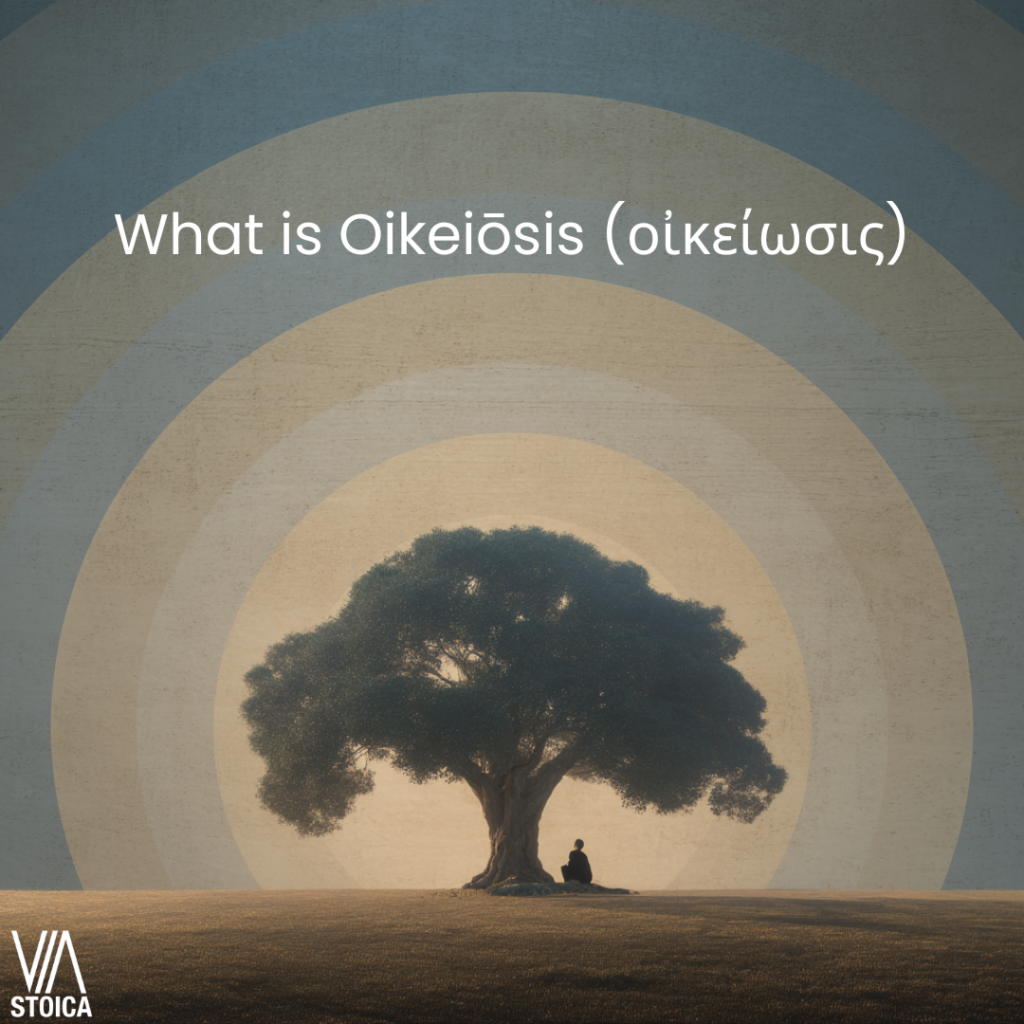
Oikeiōsis (οἰκείωσις) is a Stoic concept meaning “self-appropriation”, the natural process by which a rational being recognizes itself as its own and gradually expands concern from the self to others, forming the foundation of Stoic ethics.
Why Oikeiōsis Still Matters
In a world full of distraction, division, and confusion about identity, the ancient Stoic concept of oikeiōsis offers a quietly radical idea: we become ethical not by obeying rules, but by growing into ourselves, and then expanding that sense of “self” to include others.
At its core, oikeiōsis is the process of self-appropriation, of recognizing what is truly “ours,” aligning with our rational nature, and extending our moral concern outward. It’s the psychological and spiritual foundation of Stoic ethics.
If you’ve ever wondered how the Stoics connected personal development with justice, love, and virtue, this concept is where it begins.
Breaking Down the Word: Οἰκείωσις
The Greek term οἰκείωσις (oikeiōsis) comes from:
- οἶκος (oikos) – home, household
- οἰκεῖος (oikeios) – familiar, one’s own, related
- οἰκειόω (oikeioō) – to make one’s own, to appropriate
Literal meaning: “Making something one’s own”
Philosophical meaning: Developing a sense of belonging to oneself, and then to others
For the Stoics, this wasn’t just a metaphor. They believed oikeiōsis was the natural unfolding of reason, guiding us from instinctual self-preservation toward conscious ethical living.
Key Dimensions of Oikeiōsis
Oikeiōsis unfolds in two major stages:
• Primary Oikeiōsis — Self-awareness and self-care
- Begins at birth: a living being becomes aware of its own body and seeks to preserve it
- Lays the groundwork for rational self-love
• Secondary Oikeiōsis — Expansion of moral concern
- As reason develops, we begin to recognize others as “like us”
- This leads to empathy, community, and justice
Hierocles described this expansion as concentric circles of concern — with the self at the center, and family, community, and all humanity gradually drawn inward through ethical development.
Core Principles Connected to Oikeiōsis
- Arete (ἀρετή): Virtue begins when we act in accordance with our rational nature and extend that concern outward.
- Reason (λόγος): Oikeiōsis relies on our rational capacity to recognize the common humanity in others.
- Nature (φύσις): Living according to nature means recognizing our social nature — we are meant to connect, not isolate.
- Wisdom (σοφία): True wisdom includes understanding that the good of others is not separate from our own.
- Community (κοινωνία): Oikeiōsis creates the ethical foundation for cosmopolitanism, seeing all people as part of a shared moral order.
Oikeiōsis vs. Selfish Individualism
A common misunderstanding is that self-appropriation means becoming self-centered. But for the Stoics, it’s the opposite.
Oikeiōsis teaches us that true care for the self naturally leads to care for others. Ethical development isn’t about abandoning the self; it’s about realizing the self is part of something larger.
Why Oikeiōsis Is Central to Stoicism
Without oikeiōsis, Stoic ethics would be just abstract theory. But with it, Stoicism becomes a deeply human and progressive practice.
This concept appears in the writings of Chrysippus and Hierocles and is echoed in Marcus Aurelius, who writes:
“What injures the hive injures the bee.” Marcus Aurelius, Meditations, 6.54
From this foundation, Stoic ethics grows, from personal clarity to universal justice.
How to Practice Oikeiōsis Today
You don’t need to be a philosopher to live this idea. Here are 4 ways to embody oikeiōsis:
1. Daily self-reflection
- Ask: What part of me am I developing today?
- Focus not on image, but on character.
2. Circle expansion exercise
- Visualize your ethical circles — self, loved ones, community, strangers
- Think of one action that brings someone from an outer circle closer
3. Practice ethical self-care
- Treat yourself with respect and discipline, not indulgence
4. Recognize shared humanity
- In moments of conflict, ask: How is this person like me?
- Practice viewing others through the lens of oikeiōsis
Common Questions About Oikeiōsis
What does oikeiōsis mean in Stoicism?
It refers to the natural process of self-awareness and moral development, starting with care for the self and expanding outward to others.
Is oikeiōsis similar to empathy?
In some ways, yes, but it’s grounded in reason, not emotion. It’s a rational recognition of shared nature.
Can anyone develop oikeiōsis?
Yes. The Stoics believed every rational being has the capacity to practice and grow this ethical sense.
The Ethical Journey Inward and Outward
Oikeiōsis reminds us that Stoicism is not about suppressing emotion or detaching from others. It’s about developing our nature, rational, social, and ethical, in a way that makes us more fully ourselves and more connected to the world.
This is self-care as self-development. And this is where ethics begins.
Start caring about yourself
Pause once today to ask: What part of myself feels truly mine? How can I bring someone else into that sense of care? That’s oikeiōsis in motion.
Want to go deeper?
Explore our Stoic Philosophy Terms Guide or book a free consultation with a Stoic Coach to bring these principles to life. You can also listen to the Via Stoica podcast on Spotify or Apple Podcasts, or watch us on YouTube.
Author Bio
Benny Voncken is the co-founder of Via Stoica, where he helps people apply Stoic philosophy to modern life. He is a Stoic coach, writer, and podcast host of The Via Stoica Podcast. With almost a decade of teaching experience and daily Stoic practice, Benny creates resources, workshops, and reflections that make ancient wisdom practical today.
Related Posts
-
 Greek Stoic Philosophy Terms
What Is Ekklisis? The Stoic Art of Avoiding What Harms Your Character
What Is Ekklisis? Ekklisis in Stoicism is the rational refusal to engage with what would damage one’s moral choice. The Stoic meaning of ekklisis is important because it teaches us what to turn away from, not out of fear, but out of commitment to living well. In daily life, ekklisis helps us step back from […]
Read more -
 Via Stoica Podcast
A Hark Audio Curated Stoic Playlist for 2026
At the start of a new year, there is often an unspoken promise that things will somehow be different. Calmer. More ordered. More predictable. Yet life rarely follows that script. Delays disrupt flights, plans break down, people drift away, and life brings events we cannot control. What we can work on, and what Stoicism has […]
Read more -
 Book Reviews
The Stoic Leader by John Sellars and Justin Stead
The Stoic Leader introduces Stoicism as a practical philosophy and explores how its principles shape leadership, judgment, and character in both work and life. Summary Written by John Sellars and Justin Stead, The Stoic Leader offers what is effectively two books in one. Sellars provides an introduction to Stoicism and its philosophical foundations, while Stead […]
Read more

Comments 0