
What is Privilege?
What is privilege and why is it such a tense subject? Who has this advantage and what does that mean to them? What are your personal responsibilities in all of this? The main objective should be fo create equality of all.

There are people in our society who have certain privileges given to them at birth. That could be gender, the color of their skin, or the location where they were born. This is a hot topic because many feel attacked or misunderstood. Better yet, both sides feel misunderstood as there is no open line of communication to listen and respect each other for their struggles.
What is privilege, and why is it such a tense subject? Who has this advantag,e and what does that mean to them? On the other side, we see that there are large groups of people who have far steeper obstacles to climb to reach the same level of prosperity. Would that mean that there are different levels of privilege, and is there always a bigger fish? What are your personal responsibilities in all of this?
“Privilege – a special right or advantage that a particular person or group of people has”
Oxford Dictionary
A poster boy of privilege
Looking at the definition of the word, we could discuss that privilege is a point of view. If a person or a group of people has an advantage that you don’t have, then they are privileged as seen from your situation. But in this reflection, I wish to have a broader look and take a larger marginalized group and compare their situation to the people who have an easier start. In this case, we can look at the living situation, the work situation, the travel situation, and other aspects of life.
Let me start with myself. I am a white male from a prosperous European country. Although I wasn’t born into a wealthy family, I had everything a child could ask for. Even as a young adult, there was nothing I missed. This is all because of the tremendous effort my parents made to create these opportunities for me. To top it off, I have a very loving family who supports me. Considering all these facts, I could be a poster boy for the definition of privilege given above. Although I’m not sure if I would pass the screen test to make it to the photoshoot.
No undermining accomplishments

How do I feel about this, and what does the word privilege mean to me? The reason why I rarely play in a lottery is that Lady Fortuna has already been kind to me. Your birth is your first encounter with the randomness of life. This will have a great impact on how your life will unfold. Yet it is not all-determining; there are other factors at play that will shape you and the future that awaits. We will have many more dealings with ‘luck,’ and all this will forge us into the person we are at present. It will continue to form us as we go along.
One of those factors is how hard or smart you work and what you do with the opportunities you are given. Some people feel that the word privilege diminishes their success. They stress that it requires long hours and sacrifices to achieve their successes. And there is no denying that. Achievements don’t come easy, and they demand effort. That’s why it has nothing to do with undermining those accomplishments. However, we should look at the starting position of everyone and the number of obstacles there are on their path.
Privileges in the workspace
There is a good example to look at among the ancient Stoics. From entries in his Meditations, we can read that Marcus Aurelius, the Roman Emperor, looked to Epictetus as a role model. He thanks his mentor, Rusticus, for introducing him to the teaching of Epictetus. Where Marcus Aurelius was born into the high ranks of Roman society, Epictetus started his life in slavery. We could take an example from both of them. Epictetus became one of the most famous Stoic teachers, and Marcus Aurelius gave us the closest example to Plato’s philosopher-king. To perform one’s duties and live a virtuous life, even with ultimate power. Many current leaders and people in power could learn a thing or two from these philosophers.
For argument’s sake, let’s leave out the situation at the beginning, but look at the obstacles. There can be no discussion about the fact that there are inequalities in the workplace. Some might say that men have to do more physically demanding jobs, such as skilled labor. And while there are also examples of women working as plumbers, masons, or electricians, it is predominantly male. But can you tell me that being a teacher or a nurse is less straining? As a teacher myself, I know how tough it can be. Not only the physical aspect, but the mental one plays a massive role in both. The difference is that the pay gap between the fields is tremendous.
Is our world not free enough?

That’s one example, but I wish to explore a few more. First, I want to look at traveling or being able to work wherever you want. Nationality is often overlooked by those with strong passports. I would like to invite you to plan a holiday with someone from a country that has strict visa demands from a vast number of countries in the world. And then observe when you get to the destination, the long, gruesome queues and interrogations they have to endure, while you are already sipping your coffee.
Then there is the profiling based on skin tone and looks. Or the clothes someone chooses to wear because of their culture and beliefs. Is our world not free enough to accept everyone, or is it only free for those who conform to our comfort zone? And I myself wasn’t always aware of these things, I have to admit. But by traveling and interacting with people from different places, you see their struggles. Those are the moments where I feel privileged and witness the harsh truth of inequality that surrounds us. Even in the open-minded, free Western world.
Can you look yourself in the eye?
Why is this such a charged topic? Because there are two sides. One side is trying to fight to be on a level playing field and to have the same opportunities as the rest of the world, and not be scrutinized for things they have no control over. The other side is the group that does have that extra advantage. They feel threatened by the possibility of losing some of these privileges. If there are more people available to do certain jobs, then their chances decrease. They might do it for lower salaries, and then what will happen to me? From Daniel Kahneman’s book Thinking, Fast and Slow, we learn that it is more difficult to lose something than to gain something. That’s why the fear in this second group is harder to bear than the possible gain of being on equal footing.
“The response to losses is stronger than the response to corresponding gains. This is loss aversion.”
Daniel Khaneman, Thinking, Fast and Slow, p. 282-283

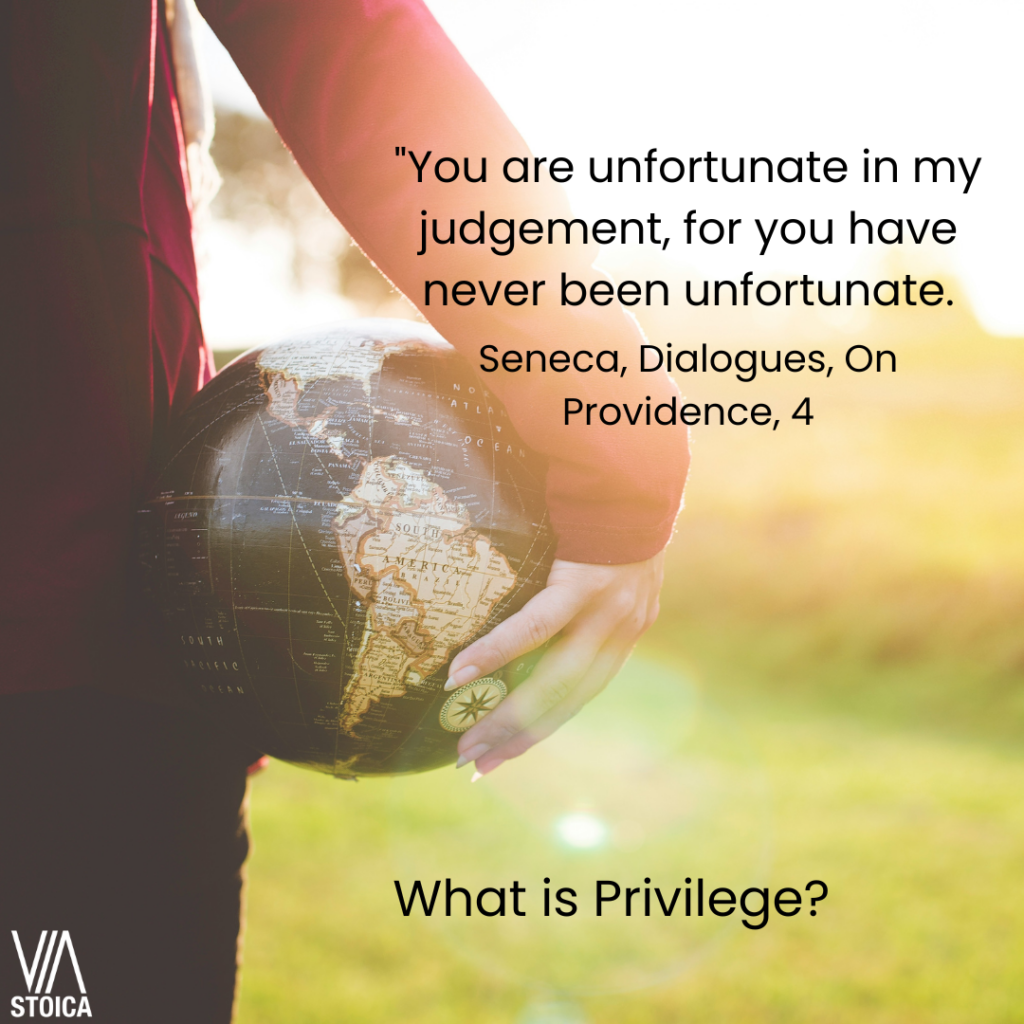
It is not my belief that those who work hard and have reached the success they desire should feel guilty. Not even those who didn’t have to work hard and have been given an easy life to lead. There is no need to feel bad if you have been living a virtuous life. At the end of the day, everyone needs to look themselves in the eye and ask if they’re content with their existence. Seneca shows us that a life without struggle is an unfortunate one.
“You are unfortunate in my judgement, for you have never been unfortunate. You have passed through life with no antagonist; no one will know what you were capable of, not even yourself.”
Seneca, Dialogues, On Providence, 4
Understanding our differences
Having viewed the different perspectives, it is now time for us as a society, a global society, to come together and reflect on this as a whole. Because there is no escaping the increasing world population, and at one moment, it will all be mixed. It is now time to work toward one goal, to do the right thing, and to live in harmony
To achieve that, we need to start listening to each other and showing compassion. Both sides need to hear and feel each other. If we can’t understand our differences and our fears or struggles, then we will always stand on opposing sides. This will only make things worse. We should start by improving our educational system and making it accessible to all. Proper education is the foundation of every society and shouldn’t be a privilege, but a basic human right. At the same time, we must ensure that it is safe for everyone to participate or simply exist in our society. Walking on the street can be a horrible experience for women, and we men need to reflect on our behavior to make a change. Getting hired for a job can prove to be almost impossible if you have an uncommon name.
A world without privilege
These aren’t always things we think about when we don’t have to deal with them, but they happen. As a non-native English teacher, I was let go of certain teaching jobs because I wasn’t British or American. That was not easy to accept, but it was also the profession I had chosen. This meant I had to work a lot harder, even if I thought I was a better teacher than some. My example is only an illustration, and it’s nothing compared to what others have to go through. And sometimes life is unfair, no matter your background or gender. This is what happens. But there are many aspects we can change to make it more equal for everyone and make sure that everyone has the same opportunities.
Let’s try to come together as a world to understand where everyone is coming from. We should be able to remove privilege from our vocabulary if we have more equality. We can create a world in which everyone has the same opportunity to make the best of their lives if they choose to do so. As long as everyone takes their responsibility to improve our co-existence.
Want to explore more Stoic Practice?
Book a free consultation with one of our Stoic Coaches to get support. Or read more about How to Practice Stoicism here. Listen to the Via Stoica Podcast on Spotify, Apple Podcasts, or YouTube.
Author Bio
Benny Voncken is the co-founder of Via Stoica, where he helps people apply Stoic philosophy to modern life. He is a Stoic coach, writer, and podcast host of The Via Stoica Podcast. With almost a decade of teaching experience and daily Stoic practice, Benny creates resources, workshops, and reflections that make ancient wisdom practical today.
Related Posts
-
 Greek Stoic Philosophy Terms
What Is Ekklisis? The Stoic Art of Avoiding What Harms Your Character
What Is Ekklisis? Ekklisis in Stoicism is the rational refusal to engage with what would damage one’s moral choice. The Stoic meaning of ekklisis is important because it teaches us what to turn away from, not out of fear, but out of commitment to living well. In daily life, ekklisis helps us step back from […]
Read more -
 Via Stoica Podcast
A Hark Audio Curated Stoic Playlist for 2026
At the start of a new year, there is often an unspoken promise that things will somehow be different. Calmer. More ordered. More predictable. Yet life rarely follows that script. Delays disrupt flights, plans break down, people drift away, and life brings events we cannot control. What we can work on, and what Stoicism has […]
Read more -
 Book Reviews
The Stoic Leader by John Sellars and Justin Stead
The Stoic Leader introduces Stoicism as a practical philosophy and explores how its principles shape leadership, judgment, and character in both work and life. Summary Written by John Sellars and Justin Stead, The Stoic Leader offers what is effectively two books in one. Sellars provides an introduction to Stoicism and its philosophical foundations, while Stead […]
Read more

Comments 0