
Book Review: How to Think Like a Roman Emperor – Donald Robertson
Book review: How to Think Like a Roman Emperor is a must-read for anyone interested in Stoicism, Roman History, or self-help, and here's why.
The most compelling introduction to Stoicism available, built around the man who practiced it under the most demanding conditions in history.
| Author | Donald Robertson |
| Year | 2019 |
| Difficulty | Entry-level with a strong emphasis on practice |
| Via Stoica score | 10 / 10 |

Core argument
Robertson argues that Marcus Aurelius is uniquely qualified to teach Stoicism, not because he wrote philosophy but because he lived it. An emperor, a general, a grieving father, and a private philosopher in his notebooks: his life was a stress test for everything Stoicism claims to offer. The tools he used are not historical artefacts. Robertson shows, through the lens of cognitive-behavioural therapy, that they form a working psychological system available to any reader willing to apply them.
Summary
Donald Robertson is a cognitive-behavioural therapist, author, and one of the most prominent voices connecting Stoicism to modern psychology. His background as a practicing therapist gives this book something most Stoic introductions lack: a clinical understanding of why the exercises work and what they actually do to the mind.
The book opens with Marcus Aurelius’s final moments. From there, it moves through his life in roughly chronological order: his upbringing, his teachers, the people who shaped him, and the philosophy he built his life around. Each chapter pairs a phase of Marcus’s life with a specific Stoic practice. Robertson then draws the connection to modern CBT, showing the reader how ancient and contemporary approaches to the mind have more in common than either tradition often acknowledges.
The final chapter stands apart from the rest. It enters the mind of Marcus Aurelius in his last hours, functioning simultaneously as a historical scene, a Stoic meditation on death, and a summary of everything that came before. It is one of the most effective closing chapters in the genre.
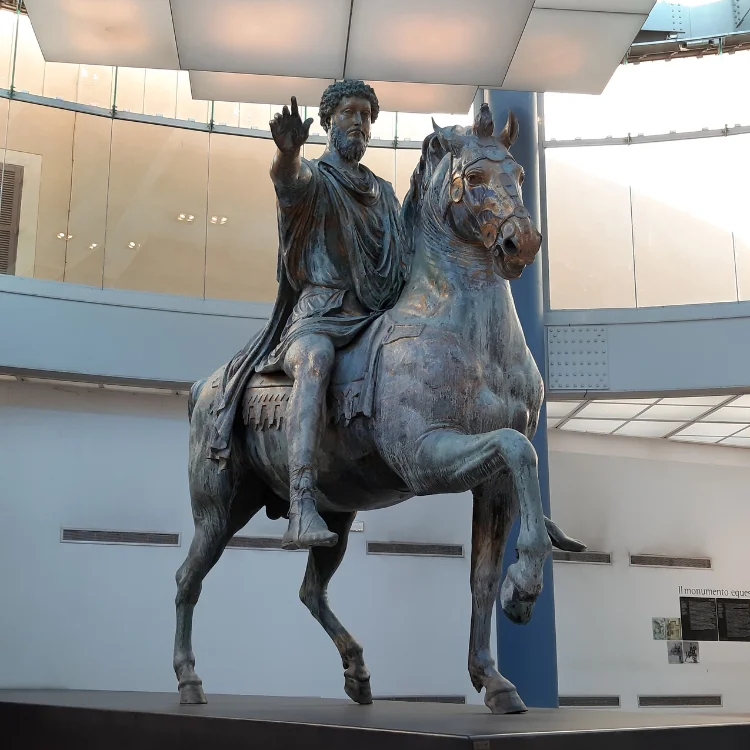
A personal note: reading the Meditations gave me a picture of Marcus Aurelius. Reading this book brought that picture to life. It added color, context, and above all, a human being behind the words. In a real sense, it brought Marcus Aurelius into my life, not just my reading. Standing in front of his statue at the Capitoline Museum in Rome felt entirely different after this book.
"Marcus Aurelius faced colossal challenges during his reign as emperor of Rome. The Meditations provides a window into his soul."
Donald Robertson, How to Think Like a Roman Emperor, Introduction, p. 14
Review
Robertson writes with the familiarity of someone who has spent years with both the primary sources and their modern psychological equivalents. There is genuine affection for Marcus Aurelius on every page. It shows in the detail and in the willingness to present him as a full human being, not a philosophical ideal.
The CBT connections are the book’s most distinctive contribution. Other introductions to Stoicism note the parallels in passing. Robertson maps them thoroughly and shows exactly how the Stoic exercises anticipate techniques that clinical psychology arrived at independently two thousand years later. For a reader with any interest in psychology, this is the most illuminating aspect of the book.
Compared to The Inner Citadel by Pierre Hadot, this book is the more accessible starting point. Hadot goes deeper into the three Stoic disciplines as spiritual exercises, and he is essential reading for anyone who wants to understand the Meditations at a scholarly level. Robertson, however, is the right first guide. He makes the territory navigable and gives the reader something to practice immediately. I would only reach for the Inner Citadel once this book has been read.
Who this book is for
This book suits anyone drawn to Stoicism, Roman history, Marcus Aurelius, or modern psychology. It requires no prior knowledge of philosophy. The writing is accessible and the structure pulls the reader forward without effort.
It works equally well before or after reading the Meditations. Reading it before gives the Meditations a biographical frame. Reading it after fills in everything Marcus Aurelius left unsaid about his own life. Either way, it sends the reader back to the primary text with more to look for.
For anyone with a background in psychology or therapy, the CBT chapters are particularly rewarding. Robertson draws the connections clearly enough that the book functions as both a Stoic introduction and a practical self-help guide, without the weaknesses that usually accompany either category.
Via Stoica verdict
There is no flaw I can find in what this book set out to do. It delivers a rigorous, personal, and practically useful introduction to Stoicism through the life of its most compelling practitioner. Furthermore, it changed how I experience Rome, the Meditations, and the philosophy itself. A score of 10 out of 10 for a book that earns its place at the top of any Stoic reading list.
Via Stoica connection
I spoke with Donald Robertson about this book on the Via Stoica Podcast. Watch the conversation on YouTube. Robertson has also returned to the podcast to discuss How to Think Like Socrates, which takes the same biographical approach to philosophy and applies it to another foundational thinker. You can buy How to Think Like a Roman Emperor on Amazon.
For the broader Marcus Aurelius context, the Via Stoica article on Marcus Aurelius is a natural companion to this review.
Read next
Explore more from the Via Stoica book review library:

The Inner Citadel
Pierre Hadot
How to Be a Stoic
Massimo Pigliucci
A Guide to the Good Life
William B. Irvine


Comments 0