
Budgeting Like a Stoic: How to save more Money
Budgeting like a stoic: How to save more money. This post will show you how Stoicism can help you set a better more personalized budget and help you save more money.

Budgeting like a Stoic can save you a lot of money. This is a sentence that sounds powerful to me. To be honest, doing anything like a Stoic works for me. But that’s my personal view. In our modern society, money seems to have taken center stage. We spend a lot of time gathering the money we need to spend on the little free time we have. While others do their best to think of ways to get that money from us. Who better to turn to than the Stoics to find a middle ground and take control of our lives?
How can I combine philosophy and a topic like money? Shouldn’t the first be to make life beautiful, and the second be discarded as the source of evil? Let’s face it, money is an important part of our lives. And since it does, we should apply philosophy to it. Our goal is to live a peaceful and content life; therefore, reducing the hold money has over us is quite important. In this article, I want to look at our budget and how Stoicism can help us improve it and stick to it.
Not to be money’s slave
The link between money and Stoicism has been made in other posts: Become Financially Independent with Stoicism and Investing Like a Stoic. Now we will ask the Stoics how they can help us with our budget. We will look at making it more efficient and try to understand what our budget might say about us. First, it is important to know what a budget is, and then let the Stoics walk us through it. Our main source will be Seneca. He was one of the wealthiest people of his time by investing the money he made as a public figure, high up in the ranks. This often led to him being scrutinized as a hypocrite. How can a Stoic have so much money and still live virtuously? Whenever this topic arises, you can sense that he’s defending himself. But for the Stoics, wealth is referred to as a preferred indifference.
As long as money doesn’t make us its slaves and we can control our relationship with it, having it is not a problem. It all depends on how we get it and how high the price we have to pay to keep it. As Seneca teaches us in On the Happy Life:
“For the wise man regards wealth as a slave, the fool as a master, the wise man accords no importance to wealth, but in your eyes wealth is everything.”
Seneca, Dialogues and Essays, On the Happy Life, 26
A budget can reduce anxiety

Having a good budget can help our relationship with money be healthier. What do we understand by a budget? It might sound straightforward, and it is. In your budget, you look at the money coming in and the money going out. You want the first part to be higher than the second one. This is an easy equation to remember, but our wants and desires can mess this up.
Our budget is a mirror of who we are. Read more about this concept and how to read your mirror here: How Our Mirror Fails to Reflect. This list of incomes and expenditures can tell us a lot about ourselves. It can be the cause of great anxiety. If our lifestyle doesn’t match the money we make, then we have a problem. We’re either stuck in a job we don’t want or we can’t make ends meet.
A good budget should help us achieve more freedom and peace. One of the four virtues, Temperance, will be our guide. But we will use all the tools we’ve been shown by the Stoics to budget as they would. Let’s rid ourselves of the control money has over us. We’ve learned how to deal with control and what we can control. Epictetus showed us our way by telling us that the only things we can control are what we do, our opinions, desires, and aversions. To sum up, our actions.
I cut my spending in half
Unfortunately, there are a lot of forces trying to take that control away from us. There are influences from the outside who try to drag us into wanting more and having certain opinions about what is proper to wear, own, or spend our time on. When looking at our budget like a Stoic, we should ask ourselves about every item: ‘how important it is to us’. Can we reduce our spending on groceries if we buy non-branded goods? Can we find ways of making our next holiday more interesting, yet cheaper? Let me give you a short personal example.
At one point, I started tracking all my expenses on an app. After a month or two, I showed a close friend the results. She was astonished at how much I spent on groceries. This made me realize that I was going to an expensive supermarket. I went there because those were the fancy products, and others were buying them. I experimented by going to a different place and ended up cutting my spending in half without any effort.
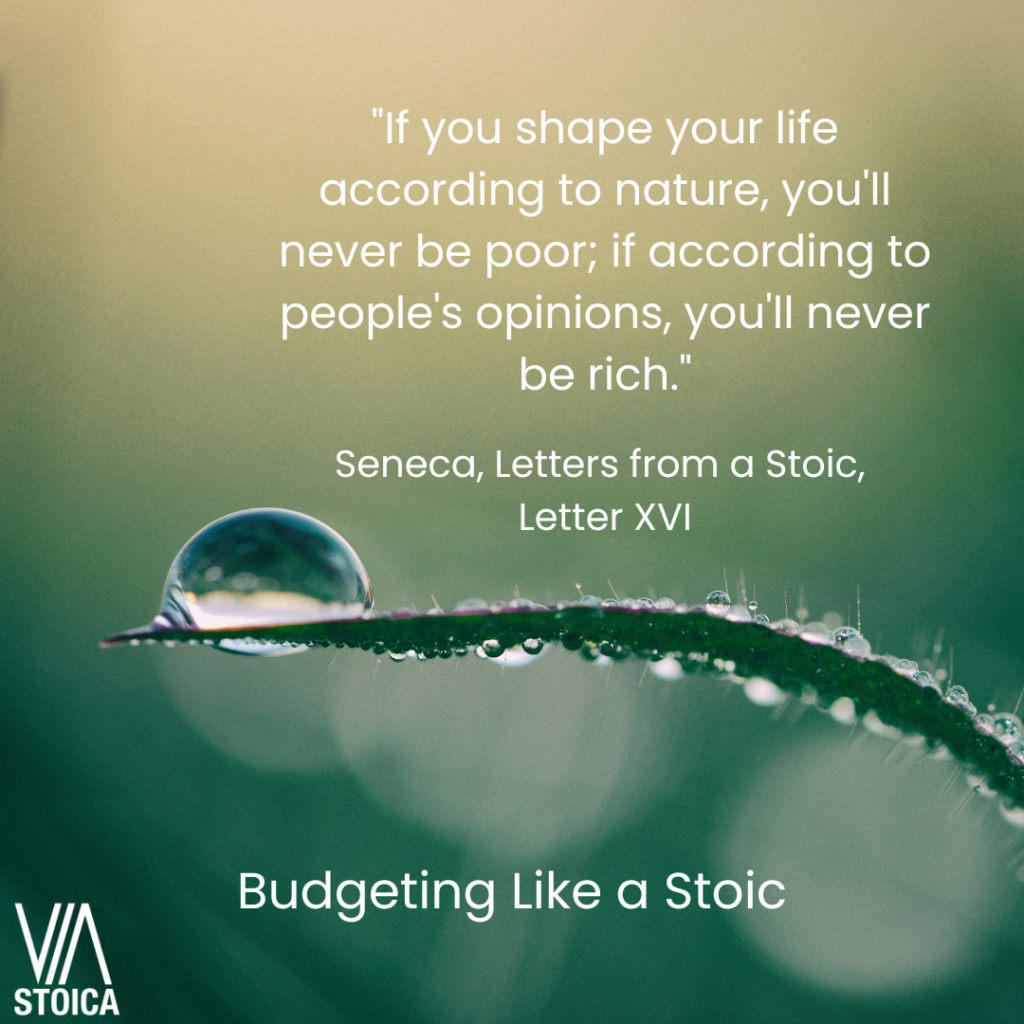
“If you shape your life according to nature, you will never be poor; if according to people’s opinions, you will never be rich.”
Seneca, Letters from a Stoic, Letter XVI
Budget like a Stoic

This showed me that we are often moved to a certain lifestyle without knowing it. It’s like the story of boiling a frog, and don’t try this, but it illustrates it well. If you put a frog in boiling water, it will jump out. But if you put it in the cold water and then gradually raise the temperature, it will stay. Our wants and desires can have similar ways of taking over our expenses. That’s why keeping track of it is important. It can show you your wants and desires, and you can ask yourself whether this is who you want to be. I’m not saying you should be a minimalist, but this use of a budget is to check your priorities. Know what is important to you and make changes elsewhere to accommodate it.
Enter Temperance, one of the virtues in Stoicism. In learning how to control our wants and desires, we need to apply moderation to them. A good budget, as the Stoics would have, needs this quality. There is no need to deprive yourself or to indulge. As Seneca puts it in his letter on the Tranquillity of the Mind.
“Where money is concerned, the ideal amount is one that does not fall into poverty and yet is not far removed from poverty.”
Seneca, Dialogues and Essays, On the Tranquillity of the Mind, 8
Control desires to increase peace
Why does Seneca want us to stay away from poverty, yet not too far? Not having the money you require to live a good life can cause anxiety, but having too much can cause the same. We need to find that balance. Besides that, if we understand poverty, we can get a better appreciation for what we have. Having a lot will lead to wanting more. A life in moderation also includes our relationship with money.
Setting a good budget will allow you to reflect on what is important to you and to stay within your means. Many want more money because that will bring them the happiness they so long for. Yet, we know from Stoicism that we should learn to be content with what we have right now. By being grateful for what we have, we can add more value to our lives. The need to compare ourselves with others will go away. And as we control our desires, we can lower our anxiety and increase our peace.
What can we take from all of this? We’ve learned how to set a budget and approach it as a Stoic. Examine your wants and desires and see what they say about you. Do you need them, or is it what others make you feel you need? The first step is to track and list your expenses, and then, after a month, evaluate the list. if you look at this with a calm and rational view, you can see that there are ways to reduce the costs while still living a good life. Maybe even a better one, because you’ll give what you have more worth and you’ll reduce the worry about money. Therefore, learn to budget like a Stoic, and your life will be more peaceful.
“You should drop your desire; do not covet many things, and you will get what you want.”
Epictetus, The Discourses, Book 3, Chapter 9.22
Want to explore more Stoic Practice?
Book a free consultation with one of our Stoic Coaches to get support. Or read more about How to Practice Stoicism here. Listen to the Via Stoica Podcast on Spotify, Apple Podcasts, or YouTube.
Author Bio
Benny Voncken is the co-founder of Via Stoica, where he helps people apply Stoic philosophy to modern life. He is a Stoic coach, writer, and podcast host of The Via Stoica Podcast. With almost a decade of teaching experience and daily Stoic practice, Benny creates resources, workshops, and reflections that make ancient wisdom practical today.
Related Posts
-
 Greek Stoic Philosophy Terms
What Is Ekklisis? The Stoic Art of Avoiding What Harms Your Character
What Is Ekklisis? Ekklisis in Stoicism is the rational refusal to engage with what would damage one’s moral choice. The Stoic meaning of ekklisis is important because it teaches us what to turn away from, not out of fear, but out of commitment to living well. In daily life, ekklisis helps us step back from […]
Read more -
 Via Stoica Podcast
A Hark Audio Curated Stoic Playlist for 2026
At the start of a new year, there is often an unspoken promise that things will somehow be different. Calmer. More ordered. More predictable. Yet life rarely follows that script. Delays disrupt flights, plans break down, people drift away, and life brings events we cannot control. What we can work on, and what Stoicism has […]
Read more -
 Book Reviews
The Stoic Leader by John Sellars and Justin Stead
The Stoic Leader introduces Stoicism as a practical philosophy and explores how its principles shape leadership, judgment, and character in both work and life. Summary Written by John Sellars and Justin Stead, The Stoic Leader offers what is effectively two books in one. Sellars provides an introduction to Stoicism and its philosophical foundations, while Stead […]
Read more

Comments 0