
How Stoics Control Anger: Seneca’s Advice on Staying Calm
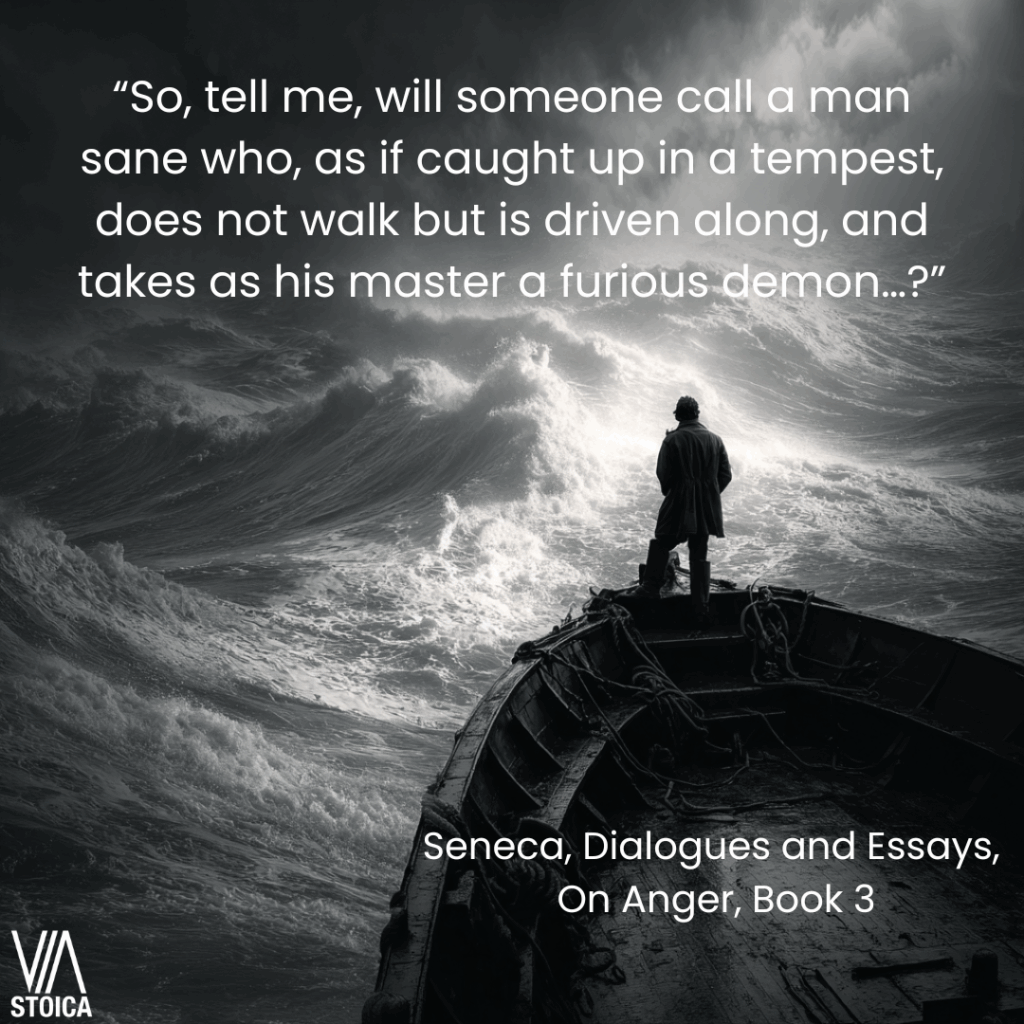
“So, tell me, will someone call a man sane who, as if caught up in a tempest, does not walk but is driven along, and takes as his master a furious demon…?”
Seneca, Dialogues and Essays, On Anger, Book 3
We’ve all felt it, that flash of heat rising in the chest, the mind clouding with fury, the impulse to lash out. In that moment, are we in control? Seneca would say no; he would say that we were caught by momentary insanity.
Read more: How to Control Anger Through Stoicism?
The Stoics believed that losing control to anger (what they called a pathos) was not just irrational, it was a form of madness. That’s why they placed such importance on mastering our inner reactions. One of the goals is to reach a state of Apatheia, where we would experience the good emotions: Eupathiai.
This quote paints a vivid image: the angry person isn’t walking through life; they’re being dragged like a leaf in a storm. No freedom, no direction, but slavery, misguided, and lost.
How Stoics Control Anger
At the heart of Stoic practice is the idea that emotions like anger come from false judgments. We believe someone has wronged us. We feel entitled to rage and deserve to express it. But for the Stoics, the real question is: Is this in accordance with the rational Nature? If not, the proper response is calm, not chaos.
Seneca’s advice is clear: don’t let yourself be possessed by anger. You are not your emotions. As a rational being, you can pause, reflect, and choose how to respond. You are a part of Nature, which is rational.
Learning how Stoics control anger doesn’t mean becoming emotionless; it means becoming free from the harmful ones and focusing on the positive emotions like joy.
How to Stay Calm Like a Stoic
- Catch the storm early. Recognize the moment your body tenses, your breath shortens. Learn to identify your signals.
- Ask the Stoic question. Am I acting rationally? If not, take a step back and review what is happening.
- Respond with reason. Choose words and actions that reflect your values and reason, not the furious tempest.
FAQ
How do Stoics control anger?
Stoics control anger by recognizing it as an irrational response to things outside their control, and by using reason to pause and reframe their perspective.
What does Seneca say about anger?
Seneca sees anger as a loss of sanity. He teaches that we must resist the impulse and avoid letting passion overtake reason.
Is staying calm Stoic?
Yes. Calmness reflects inner strength and clarity, two core Stoic concepts. But important to note, is that it needs to be achieved by reason and reflection.
Want to explore more Stoic strategies?
Book a free consultation with one of our Stoic Coaches or read more on the Seneca Quotes page. You can also listen to the Via Stoica podcast on Spotify or Apple Podcasts or watch it on YouTube.
Author Bio
Benny Voncken is the co-founder of Via Stoica, where he helps people apply Stoic philosophy to modern life. He is a Stoic coach, writer, and podcast host of The Via Stoica Podcast. With almost a decade of teaching experience and daily Stoic practice, Benny creates resources, workshops, and reflections that make ancient wisdom practical today.
Related Posts
-
 Greek Stoic Philosophy Terms
What Is Ekklisis? The Stoic Art of Avoiding What Harms Your Character
What Is Ekklisis? Ekklisis in Stoicism is the rational refusal to engage with what would damage one’s moral choice. The Stoic meaning of ekklisis is important because it teaches us what to turn away from, not out of fear, but out of commitment to living well. In daily life, ekklisis helps us step back from […]
Read more -
 Via Stoica Podcast
A Hark Audio Curated Stoic Playlist for 2026
At the start of a new year, there is often an unspoken promise that things will somehow be different. Calmer. More ordered. More predictable. Yet life rarely follows that script. Delays disrupt flights, plans break down, people drift away, and life brings events we cannot control. What we can work on, and what Stoicism has […]
Read more -
 Book Reviews
The Stoic Leader by John Sellars and Justin Stead
The Stoic Leader introduces Stoicism as a practical philosophy and explores how its principles shape leadership, judgment, and character in both work and life. Summary Written by John Sellars and Justin Stead, The Stoic Leader offers what is effectively two books in one. Sellars provides an introduction to Stoicism and its philosophical foundations, while Stead […]
Read more

Comments 0