
How to Stop Emotional Reactivity, Learn to Pause Before You React
How to stop emotional reactivity begins with learning to pause. Stoicism teaches that peace of mind comes not from controlling life, but from mastering our judgments about it.
What is emotional reactivity?
Emotional reactivity often feels like something that happens to you. A comment lands the wrong way, a situation feels unfair, or pressure builds, and before you have time to think, you react. Only afterward does reason return, when the emotional surge has passed, and judgment is no longer clouded.
Learn more about How to Practice Stoicism.
Stoicism offers a way to work with this pattern directly. Not by denying emotion, and not by forcing calm, but by learning to pause before you react. In that pause lies choice, and in choice lies freedom.
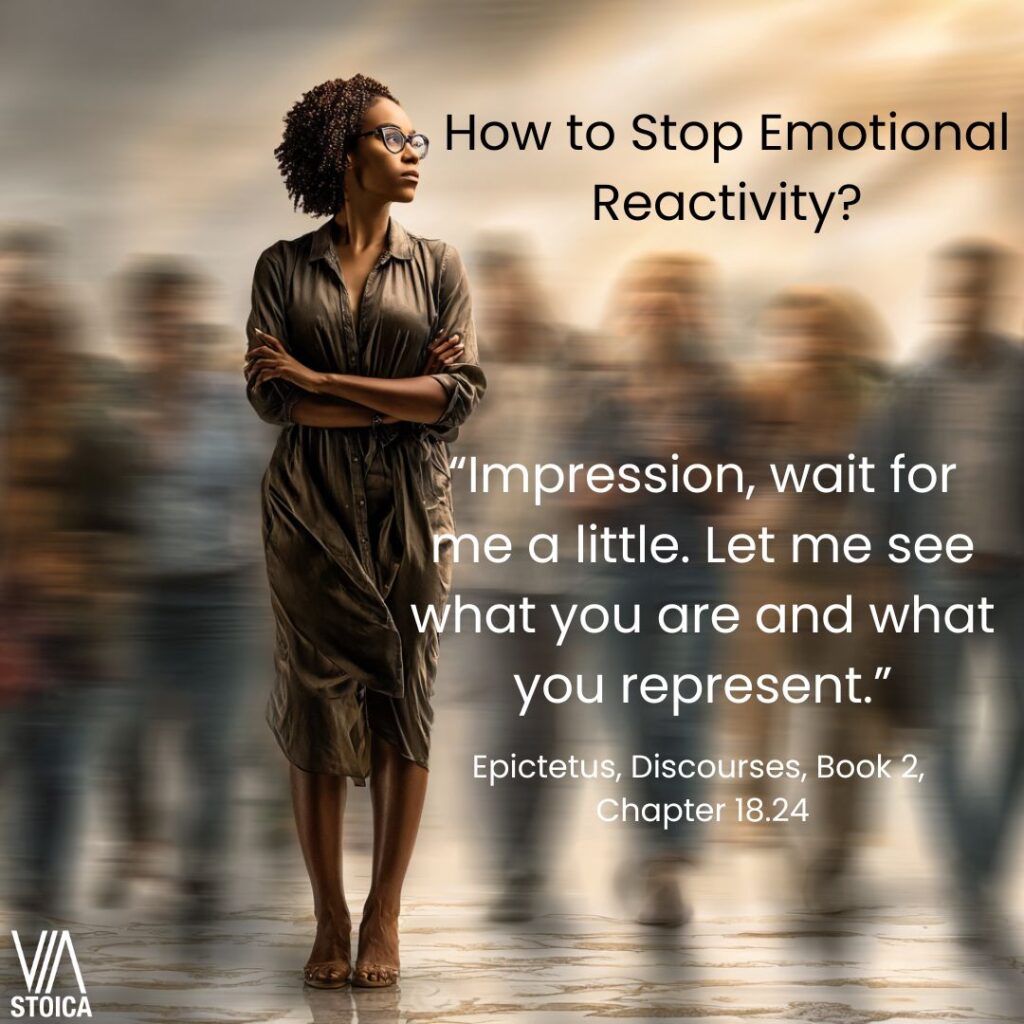
“Impression, wait for me a little. Let me see what you are and what you represent.”
Epictetus, Discourses, Book 2, Chapter 18.24
What Emotional Reactivity Is
In psychology, emotional reactivity has a precise meaning. It refers to how strongly a person reacts emotionally, how quickly that reaction reaches its peak, and how long it takes to return to baseline. As researchers describe it, emotional reactivity concerns
“the emotional response to an event that may vary between individuals in terms of intensity, the speed at which it reaches its peak, and return from this peak back to baseline”
Davidson, 1998; Rothbart & Derryberry, 1981
In everyday life, emotional reactivity shows up more practically. Ordinary or even benign situations trigger responses that feel disproportionate. A small comment feels like an attack. A delay feels like rejection. Stress, fatigue, or depleted emotional resources reduce our ability to regulate ourselves, making reactions feel automatic rather than chosen. As Psychology Today notes, emotional reactivity often involves“overreacting negatively to normal or even benign stimuli,” especially under conditions of stress or strain:
The defining feature is not emotion itself. Emotion is natural. Emotional reactivity is the loss of a pause between what happens and how you respond.
Why Emotional Reactivity Happens
From a Stoic perspective, emotional reactivity follows a clear sequence:
- Something happens externally
- An impression appears in the mind
- An impulsive and unexamined judgment is formed about that impression
- A pre-emotion arises
- Action follows, often before reflection has taken place
The important Stoic distinction is this: the pre-emotion is not yet a full emotion. It is an initial, automatic response, a physiological and psychological movement that arises from long-held beliefs and habits. It happens quickly and without conscious choice.
A full emotion, in the Stoic sense, is only formed when assent is given to the impression, when the judgment is consciously accepted as true. Emotional reactivity occurs when this assent happens immediately and without examination.
The crucial insight is that the event itself does not cause the reaction. The judgment about the event does. This idea lies at the heart of Stoicism and is stated clearly by Epictetus, who taught that people are disturbed not by events themselves, but by the views they take of them.
When judgments arise instantly and go unquestioned, reactions feel inevitable. When judgment is delayed, even briefly, the pre-emotion is allowed to pass, emotional intensity weakens, and reason can resume its role.
This is where emotional reactivity can be interrupted. When we are unable to pause and examine the pre-emotion, the impulsive judgment is accepted as truth. That unexamined judgment then becomes the basis for our choice and action.
The Pause, Where Freedom Begins

Learning to pause before reacting does not mean suppressing emotion or becoming passive. It means creating a small space between what appears in the mind and what you do next.
That space does not need to be large. Sometimes a single breath is enough. But even a brief pause interrupts emotional momentum.
For the Stoics, this pause is where freedom exists. You cannot control which impressions arise. You can control whether you agree with them. That act of agreement is what the Stoics called assent.
How to apply the pause?
Applying the pause is where the real work begins. This is not a one-size-fits-all practice. How you create space between impulse and action will differ from person to person, which is why experimentation and repetition matter.
Simple techniques can help interrupt automatic reactions. You might take a slow breath, step outside for a short walk, or use a small physical cue, such as switching a rubber band from one wrist to the other, as a reminder to pause. The technique itself matters less than the moment of interruption it creates.
This is where the practice becomes personal. By testing what works for you, you begin to learn how your own reactivity operates. More importantly, you become aware that pausing is an option. And the moment you recognize that option, you are no longer fully caught in the trigger itself.
Stoicism and the Practice of Assent
Stoicism distinguishes between impressions and assent.
An impression is what presents itself to the mind in response to an external event. The event itself is neutral; the meaning we attach to it is not. For example:
- He took my money → “This is unfair.”
- She criticized my work → “This is an insult.”
- My plan got canceled → “This should not be happening.”
Assent is the moment you accept that impression as true. When assent is immediate, emotion moves straight into action without reflection.
Stoic practice focuses on slowing this moment down. Not to deny emotion, but to ensure that action follows reason rather than impulse. As Marcus Aurelius trained himself to do, the task is to observe events plainly and remove unnecessary judgments that distort our responses.
With the pause in place, the same situations can be approached differently:
- He took my money → “What is within my control here, and what should I do next?”
- She criticized my work → “Is there something here I can learn or improve?”
- My plan got canceled → “What other options are there?”
The event does not change. What changes is the judgment, and with it, the response.
Stoic Practices to Stop Emotional Reactivity

Name the Impression
When emotion rises, silently say:
“This is an impression.”
This creates distance and reminds you that what you are experiencing is an interpretation, not the event itself.
Delay the Response
Commit to not reacting immediately.
You do not need the perfect response. You need time. Pausing before speaking or acting allows emotional intensity to crest and pass. The Stoics understood that false judgments lose force when they are not instantly obeyed.
Examine the Judgment
Once you have paused, examine the judgment behind the emotion.
Ask:
- What exactly am I judging as good or bad here?
- Is this within my control?
- Am I adding meaning that is not actually present?
This redirects attention from emotion to rational evaluation.
Broaden Your Perspective
Step back mentally and consider the situation from a wider perspective. How important will this be later today? In a week? From a broader human standpoint?
Seneca warned that many disturbances gain power only because we stay too close to them.
What Stoicism Is Not Asking You to Do
Stoicism does not ask you to suppress emotion or pretend that nothing affects you. Emotional responses are natural.
The goal is not constant calm. The goal is alignment between judgment, character, and action.
Stoicism helps you respond deliberately rather than react reflexively.
What Progress Looks Like
Progress with emotional reactivity is gradual.
Reactions soften. Recovery becomes quicker. Regret appears less often. You still feel emotions, but reason returns sooner and guides action more reliably.
That is Stoic progress.
Frequently Asked Questions
Is emotional reactivity the same as being emotional?
No. Being emotional means experiencing emotions. Emotional reactivity refers to reacting quickly and disproportionately, without reflection.
Does Stoicism teach emotional suppression?
No. Stoicism teaches discernment. Emotions arise naturally, but actions should follow reason rather than impulse.
Can Stoicism help with anger and anxiety?
Yes. Stoicism focuses on the judgments that fuel anger and anxiety, helping reduce their intensity and duration.
How long does it take to see results?
Some people notice small changes quickly, such as pausing more often or recovering faster. Deeper change comes through steady practice. It is all about making progress, not about being perfect. Focus on making improvements one event at a time and learn to welcome them to grow.
Want to Explore More Stoic Practices?
Book a free consultation with one of our Stoic Coaches to get support. Or read more about Stoicism for Everyday Life. Listen to The Via Stoica Podcast on Spotify, Apple Podcasts, or YouTube.
Author Bio
Benny Voncken is the co-founder of Via Stoica, where he helps people apply Stoic philosophy to modern life. He is a Stoic coach, writer, and host of The Via Stoica Podcast. With nearly a decade of teaching experience and daily Stoic practice, Benny creates resources, workshops, and reflections that make ancient wisdom practical today.
Related Posts
-
 Greek Stoic Philosophy Terms
What Is Ekklisis? The Stoic Art of Avoiding What Harms Your Character
What Is Ekklisis? Ekklisis in Stoicism is the rational refusal to engage with what would damage one’s moral choice. The Stoic meaning of ekklisis is important because it teaches us what to turn away from, not out of fear, but out of commitment to living well. In daily life, ekklisis helps us step back from […]
Read more -
 Via Stoica Podcast
A Hark Audio Curated Stoic Playlist for 2026
At the start of a new year, there is often an unspoken promise that things will somehow be different. Calmer. More ordered. More predictable. Yet life rarely follows that script. Delays disrupt flights, plans break down, people drift away, and life brings events we cannot control. What we can work on, and what Stoicism has […]
Read more -
 Book Reviews
The Stoic Leader by John Sellars and Justin Stead
The Stoic Leader introduces Stoicism as a practical philosophy and explores how its principles shape leadership, judgment, and character in both work and life. Summary Written by John Sellars and Justin Stead, The Stoic Leader offers what is effectively two books in one. Sellars provides an introduction to Stoicism and its philosophical foundations, while Stead […]
Read more
Comments 0