
Tao vs Logos: Five Quotes from the Tao Te Ching
Tao vs Logos: Five Quotes from the Tao Te Ching to compare the Stoic idea of Nature with Taoism. How do they match up and are they similar?

Tao vs Logos, here are five quotes from the Tao Te Ching to find harmony between these two concepts. While reading the Tao Te Ching by Lao Tzu, the Stephen Mitchell translation, I couldn’t help but see connections with Stoicism. After reading the notes by the translator, these links became even clearer. The Stoics wouldn’t have been surprised to learn that people in other parts of the world came to similar ideas of how to live a good life. And the link between the Tao and the Logos is one example that they were right.
We will look at five quotes where we can find similarities between Taoism, according to the Tao Te Ching, and Stoicism. This will be somewhat of a series, as there is too much to unpack from the Tao Te Ching and its connection with Stoic beliefs. In this article, we are focusing on the Tao vs Logos.
The Tao is the center of the universe
“The Tao is the center of the universe, the good man’s treasure, the bad man’s refuge.”
Lao Tzu, Tao Te Ching, 62
When we read the start of passage 62 of the Tao Te Ching, it is easy to see that we can switch ‘Tao’ with ‘Logos’. The Logos is the center of everything. It’s where it all started, the first cause. What Lao Tzu adds here is something that I haven’t read in any of the Stoic texts, but might as well be there. That the Tao is the treasure for the good person and the refuge for the bad one.

The Tao, or the Logos, will make the good woman feel at peace. A true treasure of what life is all about. While for those who are struggling, it can be a safe haven. A shining light to bring them back to the path. Where they can feel supported by the whole.
What the Stoics would change are the labels good and bad; they would use virtue and vice. Those are some of the details, but we can’t get around the fact that this could have been said by a Stoic. By changing the Tao for Logos.
It is always at ease
“The Tao is always at ease.”
Lao Tzu, Tao Te Ching, 73
Bringing us to a peaceful and tranquil life. The Tao is always at ease because it is what it is supposed to be. There is no need to desire any other state, only acceptance of the now. This makes me think of the state the Stoics are aiming at, what they call ‘Eudaimonia’. The good spirit and joyful state of being where peace is found. The sage, like the Master in the Tao Te Ching, is also at ease, as she lives in accordance with nature.
When we delve a bit deeper, if we find peace when we are living in accordance with nature, then nature, the Logos, must be at peace itself. If it was not, then how can we find it there? If the Tao is always at ease, it is also a point to be in a similar state. This doesn’t mean that it is calm, but that it accepts the now. The same way the Stoics would describe the Logos.
Every being is an expression of the Tao
“Every being in the universe is an expression of the Tao.”
Lao Tzu, Tao Te Ching, 51

The Stoics believe that we are all connected through the Logos. Moreover, we are cosmopolitans and belong to the universe. Because of this connection, the Logos also expresses itself through us. The dichotomy of control teaches us that we don’t control what happens to us, but we can control how we respond to it. So we are acted upon by the Logos. But the reason and Logic we possess allow us to express ourselves in ways the universe would have us act.
Whichever way we act, we are still an expression of the Logos. But if we can learn to apply our reason and logic more, we can flow better with the universe. Here again, we can use the idea of the Tao Te Ching and apply it to Stoicism as well.
The great Tao flows everywhere
“The great Tao flows everywhere. All things are born from it, yet it doesn’t create them.”
Lao Tzu, Tao Te Ching, 34
This is another great example where we can exchange Tao vs Logos. When we use Stoicism in the right way, we can be present and flow with fate. Accepting and embracing it for whatever it has in store for us. The Logos is everywhere as well. As we saw in the previous quote, it’s present in every being.
The second part resembles the cause and effect the Stoics talk about. Our existence has a cause, a natural progression of a previous action. The Logos doesn’t create us, but we are the result of it. We are the natural order of what has preceded us. Like a river flowing through all, bringing each drop with it.

It’s older than God
“The Tao is like a well: used but never used up. It is like the eternal void: filled with infinite possibilities. It is hidden but always present. I don’t know who gave birth to it. It is older than God.”
Lao Tzu, Tao Te Ching, 4
Now we come into the realm of the divine. Encountering the difficulty of defining what the ‘Tao’ or the ‘Logos’ is. From what I understand from the Tao Te Ching, is that we shouldn’t have to try to define it. It just is, and it is eternal. The ancient Stoics would argue about the infinite possibilities. For them, there would only be one possibility, and that is the now, the present. And from this present, only one rational and logical effect can come.
In many of the Stoic texts, we can read references to the gods or God. They would, however, be able to exchange that with Zeus, Nature, the Universe, or the Logos. From a pantheistic view, they would agree with this quote. It is older than god. Especially when we are able to first talk about god and then a specific God. The Logos or the Tao has always been there.
Is the Tao the Logos?

When I read the Tao Te Ching, it feels like I’m reading a Stoic text. The first mentions of the Tao made me think of the Logos. This all-encompassing force that guides us all and to which we all belong. Are there differences to be found? I am sure there are. But we can even find differences between the Stoics themselves on Stoicism. The general idea holds true that they can be seen as the same.
Both philosophies, Taoism on the one hand and Stoicism on the other, advocate for a peaceful life. Accepting this greater power in which we reside and belong. Moreover, we share one of the most elementary aspects of our humanity with the Logos, which is our reason and logic. When we start looking at the connection between the Master and the Sage, we can see that the Master in Taoism shares the essence of the Tao vs Logos.
Want to explore more Stoic Practice?
Book a free consultation with one of our Stoic Coaches to get support. Or read more about How to Practice Stoicism here. Listen to the Via Stoica Podcast on Spotify, Apple Podcasts, or YouTube.
Author Bio
Benny Voncken is the co-founder of Via Stoica, where he helps people apply Stoic philosophy to modern life. He is a Stoic coach, writer, and podcast host of The Via Stoica Podcast. With almost a decade of teaching experience and daily Stoic practice, Benny creates resources, workshops, and reflections that make ancient wisdom practical today.
Related Posts
-
 Greek Stoic Philosophy Terms
What Is Ekklisis? The Stoic Art of Avoiding What Harms Your Character
What Is Ekklisis? Ekklisis in Stoicism is the rational refusal to engage with what would damage one’s moral choice. The Stoic meaning of ekklisis is important because it teaches us what to turn away from, not out of fear, but out of commitment to living well. In daily life, ekklisis helps us step back from […]
Read more -
 Via Stoica Podcast
A Hark Audio Curated Stoic Playlist for 2026
At the start of a new year, there is often an unspoken promise that things will somehow be different. Calmer. More ordered. More predictable. Yet life rarely follows that script. Delays disrupt flights, plans break down, people drift away, and life brings events we cannot control. What we can work on, and what Stoicism has […]
Read more -
 Book Reviews
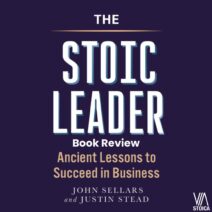
The Stoic Leader by John Sellars and Justin Stead
The Stoic Leader introduces Stoicism as a practical philosophy and explores how its principles shape leadership, judgment, and character in both work and life. Summary Written by John Sellars and Justin Stead, The Stoic Leader offers what is effectively two books in one. Sellars provides an introduction to Stoicism and its philosophical foundations, while Stead […]
Read more

Comments 0