
The Sword of Damocles
The Sword of Damocles is a story I’ve always remembered from my childhood. At first I thought my father shared this with me. But recently I asked him about it and he told me he didn’t. So the mystery of where I heard it is one for the ages. But then an amazing thing happened when I decided to read some of Cicero’s works.
The Sword of Damocles is a story I’ve always remembered from my childhood. At first, I thought my father shared this with me. But recently I asked him about it, and he told me he didn’t. So the mystery of where I heard it is one for the ages. But the story is still one of my favourites and I don’t know why it captivated me this much. Then an amazing thing happened when I decided to read some of Cicero’s works.
Marcus Tullius Cicero
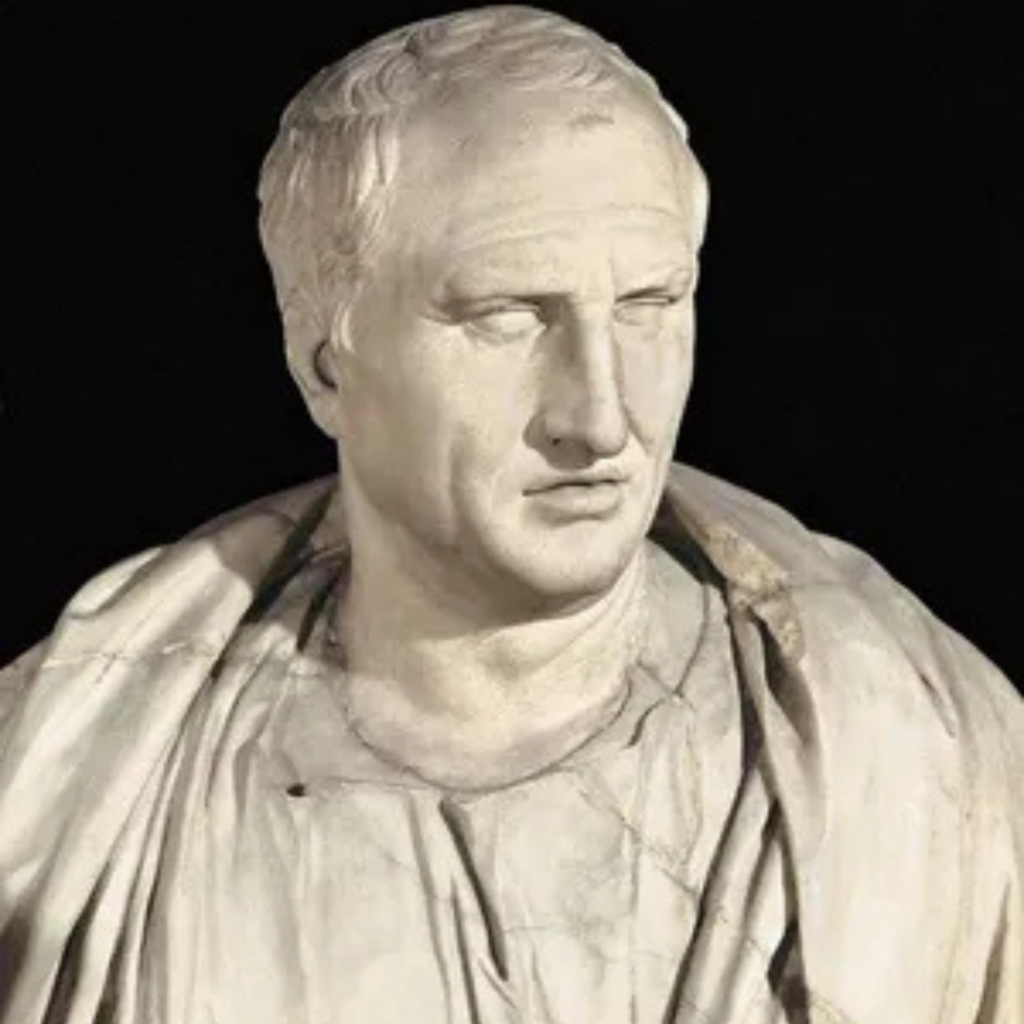
Marcus Tullius Cicero (106-43 BC) was a Roman orator a statesman during the tumultuous times of Julius Caesar’s rise to becoming emperor. Cicero was, however, not on the side of Caesar. He attached himself to Gnaeus Pompeius, who turned out to be on the losing side. There is an interesting series on Netflix, The Roman Empire, which shows you more about this time. Watching it after reading Cicero’s work was a wonderful experience. But Cicero also had his philosophical side. And although he does make plenty of references to Stoicism, he leaned more towards the Academy.
In later writings, I’d like to share more about Cicero. His writing and thought process are wonderful to read, but also because they give a beautiful insight into the world at that time. For now, though, I will go back to my story. One day, I went to the library and picked up the Penguin edition of Cicero, On the Good Life. A translation by Michael Grant of several of his works. The writing had me, and I couldn’t put it down. It engrossed me, and then it happened. I turned to page 84. It was part of the Discussions at Tusculum (V).
The tyrant of Syracuse, Dionysius I
Cicero was referring to Dionysius I. This was the infamous tyrant of Syracuse. He took to power at the age of 25 and reigned for thirty-eight years. (Dionysius I, born c.430 BC, ruled the city from 405 until his death in 367.) There are plenty of horrific stories about this man in this passage. But what stood out was that he got so paranoid that he didn’t trust anyone. He locked himself up and had his daughter shave him because he didn’t entrust the barber with his throat. He had two wives, and whenever he went to either of their rooms, he had them inspected and their rooms searched.
But now we come to where this passage hit me on a personal note. And I remember exactly where I read it. I was living in Dubai and went to my usual reading spot in a coffee shop in a mall. Once I recognized the name of Damocles, I almost jumped up and looked around me in wonder and excitement. No one paid attention or was able to understand my joy in finding this story. I continued reading, and I now would like to share the story here as it was written by Cicero. I do recommend reading Cicero’s work for yourself. But because it has a lot of personal meaning, for reasons I don’t quite know, I’ll quote it below.
The Sword of Damocles

‘Indeed, Dionysius himself pronounced judgement on whether he was happy or not. He was talking to one of his flatterers, a man called Damocles, who enlarged on the monarch’s wealth and power, the splendours of his despotic régime, the immensity of his resources, and the magnificence of his palace. Never, he declared, had there been a happier man. ‘Very well, Damocles,’ replied the ruler, ‘since my life strikes you as so attractive, would you care to have a taste of it yourself and see what my way of living is really like?
continues
A most elaborate feast
Damocles agreed with pleasure. And so Dionysius had him installed on a golden couch covered with a superb woven coverlet embroidered with beautiful designs, and beside the couch was placed an array of sideboards loaded with chased gold and silver plate. He ordered that boys, chosen for their exceptional beauty, should stand by and wait on Damocles at table, and they were instructed to keep their eyes fastened attentively upon his every sign. There were perfumes and garlands and incense, and the tables were heaped up with a most elaborate feast.
Continues
His desire to be happy had quite evaporated
Damocles thought himself a truly fortunate person. But in the midst of all his splendour, directly above the neck of the happy man, Dionysius arranged that a gleaming sword should be suspended from the ceiling, to which it was attached by a horsehair. And so Damocles had no eye for those lovely waiters, or for all the artistic plate. Indeed, he did not even feel like reaching out his hand towards the food. Presently the garlands, of their own accord, just slipped down from his brow. In the end he begged the tyrant to let him go, declaring that his desire to be happy had quite evaporated.’ –
Cicero, On the Good Life, Discussions at Tusculum (V), Pages 84-85, Penguin Books.
Do they have a sword dangling over their heads?

What happened was that I heard references to this story during my childhood. And that idea of a sword dangling over someone’s head by a horse’s hair made an impression. But I’d never read or learned the full story. Encountering it here it made things click. Especially at the time that I read it. During those years living in Dubai, I was going through somewhat of a personal transition. And with all the luxury on display all over that place, it seemed as if everyone was living their happiest lives.
This story, and the timed encounter, made me reflect on the true nature of what was happening around me. We’re prone to making judgments on the state of well-being of others if we see them wrapped in beauty and luxury. But we don’t know what price they might be paying for that lavish lifestyle. Do they have a sword dangling above their necks, which keeps them from enjoying what they have? It taught me to focus less on others and more on myself. What price was I paying for my life?
Learn to ask of all actions, “Why are they doing that?” Starting with your own.
Marcus Aurelius, meditations, book 10.37
Examine your situation
We are making decisions all the time. And as we make a decision, there is something on the other side we can’t have or must reject. Things don’t come for free. If we want shiny objects to brighten our lives, then we usually pay the price in time. Can we put all these riches on display, or are we scared someone might steal them or take them away? When going through the works of Seneca, Marcus Aurelius, or Epictetus, the warning of who owns whom keeps coming back. Are you the master of your possessions or do they own you and determine your life?
To live a happy life, at least in my personal opinion, we don’t need much. Definitely not a sword dangling over our necks. Please examine your situation. Check if your necks are safe or if your happiness is suppressed by what should bring it?
The Sword of Damocles revisited
There you have it. A beautiful accidental rendezvous with a story that had a special place in my memory from when I was a little boy, found during a pivotal moment in my life. Found not anywhere but amongst the words of Cicero. What better way to show the importance of reading and being curious? Because that’s what brought me to Cicero in the first place. Curious to explore more of the classic writings.
Pick up a book and read. And if you don’t know what to read, there is always Cicero, waiting for you from two millennia ago. I hope you enjoyed reading this as much as I did writing it and revisiting the Sword of Damocles. To leave you with a final quote from another one of Cicero’s writings. In his essay ‘On Old Age’, he describes Cato the Elder’s view on this.
“A person who lacks the means, within himself, to live a good and happy life will find any period of his existence wearisome.”
Cato the elder, according to cicero, On old age, 1
Want to explore more Stoic Practice?
Book a free consultation with one of our Stoic Coaches to get support. Or read more about How to Practice Stoicism here. Listen to the Via Stoica Podcast on Spotify, Apple Podcasts, or YouTube.
Author Bio
Benny Voncken is the co-founder of Via Stoica, where he helps people apply Stoic philosophy to modern life. He is a Stoic coach, writer, and podcast host of The Via Stoica Podcast. With almost a decade of teaching experience and daily Stoic practice, Benny creates resources, workshops, and reflections that make ancient wisdom practical today.
Related Posts
-
 Inner Life Terms
What Are Values? Principles That Guide Action and Display Nature
What are Values? Most people don’t wake up thinking about their values. They notice them indirectly, when something feels slightly misaligned. When a choice looks right on paper but leaves a faint sense of resistance. When success arrives, yet doesn’t land the way it was expected to. Values are often mistaken for opinions, preferences, or […]
Read more -
 Via Stoica Podcast
A Stoic Conversation with Jason Nelson: Six Seeds for a Happier Life
What if happiness is not something you achieve one day, but something you practice every day? In A Balm for Your Soul: Six Seeds for Happiness, Jason Nelson offers a grounded and humane answer to a question many people quietly struggle with: Why does life still feel off, even when things look good on paper?Rather […]
Read more -
 Greek Stoic Philosophy Terms
What Is Philanthropia? How Stoicism Views Love for Humankind
What Is Philanthropia? Philanthropia in Stoicism is the cultivated disposition to care for human beings simply because they are human. It describes a rational, practiced goodwill toward others that flows from understanding our shared nature, rather than from emotion, obligation, or reward. This concept matters today because modern life often treats kindness as optional, sentimental, […]
Read more

Comments 0