
The Sword of Damocles: Meaning, Story and the Original Cicero Source
The Sword of Damocles is a story I’ve always remembered from my childhood. At first I thought my father shared this with me. But recently I asked him about it and he told me he didn’t. So the mystery of where I heard it is one for the ages. But then an amazing thing happened when I decided to read some of Cicero’s works.
The Sword of Damocles is an ancient story about the anxiety that comes with power, wealth, and anything whose value depends on external circumstances rather than character. It has stayed in circulation for over two thousand years because the question at its centre never gets old: can you enjoy what you have if you are afraid of losing it?
It is a story I have always remembered from childhood. At first, I thought my father shared it with me. But recently I asked him about it, and he told me he did not. The mystery of where I first heard it remains unsolved. The story had always held a special place in me, and I never quite knew why — until something remarkable happened when I decided to read some of Cicero’s works.
What Does the Sword of Damocles Mean?
The Sword of Damocles is a metaphor for the constant sense of threat and anxiety that comes with great power or wealth. It describes how those who appear to have everything are often the least free, held hostage by the very things that seem to make them fortunate. The story comes from ancient Greek history and was first recorded by the Greek historian Timaeus of Tauromenium around 300 BC, though that original account has been lost. What survives is Cicero’s retelling in his Tusculan Disputations, written in 45 BC, which is exactly the source I found in that coffee shop in Dubai.
Marcus Tullius Cicero
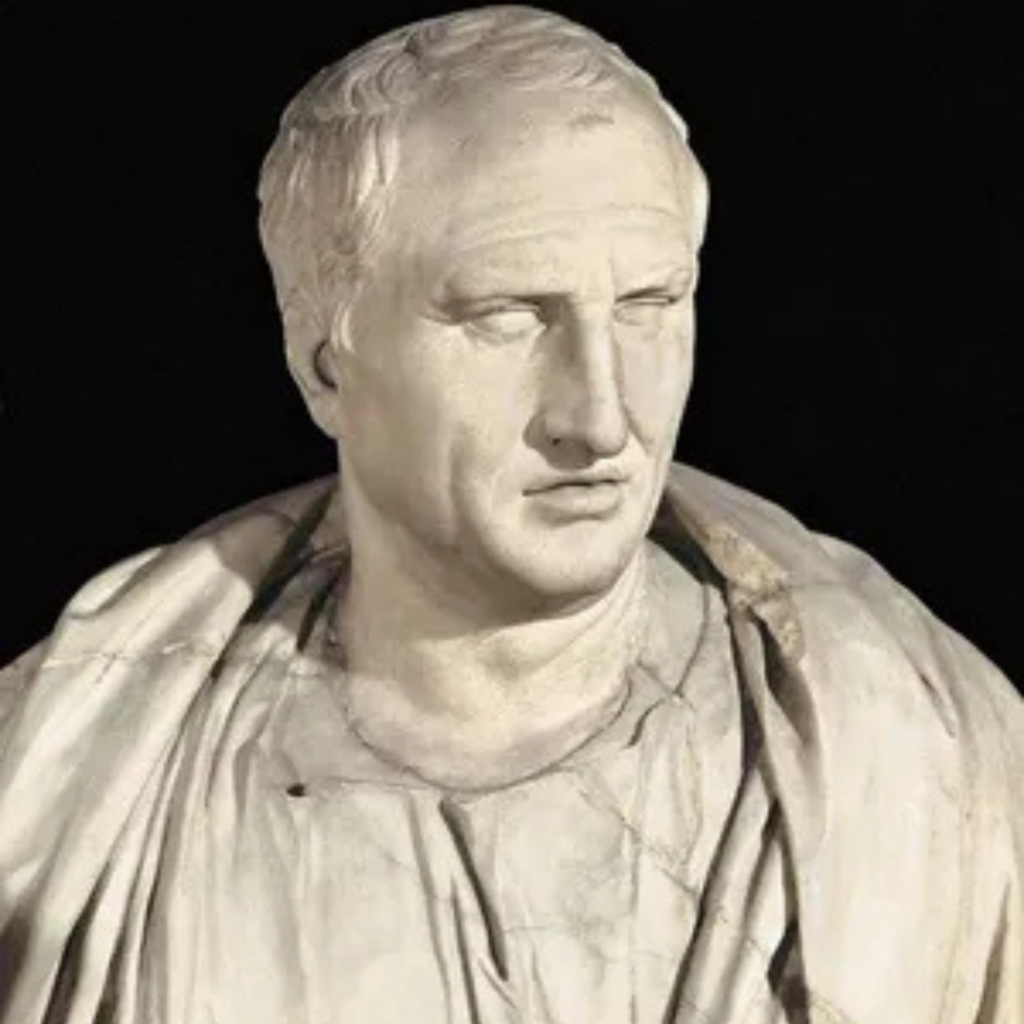
Marcus Tullius Cicero (106 to 43 BC) was a Roman orator and statesman during the tumultuous years of Julius Caesar’s rise to power. Cicero was not on Caesar’s side. He attached himself to Gnaeus Pompeius, who turned out to be on the losing side. HBO’s Rome is the best series covering this period, and watching it after reading Cicero’s work was a wonderful experience.
Cicero also had a deep philosophical side. Although he makes plenty of references to Stoicism, he leaned more toward the Academy. One day I went to the library and picked up the Penguin edition of Cicero, On the Good Life, translated by Michael Grant. The writing had me from the first page. It engrossed me, and then it happened. I turned to page 84.
The Tyrant of Syracuse, Dionysius I
Cicero was referring to Dionysius I, the infamous tyrant of Syracuse. He came to power at the age of twenty-five and reigned for thirty-eight years, born around 430 BC and ruling from 405 until his death in 367. What stood out most was how paranoid he had become. He locked himself away, had his daughter shave him because he could not trust the barber with his throat, and had both of his wives inspected and their rooms searched before he would enter.
Now we come to the part that struck me personally. I was living in Dubai at the time and had gone to my usual reading spot in a coffee shop in a mall. When I recognised the name Damocles on the page, I almost jumped up in wonder and excitement. No one paid attention or could understand my joy. I continued reading, and I want to share the story here as Cicero wrote it.
The Sword of Damocles
“Since my life strikes you as so attractive…”
"Indeed, Dionysius himself pronounced judgement on whether he was happy or not. He was talking to one of his flatterers, a man called Damocles, who enlarged on the monarch's wealth and power, the splendours of his despotic régime, the immensity of his resources, and the magnificence of his palace. Never, he declared, had there been a happier man. 'Very well, Damocles,' replied the ruler, 'since my life strikes you as so attractive, would you care to have a taste of it yourself and see what my way of living is really like?'"
Cicero, On the Good Life, Discussions at Tusculum (V), Pages 84–85, Penguin Books
The feast fit for a king
"Damocles agreed with pleasure. And so Dionysius had him installed on a golden couch covered with a superb woven coverlet embroidered with beautiful designs, and beside the couch was placed an array of sideboards loaded with chased gold and silver plate. He ordered that boys, chosen for their exceptional beauty, should stand by and wait on Damocles at table, and they were instructed to keep their eyes fastened attentively upon his every sign. There were perfumes and garlands and incense, and the tables were heaped up with a most elaborate feast."
Cicero, On the Good Life, Discussions at Tusculum (V), Pages 84–85, Penguin Books
“His desire to be happy had quite evaporated”
"Damocles thought himself a truly fortunate person. But in the midst of all his splendour, directly above the neck of the happy man, Dionysius arranged that a gleaming sword should be suspended from the ceiling, to which it was attached by a horsehair. And so Damocles had no eye for those lovely waiters, or for all the artistic plate. Indeed, he did not even feel like reaching out his hand towards the food. Presently the garlands, of their own accord, just slipped down from his brow. In the end he begged the tyrant to let him go, declaring that his desire to be happy had quite evaporated."
Cicero, On the Good Life, Discussions at Tusculum (V), Pages 84–85, Penguin Books
Do they have a sword dangling over their heads?

Cicero did not tell this story simply to illustrate the anxiety of power. He used it as the final example in a sustained philosophical argument: that virtue, and virtue alone, is sufficient for a happy life. Damocles could not enjoy the feast, not because the sword was real, but because his sense of well-being depended entirely on things outside himself. Remove the external goods, and nothing remains. The Stoics made the same point more directly. A person whose happiness is grounded in character rather than circumstance has no sword above their neck, because there is nothing that fortune can take away that matters.
The Stoic concept that speaks most directly to this is autarkeia, self-sufficiency: the state of needing nothing from outside yourself to live well. Damocles had every external good imaginable in that moment. He had none of the inner resources to enjoy them.
From philosophy to personal truth
During those years in Dubai, I was going through a personal transition. With all the luxury on display everywhere in that city, it seemed as though everyone was living their happiest lives. This story, and the timing of finding it, made me reflect on the true nature of what was happening around me. We are prone to judging the well-being of others by what we see wrapped in beauty and wealth. We do not know what price they might be paying for that lavish lifestyle.
Do they have a sword dangling above their necks, holding them back from enjoying what they have? It taught me to focus less on others and more on myself. What price was I paying for my own life?
"I say that wealth is not a good; for if it was, it would make men good; as it is, since something that is found among wicked men cannot be called good, I deny it this name. But that it is desirable, that it is useful and confers great benefit on life, I do admit."
Seneca, Dialogues and Essays, On the Happy Life, 24
Examine your situation
We are making decisions all the time. As we make a decision, there is something on the other side we cannot have or must let go. Things do not come for free. If we want shiny objects to brighten our lives, we usually pay for them in time, in anxiety, or in the energy spent protecting what we have. When going through the works of Seneca, Marcus Aurelius, or Epictetus, the warning about who owns whom keeps returning. Are you the master of your possessions, or do they own you and determine how you live?
"Remember that it is not only a desire for riches and power that makes you abject and subservient to others, but also a desire for quiet and leisure, and travel and learning. For the value you place on an external object, whatever it may be, makes you subservient to another."
Epictetus, The Discourses, Book 4, Chapter 4.1
"Learn to ask of all actions, ‘Why are they doing that?’ Starting with your own."
Marcus Aurelius, Meditations, Book 10.37
To live well, at least in my experience, we do not need much. Definitely not a sword dangling over our necks. Examine your situation. Check whether your neck is safe, or whether your happiness is being suppressed by the very things that were supposed to bring it.
The Sword of Damocles revisited
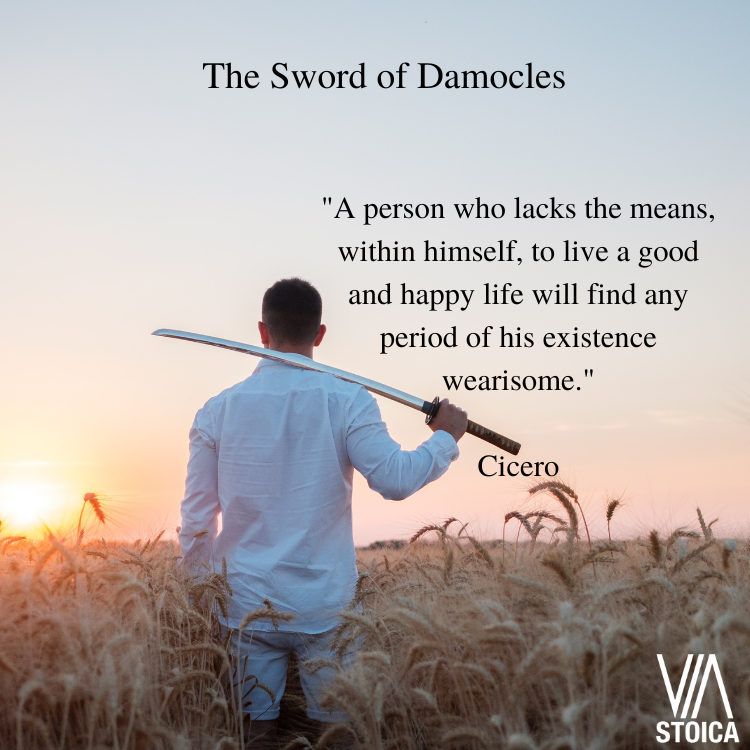
There you have it. A beautiful accidental meeting with a story that had held a special place in my memory since childhood, found during a pivotal moment in my life, and found not anywhere but in the words of Cicero. What better way to show the importance of reading and staying curious? That curiosity is what brought me to Cicero in the first place, an openness to exploring the classical writings.
Pick up a book and read. If you do not know where to begin, there is always Cicero, waiting from two thousand years ago. To close, a final word from another of Cicero’s essays. In On Old Age, he describes Cato the Elder’s view on this.
"A person who lacks the means, within himself, to live a good and happy life will find any period of his existence wearisome."
Cato the Elder, according to Cicero, On Old Age, 1
Frequently Asked Questions
What does the Sword of Damocles mean?
It is a metaphor for the anxiety and hidden threat that comes with great power or wealth. However fortunate a person appears from the outside, the sword hanging overhead represents the constant fear of losing everything. The story teaches that the trappings of power are not the same as happiness, and that a life dependent on external goods is never fully secure.
Where does the Sword of Damocles story come from?
It originates from ancient Greek history, first recorded by the Greek historian Timaeus of Tauromenium around 300 BC. That account has been lost, and the story survived through Cicero’s retelling in his Tusculan Disputations, written in 45 BC, which is how it entered the European cultural mainstream and has been retold ever since.
Who was Damocles?
Damocles was a courtier and flatterer in the court of Dionysius I of Syracuse. He praised the tyrant’s wealth and power so effusively that Dionysius offered to let him experience it for himself, seating him at a lavish banquet with a sword suspended above his head by a single horsehair. The experience cured him of his envy immediately.
What is the Stoic lesson of the Sword of Damocles?
That external goods are preferred indifferents: desirable but not the source of well-being. True security comes from within, from character and virtue, not from wealth, status, or power. A person who depends on external things for their happiness is always one horsehair away from losing it. The Stoic goal is autarkeia, the inner self-sufficiency that no sword can threaten.
How do I apply the Sword of Damocles lesson in daily life?
Start by identifying what you are afraid of losing. If the answer involves possessions, status, or other people’s opinions, that is where your sword hangs. The Stoic practice is not to abandon those things but to examine your attachment to them. Ask whether your contentment would survive without them. If it would not, that is the work. The Stoic practices of voluntary discomfort and memento mori both address this directly.
Continue the Practice
The Pause is a monthly letter on Stoic practice. One idea, one exercise, one reflection from the ancient sources, delivered to your inbox each month.
About the Author
Benny Voncken is the founder of Via Stoica and host of the Via Stoica Podcast. He has practiced Stoicism as a way of life for over six years, spoken at Stoicon, and led Stoic walks across Europe. Through Stoic coaching, he helps people use Stoic principles and practices to develop their own philosophy of life: one that gives them the tools to face obstacles, navigate change, and find more balance and peace. He writes, teaches, and walks wherever the philosophy takes him.


The Pause
A monthly Stoic newsletter
Sign up and get The Pause Framework free.
A practical Stoic tool for moments of tension. Observe what is happening. Reset your momentum. Decide with reason.
It arrives in your welcome email.
Then, once a month: one reflection, one practice, one Stoic idea.
Comments 0