
What Is Autarkeia? The Stoic Power of Self-Sufficiency
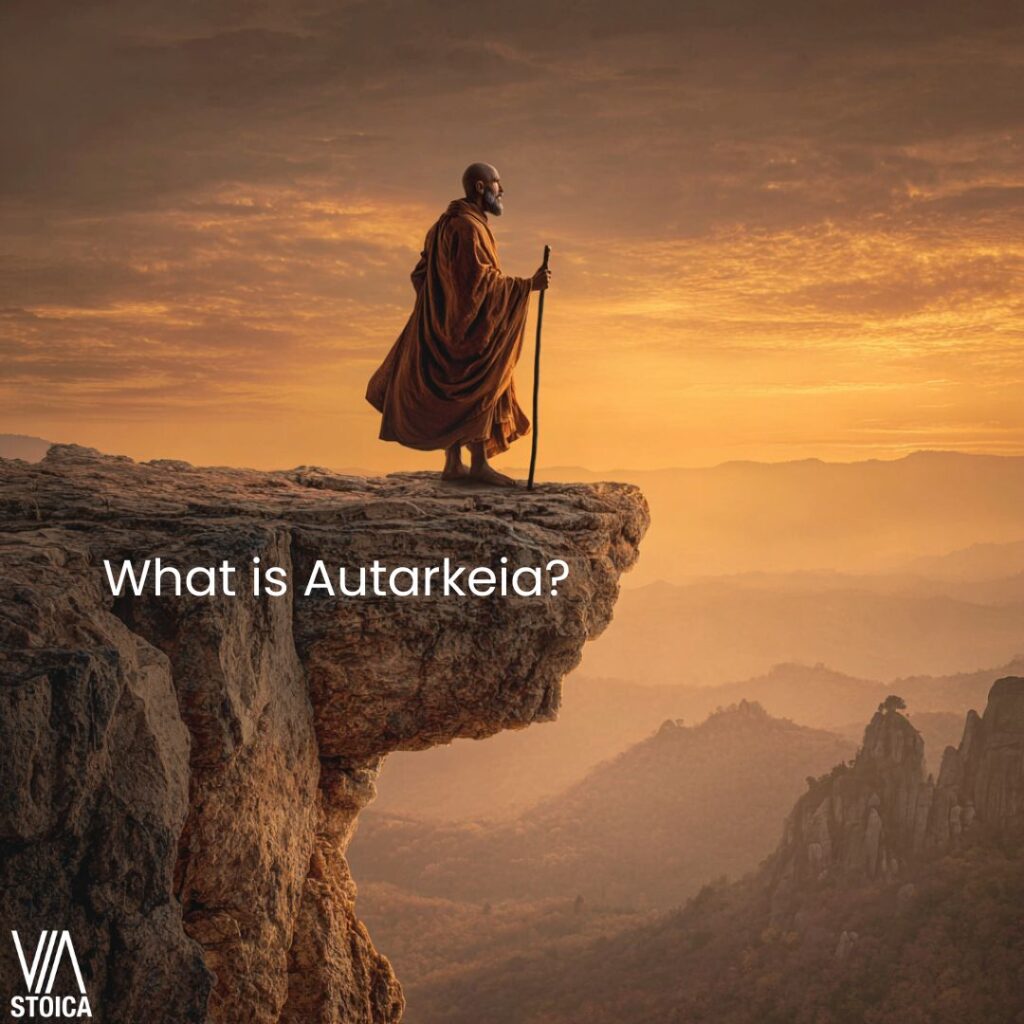
Term: Autarkeia (αὐτάρκεια) | Translation: Self-sufficiency, inner completeness | Language: Greek | Category: Psychological States
Autarkeia in Stoicism is the state of drawing your well-being from your own reasoning mind rather than from wealth, praise, or circumstance. It does not mean rejecting help or company. It means your peace no longer depends on either one arriving. Once that dependency breaks, the connections you do make tend to get better. You are making them by choice rather than by need.
Breaking Down the Word
The compound is doing the work its parts suggest.
- Greek: αὐτάρκεια
- Root: from autos (αὐτός), self, and arkeō (ἀρκέω), to suffice or be enough
- Literal meaning: self-sufficiency, having enough within oneself
- Philosophical meaning: the inner completeness that comes from living according to virtue, independent of fortune’s shifts
Arkeō appears throughout Greek in ordinary, unphilosophical contexts, a supply that is enough, a wall that holds. The Stoics took that everyday sense of sufficiency and turned it inward. To depend on externals for happiness is to hand your peace to chance. Autarkeia names the opposite move, taking that peace back.
What Autarkeia Actually Means
Autarkeia is the ability to draw satisfaction and direction from your own reasoning rather than from wealth, praise, or the approval of others. A person with this trait can still enjoy money, friendship, and reputation. What changes is where their stability comes from. It sits inside them, not in whatever is currently going well.
The word gets misread as a call to isolation more often than any other Stoic term. Autarkeia asks nothing of the kind. It asks whether your happiness would survive the loss of a relationship, not whether you should avoid having one. A Stoic can love deeply and still be self-sufficient. Self-sufficiency describes what the relationship is not carrying, your entire sense of worth, rather than what it is.
Nor is it minimalism dressed up in Greek. Owning less can support the practice, since fewer possessions means fewer things pulling at your attention. The object count was never the point. A person can live simply and still be anxious about status, or live comfortably and be entirely unmoved by losing it. Autarkeia lives in the second case, not the first.
"…we say the wise man is self-content; he is so in the sense that he is able to do without friends, not that he desires to do without them."
Seneca, Letters from a Stoic, Letter IX
Autarkeia and Koinonia: What Is the Difference?
These two look like opposites on paper and function as partners in practice. Koinonia is active community, the Stoic commitment to sharing life, effort, and purpose with others as part of a rational, social nature. Autarkeia is what makes that sharing genuine rather than transactional. A person who needs the relationship to feel whole is negotiating from dependency, not offering from strength.
The Stoics never treated these as competing values requiring a balance. Marcus Aurelius wrote about his duties to Rome and his fellow citizens constantly. He never suggested his peace of mind should hinge on how those duties were received. Autarkeia is what he brought to koinonia, not a substitute for it.
Autarkeia and Core Stoic Principles
This state rests directly on aretē (ἀρετή), virtue, the one thing the Stoics considered genuinely good. If virtue is the only real good, then a person who has it is already complete in the way that counts. Nothing external needs to be added, and nothing external can subtract from it either.
It also depends on living in accordance with physis (φύσις), nature. Much of what feels like a genuine need is a social expectation mistaken for one. Stripping those false needs away is not deprivation. It is closer to noticing weight you were carrying that was never actually yours to carry.
How to Practice with Autarkeia
Self-sufficiency builds the same way a muscle does, through repeated, specific use rather than general intention. A structured approach through Stoic self-reliance can help turn these into standing habits.
Ask What Would Still Be Mine
Each morning, ask one question before the day gets moving: if everything external disappeared today, what would still be mine? The answer is usually short. That shortness is the point, not a problem to fix.
Notice What Approval Was Doing
After a moment of praise or criticism lands harder than it should, ask what you were secretly hoping it would confirm about you. Autarkeia grows in the gap you find between that hope and what you already knew before the comment arrived.
Stoic Exercise
The Root Check
Rooted in autarkeia: self-sufficiency is not built by wanting less through force. It is uncovered by noticing how much was already there before the external validation showed up.
Name one piece of validation you leaned on today, a like, a compliment, someone’s agreement, a good result. Before that arrived, what did you already feel about the thing it was praising? Write one honest sentence describing that prior state. Then ask what would remain of it tomorrow if the validation never came at all. Most people find more was already there than they expected, which is the entire root autarkeia is named for.
Ready to go deeper? Discourses 1.9 takes this practice into its full form.
Why Autarkeia Is Central to Stoic Practice
The Cynics pushed self-sufficiency toward its most extreme form, treating comfort itself as a threat to virtue. The Stoics kept the core insight while dropping the extremity, and autarkeia is where that inheritance shows most clearly. Epictetus, born into slavery and later exiled, had every external reason to build his sense of self on nothing at all. He built it on judgment instead, which no one could take from him regardless of his circumstances.
Marcus Aurelius, holding the opposite position of nearly unlimited external power, reached for the same discipline from the other direction. He reminded himself to stand on his own reasoning rather than lean on the authority of his office. The practice removes fortune’s leverage either way, whether fortune has given everything or taken everything.
"To stand up straight – not straightened."
Marcus Aurelius, Meditations, Book 3.5
Frequently Asked Questions
What does autarkeia mean in Stoicism?
Autarkeia in Stoicism means drawing your sense of well-being from your own reasoning rather than from wealth, praise, or circumstance. It describes a state of inner completeness, not a rejection of relationships or comfort.
Is autarkeia the same as independence?
Not quite. Autarkeia is inner independence specifically, meaning your peace does not depend on external help even when you accept it freely. Ordinary independence usually refers to practical self-reliance, which is related but narrower.
How is autarkeia different from koinonia?
Koinonia is active community, the Stoic commitment to sharing life and purpose with others. Autarkeia is what a person brings into that community rather than what replaces it, the inner stability that keeps the relationship from becoming a dependency.
Can anyone develop autarkeia?
Yes. It builds gradually through the same practice repeated often, shifting attention from what cannot be controlled toward what is fully within reach, your own judgments and actions.
Does autarkeia mean avoiding friendship?
No. Seneca was explicit that the wise person can do without friends without ever wanting to. Autarkeia protects a friendship from becoming a source of anxiety, it does not ask anyone to avoid having one.
Want to Learn More?
If this resonated and you are ready to start building your own philosophy of life, a conversation with Benny as your Stoic coach can be a good place to begin. Not to be told what to think, but to have the space to figure it out. You can also sign up for the newsletter, The Pause, or watch or listen to the Via Stoica Podcast on YouTube, Spotify, or Apple Podcasts.
About the Author
Benny Voncken is the founder of Via Stoica and host of The Via Stoica Podcast. He has practiced Stoicism as a way of life for over seven years and draws on almost 15 years of teaching experience to turn dense ancient ideas into daily practice. Since 2023 he has coached clients around the world through one-on-one Stoic coaching. He also leads Stoic walks across Europe, writes the monthly newsletter The Pause, and has spoken at Stoicon.

Comments 0