
How to Stop Worrying About Your Legacy: A Stoic Approach
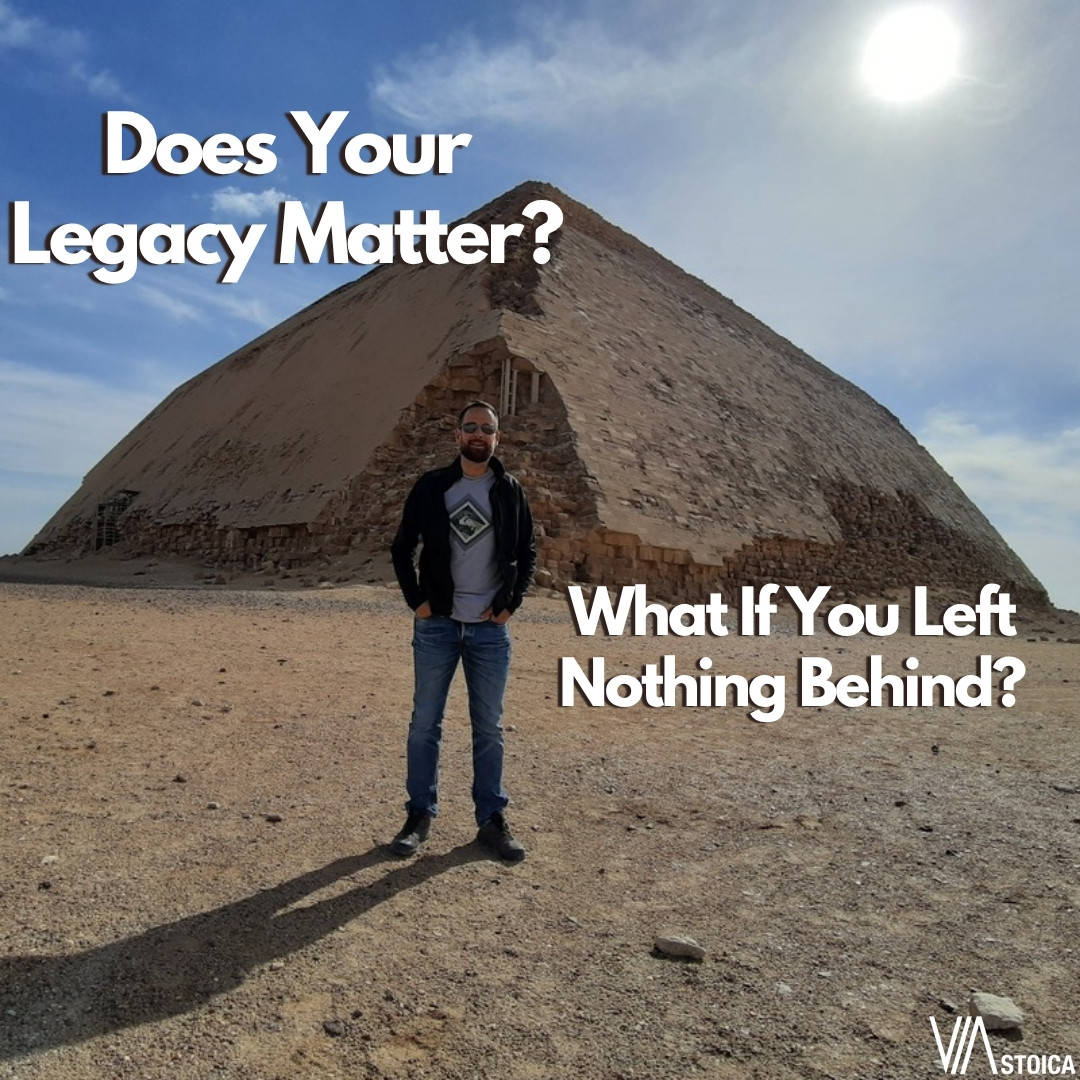
To stop worrying about your legacy, focus on what you do right now, because you will not be there to see it. The plain fact behind this is that at some point we die, and that is usually the end of our life. The Stoics saw this as natural and saw no need to label it good or bad. Yet many people cling to life and prepare for the end by building something that stays behind, so that others can still think of them and revere them.
I have watched people around me put enormous pressure on building something great right now, so that they can live on in the minds of others. I have felt that pull myself. Stoicism offers a different question, which asks what we are doing right now.
Why We Cling to a Legacy
People want monuments, books, children and a family line that carries on. Part of the reason is what the Stoics called oikeiosis, the sense of self-appropriation that makes us feel something benefits us. Passing on our genes feels like making sure we continue, and our lifeline stays alive.
None of it sits under our control, though. Even our children could take on different names, or something could end the line. A legacy is an external, and once we are gone we cannot do anything about it. Attaching our present peace to something that far beyond us makes that peace too fragile, so why would we risk it?
The Stoics would call this a false judgment. We stick the label good on something external, something that is not up to us. Our guide on what is really in your control shows where to look instead.
The Footprints on the Moon
Ask yourself how long a legacy lasts and what forever even means. Even someone like Einstein will be forgotten at some point. Billions of years from now the sun will engulf the earth, and by then everything we built will be gone.
The footprints on the moon make a good picture of this. The astronauts who walked there knew the dust would never blow away, because the moon has no atmosphere, so their prints would stay for a very long time. They could think: I have done something incredible, and everybody will remember me.
Now count how many people have walked on the moon, and name them. Most of us know Neil Armstrong and maybe Buzz Aldrin, and that is where it ends. Try to place David Scott, and see on which Apollo mission he stepped out. If footprints that survive for ages cannot guarantee a name, what can a legacy guarantee?
The Legacy Trap
We can see the trap in careers, in families and in other parts of life. Think of famous musicians and actors who were so busy creating a legacy of music and movies that they forgot to be good people while they were alive. Now people remember them for their actions, and the work comes second.
Living for the legacy often costs us the life we have. Marcus Aurelius makes the same point in his reflections, and our collection of Marcus Aurelius quotes on death gathers them. Our guide on how to approach ambition like a Stoic shows how to work hard without feeding the trap.
"And if I take the idea of legacy away, how will that change what I do?"
Benny Voncken, Via Stoica Podcast, Does Your Legacy Matter? What If You Left Nothing Behind? (09:15)
Marcus Aurelius and the Legacy He Never Planned
Marcus Aurelius never intended to leave this kind of legacy. He was the emperor of the Roman Empire, yet what we still read two thousand years later, as a global bestseller, is his personal journal. He never meant for anyone to publish it, and it inspires millions of people today.
He would probably have been utterly surprised and perhaps saw the irony in it. He could not choose what people would want to read later, whether the work would survive, or whether someone would keep it safe and publish it. That was never up to him. He knew that as long as he was a good emperor and did what he was supposed to do in the moment, he had nothing to fear and nothing to worry about after his death. Our article on the Stoic view on legacy explores his thinking in more depth.
We can wonder about other writers too. Was Seneca writing his letters to Lucilius to leave his thoughts behind? Cicero wrote most of his books in a very short period, and we can ask whether he was building a legacy or simply looking for another occupation after he could no longer govern as a senator. These are questions worth sitting with.
My Own Legacy Ambitions
I know this pull from the inside. Whenever I had an idea, I imagined it becoming a global phenomenon. Via Stoica was going to turn into a big brand in the wellness, mental health and philosophy sectors, and the podcast would echo beyond my existence. If I am completely honest, a trace of that is still there. Thoughts like these simply appear, and they appear in other people too.
That is the impulse the Stoics talk about. It jumps up sometimes, and our task is to learn how to deal with it and see things for what they are. In a way the legacy is already happening. If I died today, my content would still sit on Spotify, Apple Podcasts, YouTube and the website, and a video could carry my appearance and my voice beyond my grave. People who never knew me might even think I am still alive.
Yet that cannot be the reason to do the work. I record, write, work and study this philosophy because it feels good and makes me feel the way I should be. It lets me live more in accordance with who I am. I am a people pleaser with the usual human anxieties, and studying Stoicism has reduced them and helped me live a fuller life. I am letting go of the legacy, sometimes more actively than others, because it belongs to future generations.
How to Stop Worrying About Your Legacy: A Simple Practice
The practice has five parts, and none of them asks us to give up our ambitions.
Start by taking the legacy out of the picture. Remove the monument, the book and the name that others will remember, and ask what we are doing right now. Does it give us meaning and purpose in this moment? The same trick works for money: if we had all the money in the world, what would we still do?
Next, remember that we will not be there to see it. Whatever we fantasize about leaving behind, we cannot enjoy it, feel proud of it or steer it, and people may even turn us into an enemy figure. If we have no control over the result, why build our present on it?
Sort what is ours from what belongs to others. Whatever remains after us is for others to decide. What is ours is today, this action and this way of showing up. The Stoic discipline of assent helps us test the urge before we follow it.
Treat the urge itself as an impression that arrives. Ask what legacy means to us personally, and notice which false judgment sits behind it, so that we can see it for what it is.
Finally, do the right thing right here and now. If we do that, we no longer need to care about the legacy, because we have done what we needed to do.
"Whatever legacy that you have in mind, whatever you fantasize about that remains after you're gone, you won't be there to see it. You won't be there to enjoy it, to be proud of it. You'll be gone."
Benny Voncken, Via Stoica Podcast, Does Your Legacy Matter? What If You Left Nothing Behind? (09:42)
Frequently Asked Questions
How do I stop worrying about my legacy?
Take the legacy away and ask what we are doing right now and whether it gives us meaning. Learning how to stop worrying about your legacy also means admitting that we will not be there to see it. We then put our attention on today’s action, which is the only part we own.
What do the Stoics say about leaving a legacy?
They treat a legacy as an external, something that is not up to us. Putting the label good on it is a false judgment, and the Stoics suggest we do the right thing in the moment instead. Whatever people make of our work afterwards belongs to them.
Why do people want to leave a legacy?
Part of it is the self-appropriation that the Stoics called oikeiosis. We want what benefits us to continue, so we build monuments and books and pass on our genes. The trouble is that none of it stays under our control.
Did Marcus Aurelius want to be remembered?
He wrote his Meditations as a private journal and never meant to publish it. Two thousand years later it inspires millions of people, which he probably would have found ironic. He focused on being a good emperor in the moment and left the rest alone.
Is letting go of legacy a pessimistic idea?
No, it works as a reality check. There is so much more to life than chasing a future ideal, and whatever we aim for in the future, we miss right here and now. Letting go frees our attention for the life we have.
Your Legacy Is Not Yours to Build or to Witness
This is no pessimistic message, only a reality check. Your legacy is not yours to build, and it is not yours to witness. What is yours is today, this action and this way of showing up.
Whatever remains after you is for others to decide, and it is not under your control. You will not be there to see or experience your legacy, so live right now.
"It shouldn't be the reason that you do something because you're thinking about what it will do after you're gone. You need to do it because it feels good in the moment."
Benny Voncken, Via Stoica Podcast, Does Your Legacy Matter? What If You Left Nothing Behind? (03:39)
Watch the full episode on YouTube.
Want to Learn More?
If this resonated, a conversation with Benny as your Stoic coach can be a good place to begin. It gives you space to build your own philosophy of life. You can also sign up for the newsletter, The Pause, or follow the Via Stoica Podcast on YouTube, Spotify, or Apple Podcasts.
About the Author
Benny Voncken is the founder of Via Stoica and host of the Via Stoica Podcast. He has practiced Stoicism for over six years, spoken at Stoicon, and led Stoic walks across Europe. Through Stoic coaching, he helps people develop their own philosophy of life. It gives them the tools to face obstacles, navigate change, and find balance. He writes, teaches, and walks wherever the philosophy takes him.



Comments 0