
Book Review: Stoicism and Emotion by Margaret Graver
The book that finally gets Stoic emotion theory right, and the one that will change how you understand your own inner life.
| Author | Margaret Graver |
| Year | 2007 |
| Difficulty | Scholarly — accessible to readers with a solid Stoic foundation |
| Via Stoica score | 10 / 10 |
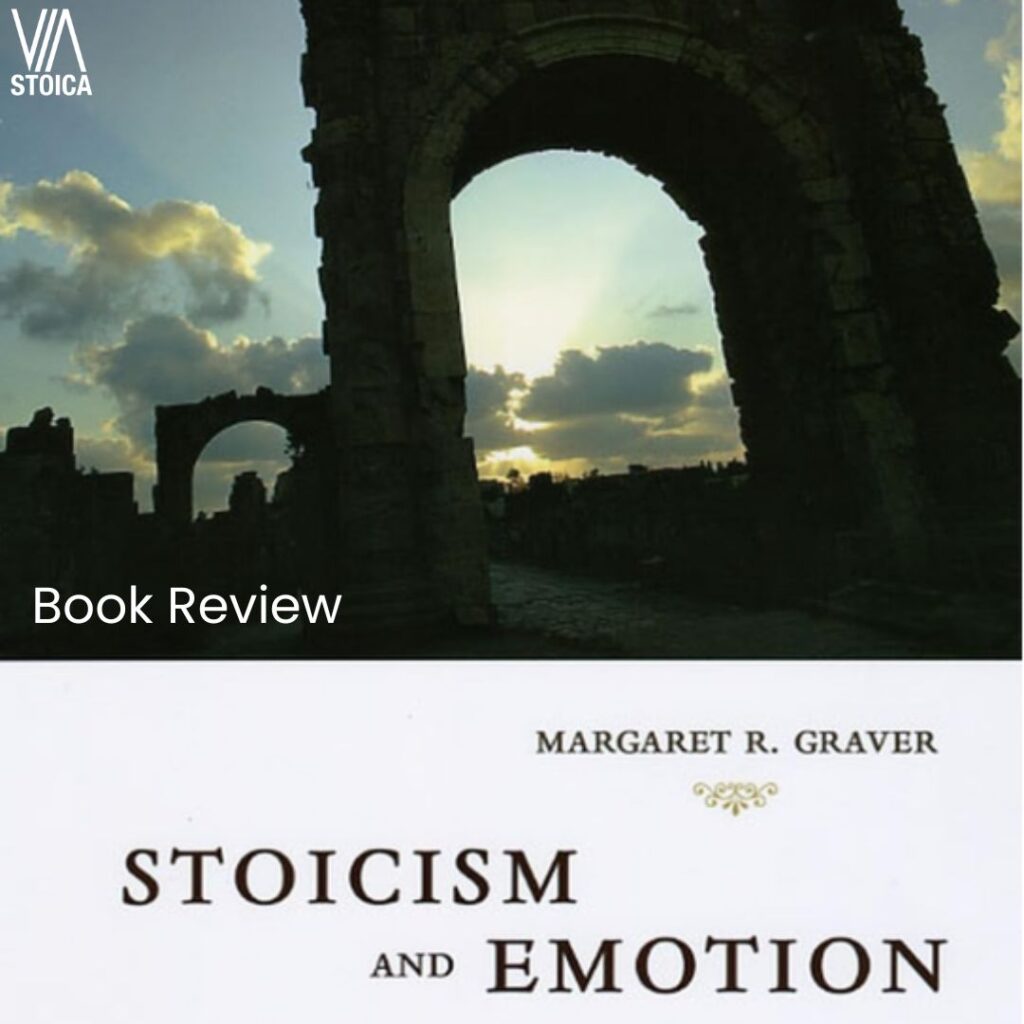
Core argument
Stoicism has never been about suppressing or denying emotion. The Stoic founders set out to understand what the natural feelings of human beings actually are. Margaret Graver argues that emotions are judgments, and that the distinction between good and bad emotions rests entirely on whether the underlying judgment is true or false. This framework does not diminish emotional life. It gives it a philosophical architecture that makes genuine joy, genuine love, and genuine grief not only possible but philosophically grounded.
Summary
Margaret Graver is Aaron Lawrence Professor of Classics at Dartmouth College. She is the author of Stoicism and Emotion (University of Chicago Press, 2007) and Seneca, the Literary Philosopher (Cambridge University Press, 2023). Her work is rooted in careful reading of the ancient texts, and it shows throughout this book in ways that few contemporary accounts of Stoicism can match.
Stoicism and Emotion moves through the subject systematically. The first part covers Stoic emotion theory from the ground up: the corporeal basis of emotions, affective judgments, and the different classes of emotional response. Graver then addresses the problem of causation, clarifying the Stoic claim that emotions are volitional. She examines the concept of pre-emotions, those involuntary flickers of feeling that precede a full emotional response, and explains why the Stoics did not consider them blameworthy.
The second part of the book turns to longer-term questions. How do individual character traits influence emotional life over time? What does moral development look like? The final chapters examine the role of love, friendship, and social connection in Stoic thought. Graver shows that the ancient Stoics were not indifferent to other people. On the contrary, responsibility to others was central to the system.
A personal note: reading this book and speaking with Margaret Graver on the Via Stoica Podcast gave me a better understanding of the sequence of my own emotions and how my judgments shape them. It has helped me manage my feelings more consciously and respond more thoughtfully to what happens around me. In a real sense, it has made my life calmer and more balanced. That is not a small thing to say about a philosophy book.
The founders of the Stoic school did not set out to suppress or deny our natural feelings; rather, it was their endeavor, in psychology as in ethics, to determine what the natural feelings of humans really are.
Margaret Graver, Stoicism and Emotion, Introduction
Good emotions are grounded in true judgments. Bad emotions are grounded in false judgments. That simple.
Margaret Graver, Via Stoica Podcast [~18:00]
Some versions of modern Stoicism present themselves too much as a coping mechanism for the individual, as if it’s ultimately all about your comfort. That’s an immature understanding.
Margaret Graver, Via Stoica Podcast [~56:00]
Review
Graver does something very few academic philosophers manage: she writes about a complex technical subject without making the complexity feel like a barrier. The book is dense, but it is dense in the way a good philosophical text should be. Every sentence is doing work. Nothing is there to impress.
The most important contribution of the book is its systematic account of pre-emotions. The Stoics distinguished between involuntary physical responses and full emotional responses. A flash of irritation, a moment of pallor, a sudden trembling: these are not emotions in the Stoic sense because they do not involve a judgment. They are not blameworthy. This distinction matters enormously for anyone who has ever felt that Stoicism demands an impossible absence of feeling. It does not. It demands something far more interesting: examined judgment.
In some ways, this book compares most naturally to The Inner Citadel by Pierre Hadot. Both books aim at a deeper understanding of what peace of mind actually is and how it is built. Hadot works through the three disciplines of Marcus Aurelius. Graver works through the architecture of emotion itself. Together, they give a reader a much clearer picture of what a Stoic inner life looks like from the inside.
Who this book is for
This book is for the reader who has already worked through the main introductions to Stoicism and wants to go deeper into the philosophy as a system. It rewards someone who has read the primary sources, particularly Epictetus and Seneca, and is now ready to understand the theoretical framework beneath the practical teachings.
It is also well suited to anyone with a background in psychology who is curious about how ancient philosophy anticipated and exceeded much of what modern psychology has discovered about emotion regulation. The parallels Graver draws are not forced. They are genuinely illuminating.
It is not the right starting point for a beginner. The academic register and the depth of engagement with ancient texts require a proper foundation. That foundation is worth building first. But once it is in place, this book belongs at the top of the reading list.
Via Stoica verdict
Stoicism and Emotion gave me a more profound view of the philosophy and a deeper respect for what the ancient Stoics understood about human nature. It also gave me something more immediate: a clearer way of watching my own emotional responses as they happen, and a better understanding of what to do with them. A score of 10 out of 10 for a book that changed how I practice, not just how I think.
Via Stoica connection
I sat down with Margaret Graver to discuss this book on the Via Stoica Podcast. We go deeper on what emotions actually are in the Stoic framework, why pre-emotions are not blameworthy, and what a genuinely Stoic emotional life looks like in practice. Watch the conversation on YouTube.
For the broader context on Stoic practice, the Via Stoica article on how to practice Stoicism is a useful companion to this review.
Read next
Explore more from the Via Stoica book review library:

The Inner Citadel
Pierre Hadot
How to Think Like a Roman Emperor
Donald Robertson
Stoicism
John Sellars



Comments 0