
Stoicism for Anxiety – Finding Peace with the Discipline of Desire
Stoicism for Anxiety
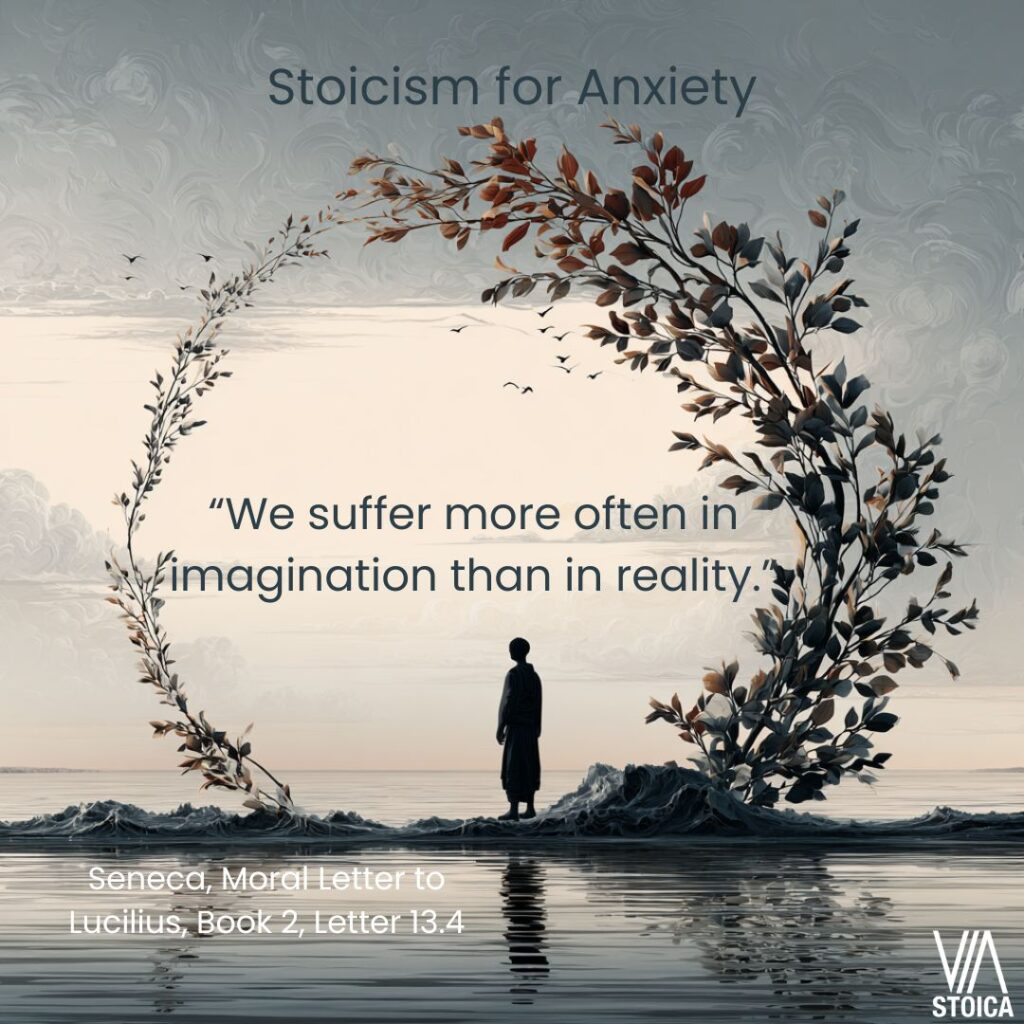
Stoicism for anxiety guides us toward a peaceful mind amid the shifting tides of life. Anxiety arises when the mind races ahead, imagining loss, rejection, or danger before anything has happened. It is the tension between what we want and what we fear.
The Stoics understood this centuries ago. They taught that peace begins when we stop trying to control what we cannot and learn to live in agreement with nature, with how things actually are. Through attention, reason, and perspective, Stoicism helps us transform anxiety into inner steadiness.
Modern psychology describes anxiety as more than a feeling; it is also physiological. Cognitive Behavioral Therapy (CBT), one of today’s most effective treatments for anxiety, rests on the same principle the Stoics expressed long ago: our emotions are driven by our judgments about events, not by the events themselves. When we learn to question our thoughts rather than obey them, calm naturally follows.
What Anxiety Really Is
Anxiety is the mind’s anticipation of imagined harm, a future-oriented emotion that prepares us for what might go wrong.
The American Psychological Association (APA) defines it as:
“An emotion characterized by apprehension and somatic symptoms of tension in which an individual anticipates impending danger, catastrophe, or misfortune. The body often mobilizes itself to meet the perceived threat: muscles become tense, breathing is faster, and the heart beats more rapidly.”
American Psychological Association, 2025
The APA also notes that
“anxiety may be distinguished from fear both conceptually and physiologically. Anxiety is a future-oriented, long-acting response broadly focused on a diffuse threat, whereas fear is an appropriate, present-oriented, and short-lived response to a clearly identifiable and specific threat.”
American Psychological Association, 2025
This distinction matters: anxiety lives in anticipation, while fear responds to reality. The Stoics would agree, anxiety is not caused by events themselves but by our judgments about what might happen.
Seneca captured this insight succinctly:
“We suffer more often in imagination than in reality.”
Seneca, Moral Letter to Lucilius, Book 2, Letter 13.4
When your thoughts tell you that losing your job would destroy your life, or that others must approve of you to feel safe, anxiety appears. Yet the cause lies not in the job or the people, but in the value you assign to them.
By changing how we interpret situations, by choosing rational, balanced judgments, we can ease both the body’s anxious response and the mind’s restless narrative.
The Stoic Understanding of Anxiety
For the Stoics, anxiety is a pathos, a disturbance of the soul caused by false belief. It arises when we confuse what is up to us (our choices, actions, and attitudes) with what is not up to us (external events, reputation, or fortune).
The Stoics called our first impressions phantasiai, automatic perceptions of the world. These impressions are not under our control, but how we respond to them is. We give assent (synkatathesis) when we accept an impression as true. Anxiety takes hold when we assent to frightening or irrational impressions.
Epictetus advised his students to pause before giving assent:
“But, in the first place, do not allow yourself to be carried away by its intensity: but say, ‘impression, wait for me a little. Let me see what you are, and what you represent. Let me test you.”
Epictetus, Discourses, Book 2, Chapter 18.24
In this pause lies freedom. By testing our thoughts before believing them, we weaken anxiety’s power. Stoicism invites us to practice this moment of awareness, to see anxiety not as an enemy, but as a signal that our attention has drifted toward what lies beyond our control.
A Core Stoic Principle That Transforms Anxiety — The Discipline of Desire
At the heart of Stoic practice lies the Discipline of Desire, the art of wanting only what is truly within your control. Epictetus taught that philosophy begins here: by learning to desire wisely.
“For the present, totally suppress desire: for, if you desire any of the things that are not up to us, you must necessarily be unfortunate; and none of the things which are up to us, and which it would be right to desire, is yet within your reach.”
Epictetus, Handbook, 2
Anxiety arises when desire extends toward externals, when we crave safety, approval, or success that depend on factors outside ourselves. The Stoics remind us that freedom comes not from getting what we want, but from wanting what depends on us: our judgments, choices, and actions.
This is where we start to align ourselves with nature, training our desire to aim only where control exists. When we stop chasing outcomes and focus instead on our effort and virtue, the grip of anxiety loosens.
Epictetus expressed this clearly:
“Freedom is not secured by the fulfilment of people’s desires, but by the suppression of desire.”
Epictetus, Discourses, Book 4, Chapter 1.75
Peace comes not from a life without uncertainty, but from desiring nothing that fate can take away.
Stoic Practices to Overcome Anxiety
1. Discipline of Desire in Action
List what you currently want: stability, health, recognition, and note which depend entirely on you. Direct your energy there, and release the rest.
Example: If you want stability at work, focus on your effort and conduct, not the company’s decisions. If you want recognition, focus on doing good work, not on who notices it.
Takeaway: Lasting peace comes when your desires depend only on your own actions.
2. Negative Visualization (Premeditatio Malorum)
Imagine potential setbacks, losing a job, being criticized, falling ill, and picture yourself responding with composure. This prepares the mind and softens fear.
Takeaway: What you rehearse in reason, you fear less in reality.
3. Prosochē — Attention to the Present
Bring your awareness to the current moment. Notice your breath, your surroundings, your immediate task. Anxiety dissolves when the mind stops living in tomorrow.
Takeaway: The present is always lighter than the future you imagine.
4. Living in Accord with Nature (Logos)
Accept that the universe unfolds through an ordered chain of cause and effect. Resistance to this order creates tension; cooperation brings peace.
Takeaway: Serenity grows from trusting the whole and loving the moment.
5. Evening Reflection
Before bed, review your day. Where did anxiety appear? Which desires extended too far? Note one improvement for tomorrow, and then focus on your next task: to sleep.
Takeaway: Awareness of misplaced desire is the start of freedom.
From Anxiety to Tranquility
Every episode of anxiety contains the seed of mastery. It invites us to practice the art of desire, to want wisely and accept gracefully.
When you catch yourself worrying, pause. Ask: Is what I want within my control? If not, release it. If it is, act with reason and let the outcome unfold.
Epictetus reminded himself:
“It is not the things themselves that disturb people but their judgements about those things.”
Epictetus, The Handbook, 5
Peace is not found in externals or in the future, but in understanding that it is already within your own mind.
FAQ
Can Stoicism really help with anxiety?
Yes. Stoicism offers a practical framework for identifying and changing the thoughts and desires that fuel anxiety, much like modern CBT.
Which Stoic practices are most effective for calming the mind?
Start with the Discipline of Desire and Prosochē. They teach acceptance and grounded awareness in daily life.
Is Stoicism the same as suppressing emotions?
Not at all. Stoicism teaches understanding and moderation of emotions, not repression.
How does Stoicism relate to CBT or therapy?
CBT was inspired by Stoic ideas, especially the principle that beliefs and desires create emotions. Both aim to replace irrational thoughts with rational ones.
Can beginners use Stoicism for anxiety relief?
Absolutely. Start small: question one anxious desire per day and remind yourself of what lies within your control.
Final Reflection
Anxiety shows us how easily our desires reach beyond what we command. By training our desire to aim only at what depends on us, our character, our effort, our perspective, we find freedom.
The Discipline of Desire does not make life easier, but it makes the mind unshakable. In a world of uncertainty, that is the truest peace.
Want to Explore More Stoic Practices?
Book a free consultation with one of our Stoic Coaches to get support. Or read more about Stoicism for Everyday Life. Listen to The Via Stoica Podcast on Spotify, Apple Podcasts, or YouTube.
Author Bio
Benny Voncken is the co-founder of Via Stoica, where he helps people apply Stoic philosophy to modern life. He is a Stoic coach, writer, and host of The Via Stoica Podcast. With nearly a decade of teaching experience and daily Stoic practice, Benny creates resources, workshops, and reflections that make ancient wisdom practical today.
Related Posts
-
 Greek Stoic Philosophy Terms
What Is Ekklisis? The Stoic Art of Avoiding What Harms Your Character
What Is Ekklisis? Ekklisis in Stoicism is the rational refusal to engage with what would damage one’s moral choice. The Stoic meaning of ekklisis is important because it teaches us what to turn away from, not out of fear, but out of commitment to living well. In daily life, ekklisis helps us step back from […]
Read more -
 Via Stoica Podcast
A Hark Audio Curated Stoic Playlist for 2026
At the start of a new year, there is often an unspoken promise that things will somehow be different. Calmer. More ordered. More predictable. Yet life rarely follows that script. Delays disrupt flights, plans break down, people drift away, and life brings events we cannot control. What we can work on, and what Stoicism has […]
Read more -
 Book Reviews
The Stoic Leader by John Sellars and Justin Stead
The Stoic Leader introduces Stoicism as a practical philosophy and explores how its principles shape leadership, judgment, and character in both work and life. Summary Written by John Sellars and Justin Stead, The Stoic Leader offers what is effectively two books in one. Sellars provides an introduction to Stoicism and its philosophical foundations, while Stead […]
Read more
Comments 0