
Musonius Rufus Quotes: The Wisdom that Taught Epictetus
Musonius Rufus Quotes
A short, verified catalogue of everything that survives from Musonius Rufus, organised by theme.
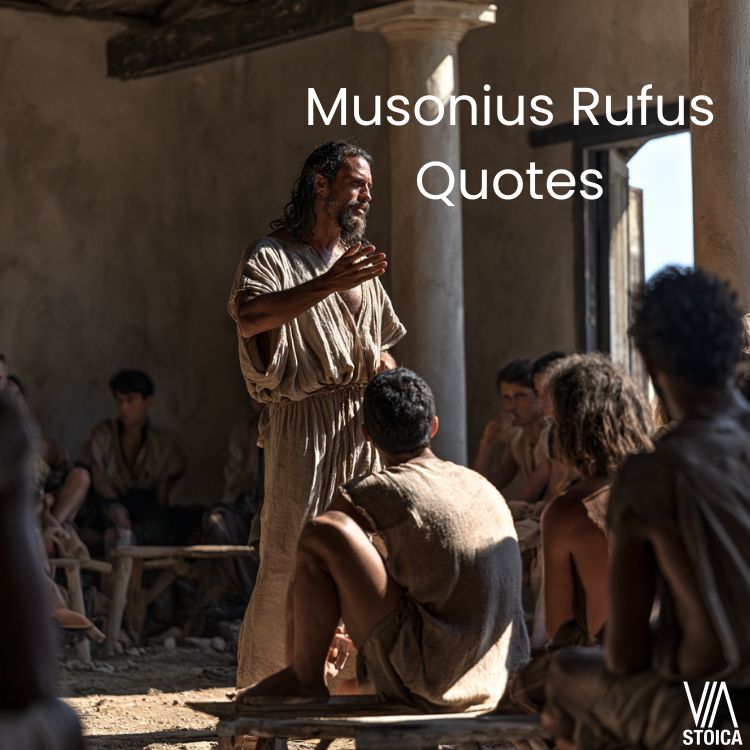
Musonius Rufus was a Roman Stoic philosopher of equestrian rank, exiled three times, and the teacher of Epictetus. Like his student, he wrote nothing himself. What survives comes mainly from his student Lucius, whose notes were preserved by the later anthologist Stobaeus in a collection usually translated as That One Should Disdain Hardship, plus a small number of sayings recorded by other ancient writers, including Aulus Gellius, Philostratus, and Epictetus himself.
This collection is deliberately short. Far less of Musonius survives than of Epictetus, Seneca, or Marcus Aurelius, and every quote below is checked against a named discourse or source rather than repeated from secondhand lists circulating online. Two quotes come to us only through later writers rather than the direct discourse collection, and both are marked as such.
For his full life and teaching, read the Musonius Rufus biography. For quotes from the other Roman Stoics, browse the Epictetus quotes collection, the Marcus Aurelius quotes collection, and the Seneca quotes collection. For all of them together and more, the Stoic quotes library will give them to you all.
On Human Nature and Living Well
"All of us are so fashioned by nature that we can live our lives free from error and nobly, not that one can and another cannot, but all."
Musonius Rufus, That One Should Disdain Hardship, Discourse 2, p. 7
Post: Musonius Rufus Biography
"Philosophy is nothing else than to search out by reason what is right and proper and by deeds to put it into practice."
Musonius Rufus, That One Should Disdain Hardships, Discourse 14, p. 71
Post: Musonius Rufus Biography
On Teaching, Proof, and Conduct
Post: Musonius Rufus Lecture 1: How to Teach Like a Stoic
Post: Musonius Rufus Lecture 1: How to Teach Like a Stoic
Post: Musonius Rufus Lecture 1: How to Teach Like a Stoic
Post: Musonius Rufus Lecture 1: How to Teach Like a Stoic
Post: Musonius Rufus Lecture 1: How to Teach Like a Stoic
On Farming and the Simple Life
"Earning a living by farming seems to be most suitable for a philosopher."
Musonius Rufus, That One Should Disdain Hardship, Discourse 11, p. 57
On Diet, Clothing, and Appearance
"He believed that the beginning and foundation of temperance lay in self-control in eating and drinking."
Musonius Rufus, That One Should Disdain Hardship, Discourse 18A, p. 87
Post: Musonius Rufus Biography
"One should prefer inexpensive food to expensive and what is abundant to what is scarce, so one should prefer what is natural for men to what is not."
Musonius Rufus, That One Should Disdain Hardship, Discourse 18A, p. 87
Post: Musonius Rufus Biography
"He also thought it best to provide moderate covering for the body, not expensive and superfluous, for he said that one ought to use clothing and shoes in exactly the same way as armor, that is, for the protection of the body and not for display."
Musonius Rufus, That One Should Disdain Hardship, Discourse 19, p. 95
Post: Musonius Rufus Biography
"He used to say that a man should cut the hair from the head for the same reason that we prune a vine, that is, merely to remove what is useless."
Musonius Rufus, That One Should Disdain Hardship, Discourse 21, p. 103
Post: Musonius Rufus Biography
On Women and Philosophy
"Women as well as men have received from the gods the gift of reason, which we use in our dealings with one another and by which we judge whether a thing is good or bad, right or wrong."
Musonius Rufus, That One Should Disdain Hardship, Discourse 3, p. 11
Post: Musonius Rufus Biography
"But I do say that, since in the human race man's constitution is stronger and woman's weaker, tasks should be assigned which are suited to the nature of each; that is, heavier tasks should be given to the stronger and lighter ones to the weaker."
Musonius Rufus, That One Should Disdain Hardship, Discourse 4, p. 17
Post: Musonius Rufus Biography
"All human tasks, I am inclined to believe, are a common obligation and are common for men and women, and none is necessarily appointed for either one exclusively, but some pursuits are more suited to the nature of one, some to the other, and for this reason some are called men's work and some women's."
Musonius Rufus, That One Should Disdain Hardship, Discourse 4, p. 18
Post: Musonius Rufus Biography
Preserved by Others
Neither of the two quotes below comes from the discourse collection recorded by Lucius. Both survive only because later writers preserved them, which is worth knowing, not to doubt them outright, but to read them with that context in mind.
"Like a stone, if you cast it upward, will be brought down to the earth by its own nature, so the man whose mind is naturally good, the more you repel him, the more he turns toward that to which he is naturally inclined."
Musonius Rufus, as recorded by Epictetus, Discourses, Book 3, Chapter 6
Post: Musonius Rufus Biography, The Discourses of Epictetus
"You are distressed, Demetrius, to see me digging through the Isthmus for Greece; but if you saw me playing the harp like Nero, what would you feel then?"
Musonius Rufus, as recorded by Philostratus, Life of Apollonius, Book 5, Section 19
Post: Musonius Rufus Biography
If any of these quotes speak to you and you want help putting them into practice, that is what Stoic Coaching is for. You can also book a free consultation to talk it through first.
For weekly reflections drawn from texts like these, join The Pause newsletter below, or find the Via Stoica Podcast on YouTube, Spotify, and Apple Podcasts.
About the Author
Benny Voncken is the founder of Via Stoica and host of The Via Stoica Podcast. He has practiced Stoicism as a way of life for over seven years and draws on almost 15 years of teaching experience to turn dense ancient ideas into daily practice. Since 2023 he has coached clients around the world through one-on-one Stoic coaching. He also leads Stoic walks across Europe, writes the monthly newsletter The Pause, and has spoken at Stoicon.
The Pause
A monthly Stoic newsletter
Sign up and get The Pause Framework free.
A practical Stoic tool for moments of tension. Observe what is happening. Reset your momentum. Decide with reason.
It arrives in your welcome email.
Then, once a month: one reflection, one practice, one Stoic idea.