
What is Brain Rot: The Stoic Answer to Reclaiming Your Attention

You pick up your phone. You’re not sure why. There was no notification, no reason you can name. You open an app, close it, open another one. A few minutes pass, maybe more. You put the phone down and feel vaguely worse than before, without being able to say exactly what happened.
Let me be honest, this is me describing my own behavior, and I recognize the habit of useless scrolling. It is difficult to beat, because the algorithms are working against us. But we can do something about it, and for that, we go back in time. 2300 years ago, to the ancient Stoics.
What Brain Rot Actually Is
Brain rot (also written as brainrot, one word) has two related meanings, and it’s worth separating them.
The first refers to the content itself: low-quality, low-value digital media, particularly short-form video, doomscrolling, and AI-generated content, described as causing harm to the viewer. This is how younger generations use the term, often with irony.
The second meaning is the one that matters for most people searching this term: the cognitive state that results from overconsumption of that content. The deterioration of a person’s mental or intellectual state through prolonged exposure to trivial or unchallenging material.
Oxford University Press named brain rot its Word of the Year for 2024. Their official definition reads:
“The supposed deterioration of a person’s mental or intellectual state, especially viewed as the result of overconsumption of material, now particularly online content, considered to be trivial or unchallenging.”
Oxford University Press, Oxford Word of the Year 2024
Usage of the term increased 230% between 2023 and 2024 and continues to grow. If you’re reading this, you’re probably experiencing the second meaning and looking for something to do about it.
What It Feels Like from the Inside
Brain rot is not a dramatic collapse. It tends to arrive gradually, and then it just seems like normal life.
Research describes it as a cluster of symptoms: brain fog, reduced concentration, mental fatigue, difficulty organising information, difficulty solving problems, difficulty making decisions, difficulty recalling things you read or watched an hour ago, emotional desensitisation, and a general sense that your thinking has become slower or shallower. Doomscrolling in particular carries measurable consequences: a peer-reviewed study published in Applied Research in Quality of Life (Satici et al., 2022) found that heavy doomscrolling is directly associated with psychological distress, reduced life satisfaction, and reduced well-being, with the relationship holding across multiple studies and populations.
The problem is not persuading anyone that something is wrong. The problem is knowing what to do about it. But before getting to that, it’s worth understanding what we are actually dealing with. Because this is not a new phenomenon, and the people who saw it first had something to say.
This Is Not a New Problem
The Druids and the Written Word (~50 BCE)
Julius Caesar, writing in The Conquest of Gaul, described a practice of the Druids that stopped him:

“The Druids believe that their religion forbids them to commit their teachings to writing, although for most other purposes, such as public and private accounts, the Gauls use the Greek alphabet. But I [Julius Caesar] imagine that this rule was originally established for other reasons: because they did not want their doctrine to become public property, and in order to prevent their pupils from relying on the written word and neglecting to train their memories; for it is usually found that when people have the help of texts, they are less diligent in learning by heart, and let their memories rust.”
Julius Caesar, The Conquest of Gaul, Book VI, 3.14
The Druids were not worried about bad content. They were worried about outsourced cognition. When something external does the work, the internal faculty weakens. Writing was the technology they feared. The dynamic is identical to what we face today with the smartphone. The tool changes. The problem does not.
Socrates and the Danger of Writing (~370 BCE)
Plato’s Phaedrus contains one of the earliest recorded arguments against a new technology. Socrates recounts a myth in which the god Theuth presents the gift of writing to the king Thamus, who refuses it. Thamus’s reply is worth reading in full:
“O most ingenious Theuth, the parent or inventor of an art is not always the best judge of the utility or inutility of his own inventions to the users of them. And in this instance, you who are the father of letters, from a paternal love of your own children have been led to attribute to them a quality which they cannot have; for this discovery of yours will create forgetfulness in the learner’s souls, because they will not use their memories; they will trust to the external written characters and not remember of themselves. The specific you have discovered is an aid not to memory, but to reminiscence, and you give your disciples not truth, but only the semblance of truth; they will be hearers of many things and will have learned nothing; they will appear to be omniscient and will generally know nothing; they will be tiresome company, having the show of wisdom without the reality.”
Plato, Phaedrus, 275a–275b
The concern here is not that writing is evil. It is that people will mistake the appearance of knowledge for the thing itself. They will have consumed without transforming. They will seem informed and be hollow. Sound familiar?
Thoreau Coins the Term (1854)
The phrase “brain rot” was first written down by Henry David Thoreau in the conclusion of Walden, published in 1854. He was criticising the tendency to simplify, to level everything down to the lowest common understanding, to prefer easy ideas over difficult ones. He opened the paragraph with a question: “Why level downward to our dullest perception always, and praise that as common sense?” And he closed it with the line that named what we are still living through:
“While England endeavors to cure the potato-rot, will not any endeavor to cure the brain-rot, which prevails so much more widely and fatally?”
Henry David Thoreau, Walden, Chapter 18, Conclusion, p. 160
The potato-rot reference is an interesting one. He was writing in the shadow of the Irish famine of the 1840s, when crop disease had caused devastation visible across the Atlantic. His point was precise: we mobilise to save potatoes. We do nothing to save minds. For Thoreau, brain rot was what happens when people suppress their instincts for curiosity and wonder and resign themselves to unreflective habits: fitting in, getting by, chasing profits, consuming other people’s ideas at second hand rather than thinking for themselves.
The Pattern Across Twenty Centuries
Here is what connects Caesar, Socrates, and Thoreau: none of them were opposed to the technology of their era. They were concerned about what happens to the human mind when a tool begins to do the thinking for it, and when that substitution goes unnoticed.
Every significant leap in how we handle information has offloaded a cognitive function. Writing offloads memory. The printing press offloads the scarcity of knowledge. The telegraph and then the mass media offload the effort of finding out what is happening in the world. The internet offloads the labour of searching. The smartphone offloads attention itself. AI is beginning to offload the effort of forming thoughts.
We keep advancing precisely because we give things away. That is not the problem. The printing press gave us science. The internet gave us access to all of human knowledge. These are genuine goods.
The problem is the absence of awareness about what is being given away and what you are actually getting back.
Reading one hundred books

Reading one hundred books is admirable on paper. But how much do you retain? What do you do differently because of it? If the books become a kind of consumption, absorbed at volume without integration, the mechanism is not so different from scrolling. You have taken in information. You have not been changed by it.
Watching ten hours of short-form video a day is the visible version of the same question. What is it doing to your thinking? How is it shaping your responses, your attention span, your ability to sit with a difficult thought? The difference between the two examples is mostly optics. The underlying question is the same: what are you bringing back from it?
Epictetus made exactly this point about students of philosophy who collected arguments the way people today collect content, to repeat at dinner parties without transformation. The knowledge was external. The change was not happening. That is brain rot with a library card.
What the Stoics Said About This
The Stoics had a name for what brain rot erodes. They called the ruling faculty of the mind the hegemonikon: the seat of reason, judgment, and choice. It is the part of you that decides what to do with an impression before acting on it. And they had a name for what protects it.
Prosoche: The Practice of Vigilant Attention
Prosoche (προσοχή) is the fundamental Stoic spiritual practice. Pierre Hadot, who spent his life studying ancient philosophy, called it the foundational Stoic attitude. It is not mindfulness in the relaxation sense. It is moral alertness: an active, demanding watchfulness over your own thoughts, impressions, judgments, and actions.
Epictetus devoted an entire chapter of his Discourses to it. The chapter is titled “On Attention,” and it opens with a direct warning:
“When you relax your attention for a while, do not fancy you will recover it whenever you please; but remember this: because of your fault today your affairs must necessarily be in a worse condition on future occasions.”
Epictetus, Discourses, Book 4, 12.1
He saw distraction not as a minor inconvenience but as a compounding failure. Every lapse makes the next lapse more likely. This is the mechanism that brain rot exploits. It is not one bad afternoon on the phone. It is the habit that forms when no one is standing guard.
He continues, and brings it back to nature:
“A habit arises in you of not paying attention, and next a habit of deferring attention: and so you get into the habit of putting off from one time to another the happy and befitting life, that would enable you to live, and continue to live, in conformity with nature.”
Epictetus, Discourses, Book 4, 12.2
The word habit is doing the real work there. Brain rot is not an event. It is a direction of travel, one deferred moment of attention at a time.
Brain rot, in Stoic terms, is the prolonged absence of prosoche. It is what happens when you stop standing guard at the gate of your mind.
The Discipline of Assent
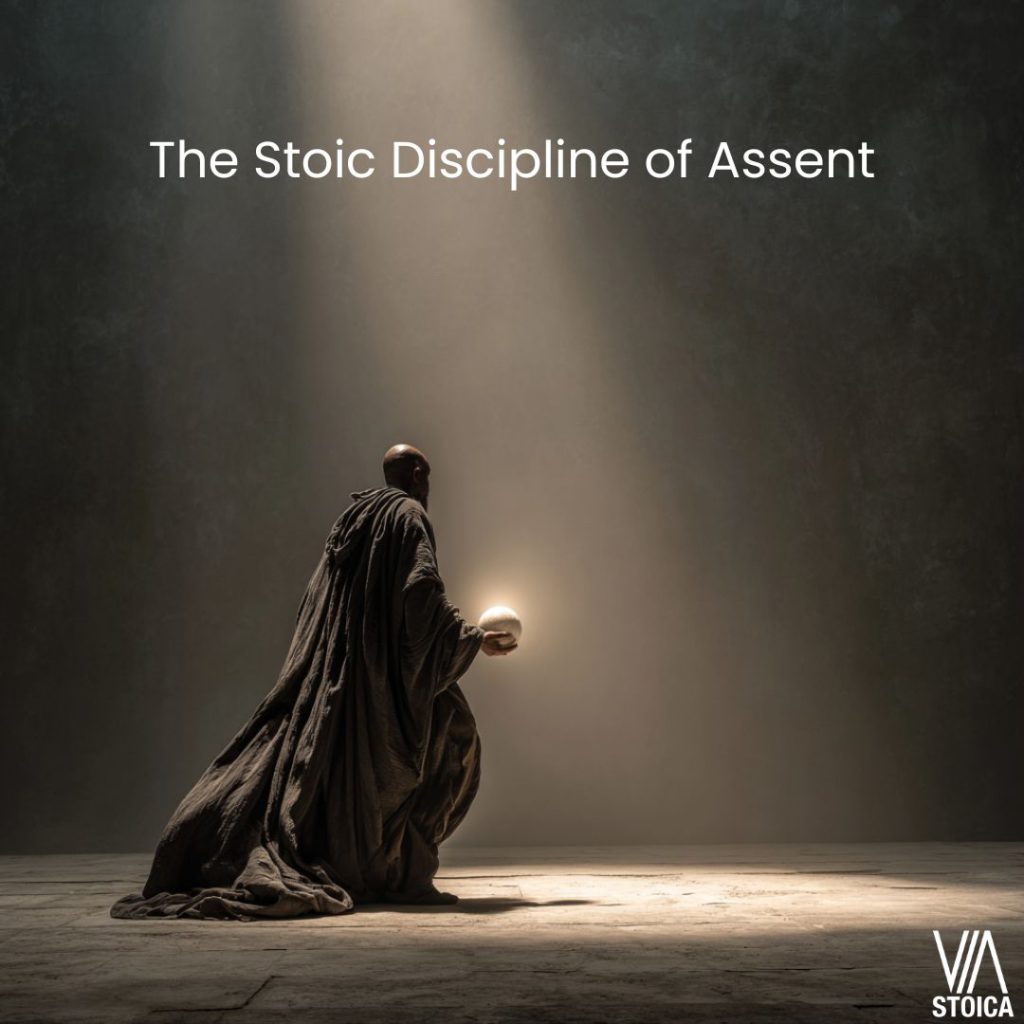
The Stoics taught that between an impression and your response to it, there is a moment of choice. You see something. You feel an impulse. Before acting on it, there is a space, however brief, in which you can assent to that impression or not. The scroll works by collapsing that gap entirely. Swipe, react, swipe, react. The design is not neutral. It is engineered, by teams of people whose job is to keep you moving, to remove that space altogether.
The discipline of assent is the practice of restoring it.
What Is in Your Control
The platforms are built by engineers whose success depends on your attention. That is not in your control. What is in your control: what you pick up, what you allow in, what you choose to assent to, and how you train your attention over time. The Stoic response is never to blame the external thing and stop there. It is always to ask: what is mine to do?
What You Can Actually Do
The attention pause before picking up your phone
Before you reach for it, stop. Ask yourself what you are actually looking for. Name it. If you cannot name it, put the phone down. This is the discipline of assent made practical: restoring the gap between impulse and action. It takes about three seconds, and, done consistently, it begins to rebuild the habit of noticing. The pause here is essential to regaining your agency in a world of algorithms that are designed to take it away from you.
The evening review
Marcus Aurelius used his private journals as a nightly examination of character: where had he fallen short of his own standards, where had he acted well, what needed correction. Epictetus framed it differently, as a check on whether attention had been properly governed throughout the day: where had he lost the guard, where had an impression been accepted without scrutiny. The form differs, but the purpose is the same. Five minutes at the end of the day, not as productivity tracking but as a moral audit, restoring awareness of the pattern before it hardens.
Direct experience over second-hand consumption
This connects Thoreau directly to Stoic practice. Both valued engaging with the world through your own perception rather than consuming other people’s reactions to it. A walk without a podcast. A meal without a screen. A conversation without checking your phone. It is not asceticism. It is reclaiming the capacity for your own thought, which is the thing that brain rot most directly erodes.
Reading for absorption rather than improvement
Pick up a book you actually want to read. Not one you think you should read, not one that will make you better at something, but one that pulls you in because you want to know what happens next, or because the writing itself gives you pleasure. Read it without underlining, without taking notes, without optimising. The goal is to get lost in it. This is not a trivial pursuit. It is one of the oldest forms of sustained, voluntary attention we have, and it is exactly what the short-form scroll is designed to replace. An hour of genuine absorption in something you chose, for no reason other than that you wanted to, is a direct act of reclaiming your own mind.
Sleep enough
This one is personal. Getting enough sleep has changed more about how I think, respond, and pay attention than almost any other single change. The research is unambiguous: sleep deprivation impairs the prefrontal cortex, the part of the brain responsible for judgment, impulse control, and the ability to pause before reacting. In Stoic terms, it degrades the hegemonikon before the day has even started. You cannot practice the discipline of assent on four hours of sleep. The gap that prosoche depends on simply does not exist when you are running on empty. This is not wellness advice. It is a precondition for everything else on this list.
Frequently Asked Questions
What is brain rot?
Brain rot refers to two related things: the low-quality digital content described as causing harm to the viewer, and the cognitive state that results from overconsumption of that content: reduced concentration, mental fatigue, difficulty thinking clearly, and a general shallowing of attention.
What causes brain rot?
The primary driver is prolonged, passive consumption of low-value digital content, particularly short-form video and doomscrolling. These formats are designed to remove the gap between impulse and action, keeping you consuming without giving you time to process or choose.
Is brain rot real?
The colloquial term is informal, but the underlying cognitive effects are well-documented. Research links heavy passive digital consumption to reduced concentration, mental fatigue, emotional desensitisation, and difficulty with recall and decision-making.
Is brain rot permanent?
No. The brain is adaptable. The habits that produce brain rot can be interrupted and replaced. The Stoic tradition is clear on this: attention is a practice, not a fixed state. It degrades through neglect and recovers through deliberate effort.
How do I fix brain rot?
Start with the gap. Before picking up your phone, pause and name what you’re looking for. Build a daily attention review. Spend more time in direct experience and less time consuming other people’s reactions to things. These are not dramatic interventions. They are small, consistent acts of choosing.
What does brain rot feel like?
Brain fog, difficulty concentrating, mental fatigue, trouble recalling recent information, emotional flatness, and a general sense that your thinking has become slower or less sharp. Many people experience it as a kind of restlessness: an inability to sit with anything for more than a few seconds.
What is the Stoic approach to brain rot?
The Stoics would frame brain rot as the prolonged absence of prosoche: vigilant attention to your own mind. They would point to the discipline of assent as the practical corrective, and to the evening review as the tool for restoring awareness before the habit hardens. They would also be clear that the platforms are not in your control, but your response to them is.
This Is Only the Start
If this way of thinking about attention resonates with you, Stoicism goes much deeper than any single article can take you. The primary texts are short, direct, and written by people living under real pressure. Marcus Aurelius’ Meditations, Epictetus’ Enchiridion, and Seneca‘s Letters from a Stoic are the places to start. Everything on this site is built around making those texts practical for a modern life. You’re in the right place.
Want to Go Deeper?
The newsletter, The Pause, goes out once a month with practical Stoic reflection for people who want to use this, not just read about it. Subscribe here.
Listen to The Via Stoica Podcast on Spotify, Apple Podcasts, or YouTube.
If you want to work through any of this more directly, I offer Stoic thinking partnership sessions: one-to-one conversations that use Stoic philosophy as a practical tool for whatever you’re actually dealing with. Book your free consultation here.
Author Bio
Benny Voncken is the founder of Via Stoica and host of The Via Stoica Podcast. He has practiced Stoicism as a way of life for over seven years and draws on almost 15 years of teaching experience to turn dense ancient ideas into daily practice. Since 2023 he has coached clients around the world through one-on-one Stoic coaching. He also leads Stoic walks across Europe, writes the monthly newsletter The Pause, and has spoken at Stoicon.
Related Posts
-
 Musonius Rufus Lectures
Musonius Rufus Lecture 1: How to Teach Like a Stoic
Musonius Rufus Lecture 1 explains how to teach like a Stoic: a few convincing proofs, a student who tests them, and a teacher who lives them.
Read more -
-


Comments 0