
How to Enjoy Life as a Stoic
How to enjoy life as a Stoic. Learn what enjoyment means and let's resolve some preconceptions on Stoicism.

How to enjoy life as a Stoic might sound like a strange question. People are often referred to as stoics when they cope with things without moving the emotional needle. This gives Stoicism the reputation of being emotionless and not capable of enjoying life. In this post, I wish to show you that by learning more about Stoicism, you can get more joy out of life.
The fact that I focus on Stoicism doesn’t mean everyone should follow it. And even then, there are different degrees. I’d like to show you that there is more to Stoicism than is often portrayed. That’s why today we will have a look at how you can enjoy life as a Stoic. We will explore what this means and that Stoicism isn’t a dark, joyless philosophy, but one that makes you focus on the right things. In the end, it is up to you to take away what works for you. This is another step in creating your own philosophy of life.
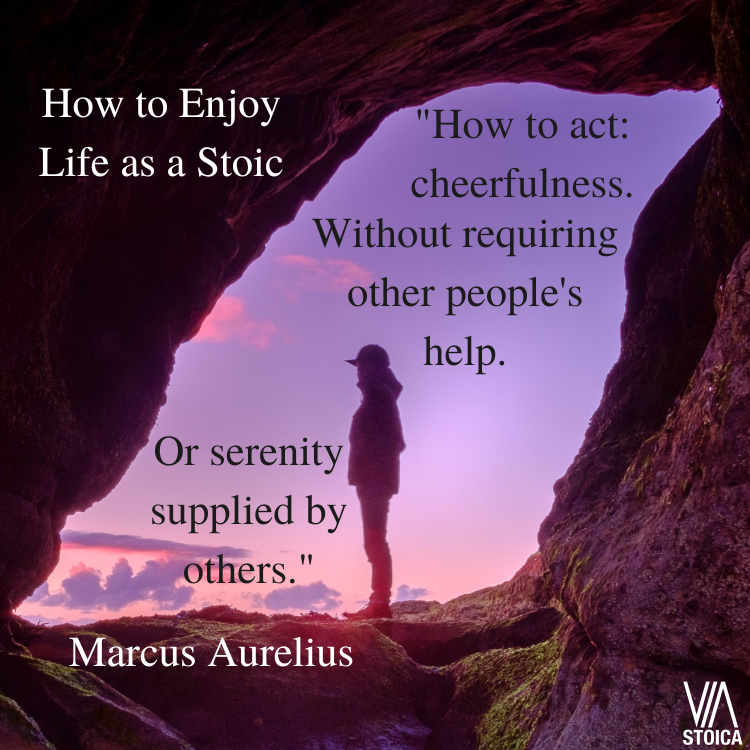
“How to act: Cheerfulness. Without requiring other people’s help. Or serenity supplied by others.”
Marcus Aurelius, Meditations, Book 3.5
Be grateful for every moment
In Stoicism, the main aim is a state of eudaimonia. This can be roughly translated as living for the highest good. Which will lead to a peaceful and flourishing life. To achieve this, we need to live a virtuous life according to nature. The Stoics divided this into the four virtues: Wisdom, Justice, Courage, and Temperance. This kind of living has to come from within. Externals are not under our control and can’t give us the peace of mind we seek. They can give us anxiety when things don’t happen as we wish them to happen. But how can we enjoy our life as the Stoics if we look for a peaceful life?
When we think of enjoyment, we often describe parties, laughter, dancing, playing games, or hanging out with others. But we should learn to enjoy more parts of life. Such as running errands, finishing a project at work, or doing our daily tasks. There can be a lot of power in learning to be grateful for those moments and to enjoy doing them.
Enjoy the little things

“If you do the job in a principled way, with diligence, energy, and patience, if you keep yourself free of distractions, and keep the spirit inside you undamaged as if you might have to give it back at any moment –
If you can embrace this without fear or expectations – can find fulfillment in what you’re doing now, as Nature intended, and in superhuman truthfulness (every word, every utterance) – then your life will be happy.
No one can prevent that.”
Marcus Aurelius, Meditations, Book 3.12
Again, we fall back on Marcus Aurelius, the Roman Emperor, to show us how any life can be lived in a grounded and normal way. This doesn’t mean that we can’t do fun things; we should. But those moments don’t make up the majority of our time. And even if they did, they would become the standard, and we would have to seek new thrills. What we need to learn is to be consistent in how we go about our business. That’s why it is important to have a philosophy of life as a guide. When we learn how to live in the moment and be grateful for it, we can learn to enjoy the little things.
Don’t let joy lead to anxiety
One major misconception surrounding Stoicism is that we should be emotionless. But when we read the Stoics, we see that we need to control the negative ones. They even go a step further by saying that we should examine these bad emotions. This will make us stronger and show us who we are. It is then up to us to take them on in a virtuous way and in accordance with our nature. The enjoyment can come from the fact that we realize how strong we can be. The Stoics teach us that there is no good or bad; it’s all how we perceive it. And in this case, we look at the negative influences and make something good out of them.
The positive emotions we experience are preferred indifferences. They are often triggered by external events, which won’t always turn out as we wish. With high expectations for a party, we could end up being disappointed. But if it does turn out how we thought, then there is nothing wrong with enjoying it. To do that, we must stay in the moment and make sure we don’t act in a way that can leave us embarrassed and full of anxiety afterward. This is something we have to judge for ourselves. We must remain virtuous, even in moments of joy.
Getting more enjoyment in being sober
Those moments can be increased if we learn to achieve them from within. Here’s a personal example. I used to party a lot and drink a lot. Getting drunk was the only way I thought I could enjoy a party. The day after, and the days following, would be accompanied by bad headaches and anxiety about my behavior. Since I’ve given up alcohol, I have realized that going out is much more fun and meaningful. I get to enjoy a party or a concert and still function at the end.
This way, I’m no longer a burden or embarrassment to the people around me. And let me tell you, it is not easy. Having to explain why I don’t drink and choosing what to drink can be tough. That does strengthen my resolve, though. But I don’t mind other people drinking, not one bit. If they can enjoy themselves and have it under control, that’s great. I can’t do that. So I take my enjoyment out of the fact that I can experience these events sober and have my good times last until the next day.
Enjoy life as a Stoic
To enjoy life as a Stoic requires some rethinking on our side. We need to know who we are and what is important to us. Then we can make sure to be consistent in how we act if that is in accordance with our nature and the Virtues. Once we get there, we will see that there is much more to enjoy in life. The fact that we have become more peaceful will allow us to appreciate everything around us more. We are calmer and can soak it all in. Even the hardship will be a reason to feel good about ourselves. Knowing how strong we are and what we can endure will give us the confidence to deal with any situation. This results in less anxiety and stress.
Let’s give the final word to Seneca.
“Such pleasures are insubstantial and unreliable; even if they don’t do one any harm, they’re fleeting in character. Look around for some enduring good instead. And nothing answers this description except what the spirit discovers for itself within itself. A good character is the only guarantee of everlasting, carefree happiness.”
Seneca, Letters from a stoic, Letter XXVII
Want to explore more Stoic Practice?
Book a free consultation with one of our Stoic Coaches to get support. Or read more about How to Practice Stoicism here. Listen to the Via Stoica Podcast on Spotify, Apple Podcasts, or YouTube.
Author Bio
Benny Voncken is the founder of Via Stoica and host of The Via Stoica Podcast. He has practiced Stoicism as a way of life for over seven years and draws on almost 15 years of teaching experience to turn dense ancient ideas into daily practice. Since 2023 he has coached clients around the world through one-on-one Stoic coaching. He also leads Stoic walks across Europe, writes the monthly newsletter The Pause, and has spoken at Stoicon.
Related Posts
-
 Musonius Rufus Lectures
Musonius Rufus Lecture 1: How to Teach Like a Stoic
Musonius Rufus Lecture 1 explains how to teach like a Stoic: a few convincing proofs, a student who tests them, and a teacher who lives them.
Read more -
-


Comments 0