
On Dealing With the General Public

When dealing with the general public, we can find plenty of moments for friction. For example, when we travel, go to the shop, or drive our car. This last example is exactly where Epictetus made my life a lot more peaceful.
As most of us know, not everyone drives the same way we do. Some go fast, some go slow, and some don’t even seem to know what they are doing. This is something we can foreshadow before we set off in our car.
A real local hammam
Back in Epictetus’s day, there were no cars. Yet, he dealt with the general public in another way. In his example, he used his visits to the baths. Let’s take a step back and find out what the baths looked like back in the day. We can actually, still now, find similar examples in certain parts of the world.
During one of my trips to the south of Morocco, I had the opportunity to visit one of the local baths there, called hammams. This was nothing like the spas you might see advertised on TV or in a magazine. This was a real local hammam, where you had to fill your own plastic buckets of hot and cold water. I had to bring all the equipment, including a little plastic mat to sit on. The men were surprised to see me there, but were friendly enough to try to help me.
Imagine what happens in baths
Unfortunately, my Arabic was only to the level where I could order my eggs for breakfast. Which caused some confusing moments. Some gesturing and pointing did help me get underway. They then tried to stop me after I was ready to leave, about twenty minutes later. But I had washed and had even taken my time in doing so. Apparently, one would normally stay there for an hour or longer. This experience allowed me to get a better sense of what Epictetus meant with the following:

‘If you intend to engage in any activity, remind yourself what the nature of the activity is. If you are going to bathe, imagine yourself what happens in baths: the splashing of water, the crowding, the scolding, the stealing. And like that, you will more steadily engage in the activity if you frankly say ‘I want to bathe and want to hold my will in accordance with nature’.
Epictetus, the handbook of Epictetus, 4
I was still alive
How did this help me when I looked in the rearview mirror and saw a fast-approaching car flashing its lights at me? At that moment, I thought, I have to drive and want to hold my will in accordance with nature. I prepared myself before setting off from the parking lot by reminding myself of the different drivers I could encounter. Including the spectacle that was now blinding me as I looked back.
Once I recognized this situation from my visualization earlier, it made me smile. There is the fast-flashing driver, who is in such a hurry that he needs to signal it from miles away. I then checked the road, made sure it was safe, and went out of my way. There were two positives to handling it this way. One, I was still alive. Two, I remained calm and went on my peaceful way.
The ones who can’t decide
As you can read in the reflection On Dealing with Frustration People, it is possible to apply the same thought process to these situations. Except for the fact that we don’t know these people personally, and that there are many. That’s why we should try to picture the people whom we can meet during the activity.

When I have to go grocery shopping, I take the following steps: I have a quick look to assess the situation. I take a deep breath and envision all the people I might encounter. The ones who take up an entire aisle, the ones who try to cut the queue, the ones who can’t decide, the ones who leave their trolley in the middle of the store, and I am sure you can come up with a few more. I breathe out and tell myself I am going shopping, and I want to hold my will in accordance with my nature. This raises my awareness of my surroundings and prepares me for all of them.
Set your calmness as the priority
Through practice and training, I find myself better equipped against busy and hectic situations. This is still quite challenging for me, but I can keep my calm a lot better. It has improved my life in many ways. I find myself in less of a hurry. My awareness of the things around me has increased a lot, and I don’t feel the need to be first or faster than others anymore.
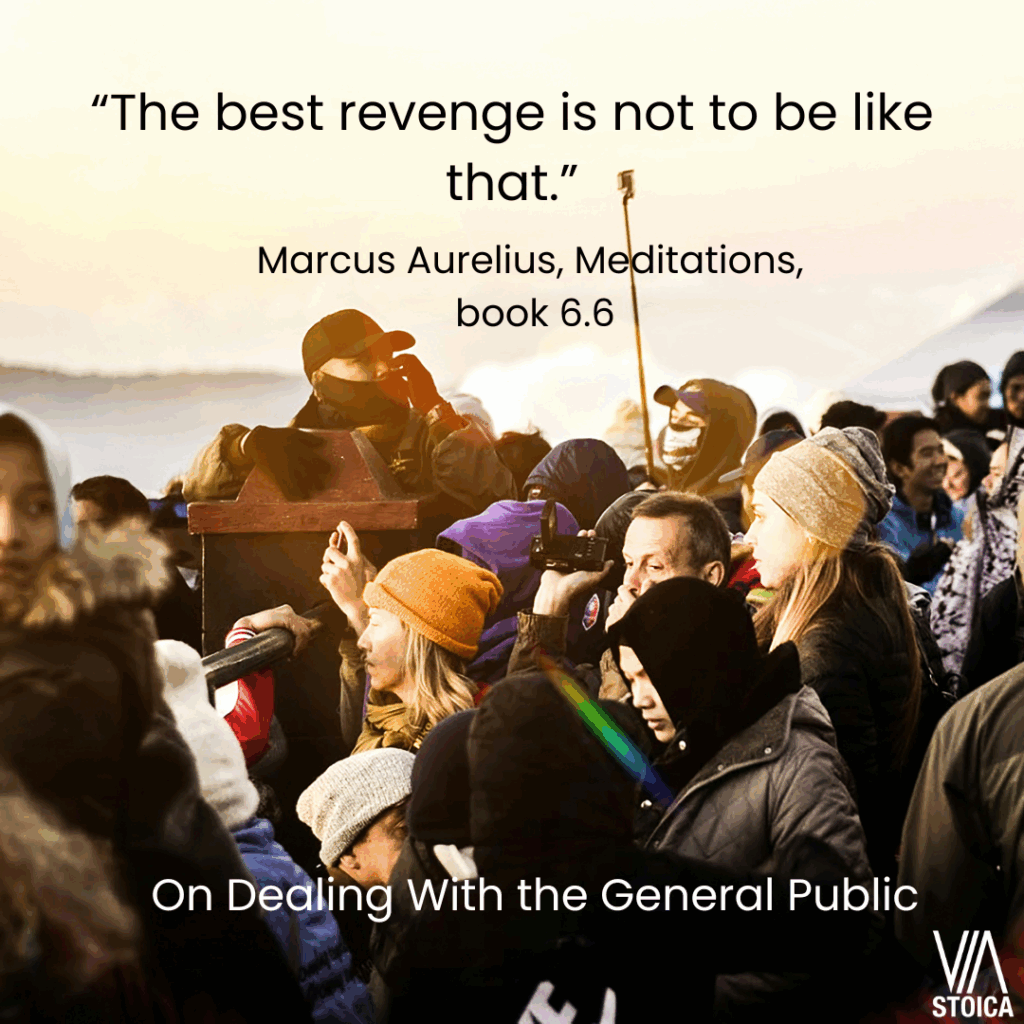
“The best revenge is not to be like that.”
Marcus Aurelius, meditations, book 6.6
This quote can apply to the drivers and shoppers we meet around us. If they wrong us, don’t be like them. Make a bit of an effort to act the way you think we should act. We can only control our own thoughts and the actions that come therefrom. Moreover, we can set a good example for people to measure themselves by. Set your calmness as the priority and train yourself to stay that way even if the world around you does its best to shake you.
Who do you want to be?
Now I can hear some of you asking yourself why I should make such an effort. Why should I be the better person? This question answers itself: to be a better person. It isn’t easy, but some people need some guidance, and oftentimes telling them doesn’t work. The saying, ‘Show, don’t tell,’ resonates a lot with reality.
Besides all this, it shows me the absurdity of some of our actions. Seeing how we can act in certain circumstances as if our lives depend on it makes me laugh. Why do we need to be first? What will we gain with that extra minute? Is it because we feel we are wasting so many of them doing things we don’t want to do? When you see the kind of behavior that annoys you, ask yourself if you have never displayed it. We are all the same, yet some choose to grow and be better people. Who do you want to be?
Want to explore more Stoic Practice?
Book a free consultation with one of our Stoic Coaches to get support. Or read more about How to Practice Stoicism here. Listen to the Via Stoica Podcast on Spotify, Apple Podcasts, or YouTube.
Author Bio
Benny Voncken is the founder of Via Stoica and host of The Via Stoica Podcast. He has practiced Stoicism as a way of life for over seven years and draws on almost 15 years of teaching experience to turn dense ancient ideas into daily practice. Since 2023 he has coached clients around the world through one-on-one Stoic coaching. He also leads Stoic walks across Europe, writes the monthly newsletter The Pause, and has spoken at Stoicon.


Comments 0