
How to deal with Frustrating People: A Stoic Quote To The Rescue
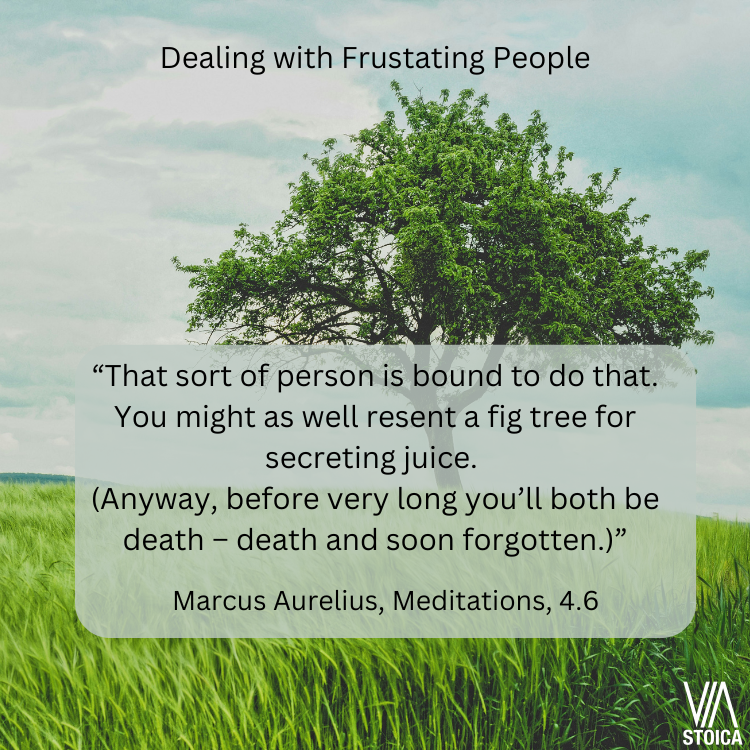
On Dealing with Frustrating People “That sort of person is bound to do that. You might as well resent a fig tree for secreting juice. (Anyway, before very long you’ll both be death – death and soon forgotten.)” - Marcus Aurelius

Stoicism offers a direct answer to frustrating people: the problem is not the person, but the judgment you attach to their behavior. Marcus Aurelius captured this in one of the most practical passages in the Meditations, and it is worth reading slowly before doing anything else.
"That sort of person is bound to do that. You might as well resent a fig tree for secreting juice. (Anyway, before very long you'll both be dead, death and soon forgotten.)"
Marcus Aurelius, Meditations, Book 4.6
That sentence, “that sort of person is bound to do that,” is the whole teaching. Not a technique. Not a breathing exercise. A shift in how you see what is happening. This article unpacks why it works and how to put it into practice.
The fig tree: why frustration is a judgment, not a fact
A fig tree secretes sticky juice. That is its nature. You would not resent a fig tree for doing what fig trees do. And yet when a person acts according to their nature, something we could have predicted if we had been paying attention, we feel wronged. We feel that they have done something to us personally.
Marcus Aurelius is pointing at something precise here. The frustration is not caused by the person. It is caused by the phantasia, the impression, that you attach to their behavior. The Stoic term for what happens next is synkatathesis: the moment you give your assent to that impression, accepting it as meaning what you think it means. The frustration only has power because you agreed to it.
This was not theoretical for me. I came across this passage while working a job that was draining me. The people around me were difficult in predictable, consistent ways. One person in particular had a set of behaviors that I had come to dread. When I read “that sort of person is bound to do that,” I pictured him immediately. He was acting according to his nature, exactly as he always had. The fig tree was doing what fig trees do. The problem was that I kept touching the juice and being surprised that my hands were sticky.
What Stoicism actually asks of you

Stoicism does not ask you to like difficult people or to pretend their behavior is acceptable. It asks you to see it accurately. The discipline of assent is the Stoic practice of examining an impression before you agree to it. Before you decide that what someone did was an attack on you, a sign of disrespect, or proof that the world is unfair, you pause. You ask whether the impression is actually true.
Most of the time, what you find is this: the person acted according to their nature. They were consistent. You could have predicted it. The frustration came not from what they did, but from the gap between what you expected and what happened. And that gap is something you created.
Prohairesis, the Stoic concept of moral choice, is what makes this practice possible. What is up to you is not the other person’s behavior. What is up to you is the judgment you apply to it. That is where your power is, and also where your responsibility sits.
The second half of the Marcus Aurelius quote matters too. “Before very long you’ll both be dead, death and soon forgotten.” This is not nihilism. It is a proportionality exercise. The encounter that feels enormous right now will, very soon, mean nothing at all. The memento mori perspective shrinks the frustration to its actual size.
How to apply this in practice
Think of a specific person who regularly frustrates you. Not a category of person, a specific individual whose behavior you know well. Now ask whether their behavior is actually surprising, or whether it is entirely consistent with who they have always been.
If it is consistent, that is the fig tree. You already know what this tree does. The Stoic move is not to avoid the tree or to change it. It is to stop being surprised by the juice.
Steps to work with frustration in the moment
When you notice frustration arising in response to another person, move through these steps before reacting.
Pause and name the impression. Say to yourself, in neutral language, what just happened. Not “she attacked me” or “he is impossible.” Simply: “She said X. He did Y.” Remove the judgment from the description. This is the first step in the discipline of assent: separating the impression from the evaluation.
Ask whether this is surprising. Is this person acting consistently with their nature? If yes, the fig tree is secreting juice again. You already knew this was possible. The surprise is the judgment you added, not a feature of the situation.
Identify what is actually in your control. Their behavior is not in your control. Your response is. Your next sentence, your next decision, your next action: these belong to you. Focus there.
Apply the memento mori perspective. Before very long, you will both be forgotten. This specific moment, which feels urgent and personal right now, will leave no trace. That is not a reason to dismiss it, but it is a reason to keep it in proportion.
Find the opportunity. Every frustrating encounter is a training ground for the askesis, the Stoic practice of building character through repeated effort. The person frustrating you is, without knowing it, offering you a chance to practice. Thank them for it internally, even if that feels strange at first.
There it is
Ever since that first reading, I use a simple internal phrase when I recognise the pattern beginning. I say to myself: “There it is.” Not with contempt. Not with resignation. Just with recognition. The fig tree is doing what fig trees do. I know this tree. I will not let the juice stick to me today.
It changes the quality of the interaction immediately. You move from reacting to observing; you are no longer inside the frustration, and you are watching it from a small distance. And in that distance, you recover the freedom to choose how to respond.
This is what Stoic practice actually looks like in daily life. Not grand gestures. Not philosophical treatises. A two-word phrase, a breath, and the choice to act from reason rather than reaction.
Frequently Asked Questions
What does Stoicism say about dealing with frustrating people?
Stoicism teaches that frustration is not caused by the other person but by the judgment you attach to their behavior. Marcus Aurelius uses the image of a fig tree: resenting someone for acting according to their nature is as absurd as resenting a tree for secreting juice. The Stoic practice is to recognise the pattern, withhold your automatic reaction, and respond from reason rather than impulse.
How do I stop letting difficult people affect me?
The first step is separating the impression from the evaluation. When someone’s behavior triggers frustration, describe what happened in neutral language before adding any judgment. This is the Stoic discipline of assent: you choose which impressions to accept as meaningful and which to let pass. Over time, this becomes a habit that genuinely reduces the power other people have over your inner state.
Is it Stoic to avoid difficult people?
Not necessarily. Stoicism does not teach withdrawal from the world. The discipline of action asks you to engage with your role and your community, which includes the difficult people in it. The goal is not to avoid them but to interact with them from a place of reason rather than reaction. Avoidance is sometimes appropriate, but it should come from a considered judgment, not from frustration.
What is the Marcus Aurelius quote about frustrating people?
The most direct passage is from Meditations Book 4.6: “That sort of person is bound to do that. You might as well resent a fig tree for secreting juice. Anyway, before very long you’ll both be dead, death and soon forgotten.” Marcus Aurelius uses this reflection regularly throughout the Meditations, reminding himself that other people act according to their nature, and that the encounter is brief in the context of a life.
What is prohairesis and why does it matter for dealing with people?
Prohairesis is the Stoic concept of moral choice, the faculty that governs your judgments, intentions, and responses. It is the only thing fully within your control. When someone frustrates you, their behavior lies outside your prohairesis. Your response lies inside it. Understanding this distinction does not eliminate the frustration immediately, but it relocates where you direct your energy, away from what you cannot change and toward what you can.
Continue the Practice
If this article was useful, here are the natural next steps.
The Pause is a monthly letter on Stoic practice. One idea, one exercise, one reflection from the ancient sources, delivered to your inbox each month.



The Pause
A monthly Stoic newsletter
Sign up and get The Pause Framework free.
A practical Stoic tool for moments of tension. Observe what is happening. Reset your momentum. Decide with reason.
It arrives in your welcome email.
Then, once a month: one reflection, one practice, one Stoic idea.
Comments 0