
Men’s Mental Health: A Stoic Approach

Something is happening to men’s mental health right now, and most of the available responses to it are wrong.
The clinical response tells you to name your feelings, reach out, and open up. That’s not bad advice, but it’s written for someone who has already decided they have a problem. Most men haven’t made that decision. They’re just tired, or irritable, or running on a shorter fuse than they used to, or quietly not enjoying things they’re supposed to enjoy.
The manosphere response tells you to suppress all of it; that difficulty is the point, that discomfort is growth. That’s not entirely wrong either, but it tends to produce men who perform strength rather than develop it, who are harder on the outside and no less lost on the inside.
Neither of these is what Stoicism offers. And that’s exactly why men’s mental health, as a real and pressing challenge, is a conversation ancient philosophy is unusually well equipped to enter.
If you want to understand what Stoic philosophy asks of a man in practical terms, start with What Is the Stoic Man and come back here for the wider picture.
The Problem Isn’t That You Feel Things
The most persistent misreading of Stoicism is that it tells you not to feel anything. That it’s a philosophy of detachment, of stone-faced endurance, of cutting yourself off from the full range of human experience.
The Stoics themselves would have found this baffling.
Marcus Aurelius filled his private journals with doubt, frustration, grief, and the ongoing difficulty of living up to his own standards. Seneca wrote letters soaked in warmth and personal confession. Epictetus, who had been enslaved and lived with a permanent physical disability, spoke not about suppressing his circumstances but about maintaining freedom of mind within them.
The Stoics weren’t teaching men not to feel. They were teaching men to understand what they were feeling, to trace it back to its source, and to respond rather than react. That is a very different project, and it’s one that speaks directly to the men’s mental health conversation that most modern content keeps missing.
The Stoic term for this is prohairesis, the faculty of choice, the part of you that decides what something means before you act on it. The Stoics were interested in that gap between event and response. Not to fill it with performance, but to fill it with reason.
If you’ve ever felt like your reactions are outrunning your judgment, that’s exactly the gap they were working in.
What Ancient Philosophy Got Right About the Male Experience
Men’s mental health is a growing topic in public conversation, and most of the conversation misses something important.
The dominant framing treats men’s emotional difficulties as primarily a problem of expression, that men struggle because they’ve been taught not to show what they feel. Fix the expression, improve the health. It’s not wrong, exactly. But it locates the problem at the output end of something much longer.
The Stoics located it at the input end. They were interested in how we interpret what happens to us, not just how we express it afterward. They called these interpretations phantasiai, the impressions that events make on us before we’ve consciously processed them. And they argued that most of our suffering comes not from events themselves but from the judgments we add to them.
This is an argument that lands differently for men who would never walk into a therapist’s office, because it doesn’t start from vulnerability. It starts from intelligence. It asks: Are you seeing this situation clearly? Are you reacting to what’s actually there, or to the meaning you’ve constructed around it?
That’s not a therapeutic question. It’s a philosophical one. And Stoicism has been asking it for two thousand years with more precision than most modern frameworks manage.
If you’re dealing with the weight of pressure, comparison, failure, or the specific exhaustion of trying to hold things together without anyone noticing, a Stoic approach to men’s mental health offers tools that don’t require you to become someone you’re not. They require you to think more clearly about who you already are.
Three Stoic Practices That Actually Help
1. The Discipline of Assent
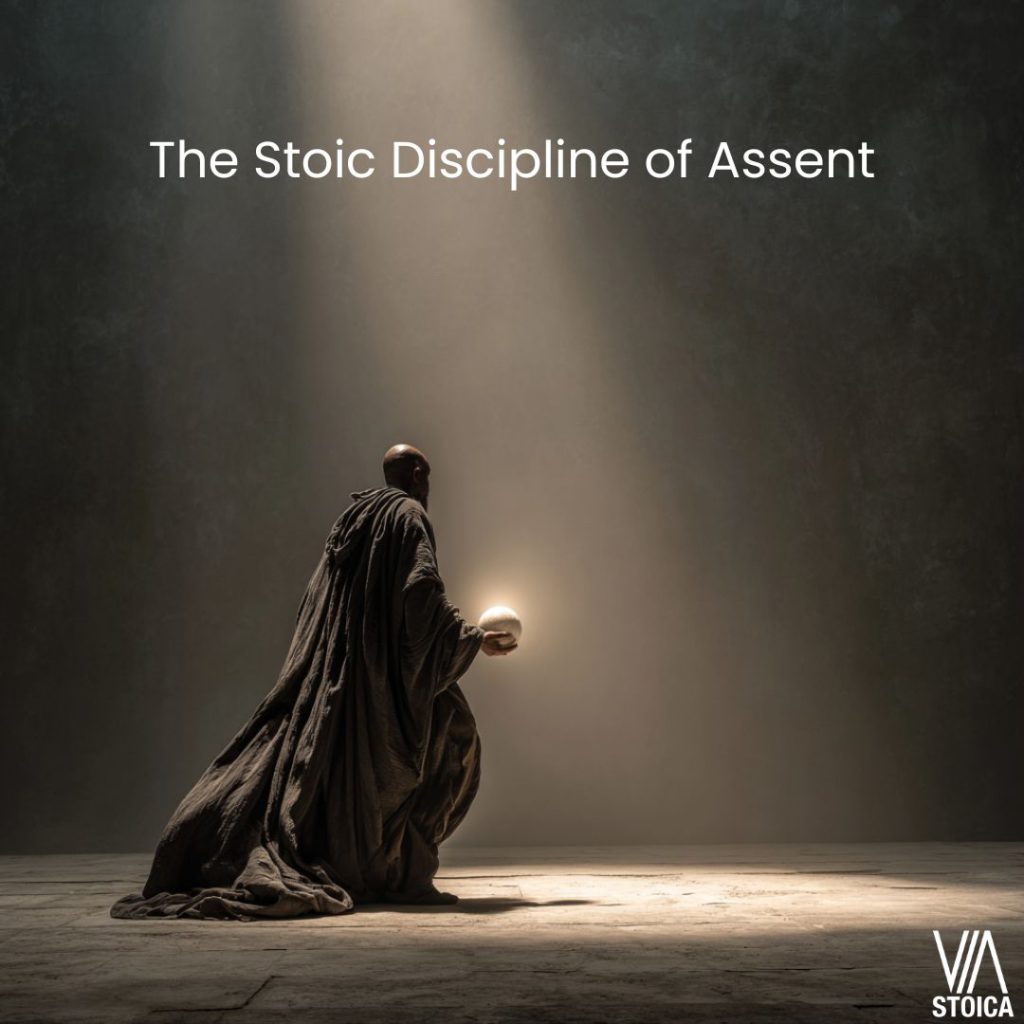
The Stoics taught that we have the ability, and the responsibility, to pause before accepting an impression as true. When something happens and your mind immediately generates an interpretation, that interpretation is not a fact. It’s a proposal. You can examine it.
This is especially useful for the kind of mental experience that most affects men’s wellbeing: the running commentary of self-evaluation that happens when things go wrong at work, in relationships, or in pursuit of something that matters to you. That commentary moves fast and tends to be brutal. The Stoic practice is to slow it down and ask what it’s actually made of.
This connects directly to what the Stoics understood about overthinking. The mind that spirals is usually a mind that has accepted a series of impressions without examining them. The discipline of assent interrupts that.
2. The Dichotomy of Control
Epictetus opens the Enchiridion with it: some things are in our power, some are not. What’s in our power is our intention, our attention, our response. What’s not in our power is the outcome.
Men tend to carry an enormous amount of weight attached to outcomes. Career, respect, relationships, physical condition, the trajectory of their lives. All of it feels like a direct measure of worth. And when outcomes don’t cooperate, which they regularly don’t, that can produce a kind of low-grade suffering that doesn’t have a name and is therefore hard to address.
The Stoic move is not to stop caring about outcomes. It’s to relocate your sense of agency to the part of the equation you actually control. That’s not resignation. It’s precision. The nervous system responds differently when you’re no longer braced for a verdict on your fundamental worth from every outcome you face.
3. Negative Visualisation
The Stoics practised premeditatio malorum, the premeditation of difficulties. They would mentally rehearse what could go wrong, not to produce anxiety but to dissolve it. When you’ve already considered the difficult outcome, it loses its power to ambush you.
This is also a practice in appreciating what you have. Most chronic low-level dissatisfaction is driven by the opposite of this, by taking present circumstances for granted while orienting entirely toward what’s missing. Negative visualisation interrupts that without requiring gratitude journaling or any of the other wellness-adjacent practices that many men find genuinely difficult to engage with.
What a Stoic Approach to Men’s Mental Health Actually Changes
The practices above are not techniques for feeling better in the moment. They’re training in a particular quality of attention, and like any training, the results accumulate slowly and then noticeably.
What tends to change first is the speed of reaction. You find yourself less immediately derailed by what previously derailed you. Not because you care less, but because there’s a small gap where there wasn’t one before.
What changes later is something harder to describe: a growing sense that your response to your life is genuinely yours, not a product of whatever happened to you on a given day. The Stoics called this eudaimonia, a good state of character and soul. Not a mood. Not an outcome. A way of being that you’ve actually built.
Men’s mental health, in the end, is not primarily a problem of emotional vocabulary. It’s a problem of living with more pressure, more ambiguity, and more isolation than most frameworks are willing to acknowledge, while having fewer culturally sanctioned tools for processing any of it.
Stoicism was built for exactly that terrain. It was built by men who held enormous responsibilities, faced genuine losses, and still found a way to remain, as Marcus Aurelius put it, undisturbed.
That’s not performance. That’s philosophy. And two thousand years later, it still works.
This is only the start

If this way of thinking about men’s mental health resonates with you, Stoicism goes much deeper than any single article can take you. The primary texts are short, honest, and written by men under real pressure. Marcus Aurelius’ Meditations, Epictetus’ Enchiridion, and Seneca’s Letters from a Stoic are the places to start. Everything on this site is built around making those texts practical for a modern life. You’re in the right place.
You can also check out our Stoic Reading List for Beginners.
Frequently Asked Questions
What is the Stoic approach to men’s mental health?
The Stoics were not interested in suppressing difficulty. They were interested in understanding it, specifically in tracing suffering back to the interpretations and judgments that generate it rather than the events themselves. For men dealing with pressure, failure, or emotional disconnection, Stoicism offers practical tools grounded in reason rather than vulnerability, which makes it unusually accessible for men who wouldn’t typically engage with mental health content.
Does Stoicism mean suppressing your emotions?
No. This is the most common misreading of Stoic philosophy. Stoicism distinguishes between passions, emotions that prevent rational actions, and eupatheiai, emotions arising from virtue and are in accordance with nature. The goal is not emotional flatness but emotional clarity. Marcus Aurelius, Seneca, and Epictetus all wrote with considerable emotional honesty. Suppression was never the point.
Can Stoicism help with stress and anxiety?
It can offer something more fundamental than stress management. The Stoic dichotomy of control reorients attention away from outcomes, which are not fully in our power, toward response and intention, which are. Men who carry a lot of weight attached to results often find this reorientation genuinely relieving, not because outcomes stop mattering but because they’re no longer the sole measure of worth.
What is the best Stoic text for men struggling with mental health?
Marcus Aurelius’ Meditations is the most direct entry point. It was written privately, never intended for publication, and reads as an honest account of a man trying to hold himself together under enormous pressure. Epictetus’ Enchiridion is shorter and more direct on practical tools. Seneca’s Letters from a Stoic is warmer in tone and closer to conversation.
How is a Stoic approach to men’s mental health different from therapy or wellness content?
Most men’s mental health content is either clinical wellness writing, which assumes the reader has already identified themselves as someone who needs help, or manosphere content, which reframes suppression as discipline. Stoicism offers a third path. It respects intelligence, it draws on primary philosophical texts with two thousand years of serious engagement behind them, and it asks not that you become more vulnerable or more hardened, but that you think more clearly.
Want to go deeper?
The Stoic Man article looks at what it actually means to live these principles as a man in modern life. The nervous system article explores the science of stress and where Stoic practice meets the biology underneath it. And if you want practical tools for the mind that runs ahead of you, the Stoic approach to overthinking is a good next step.
The newsletter, The Pause, goes out once a month with practical Stoic reflection for people who want to use this, not just read about it. Subscribe here.
Listen to The Via Stoica Podcast on Spotify, Apple Podcasts, or YouTube.
If you want to work through any of this more directly, I offer Stoic thinking partnership sessions, one-to-one conversations that use Stoic philosophy as a practical tool for whatever you’re actually dealing with. Book your Free consultation here.
Author Bio
Benny Voncken is the founder of Via Stoica and host of The Via Stoica Podcast. He has practiced Stoicism as a way of life for over seven years and draws on almost 15 years of teaching experience to turn dense ancient ideas into daily practice. Since 2023 he has coached clients around the world through one-on-one Stoic coaching. He also leads Stoic walks across Europe, writes the monthly newsletter The Pause, and has spoken at Stoicon.
Related Posts
-
 Musonius Rufus Lectures
Musonius Rufus Lecture 1: How to Teach Like a Stoic
Musonius Rufus Lecture 1 explains how to teach like a Stoic: a few convincing proofs, a student who tests them, and a teacher who lives them.
Read more -
-


Comments 0